
Seizing Bitcoin: Implications for Digital Asset Regulation and Institutional Adoption
The U.S. government's 2025 regulatory pivot in digital assets marks a tectonic shift in the crypto landscape. For years, the Department of Justice (DOJ) and Securities and Exchange Commission (SEC) operated under a "regulation by enforcement" model, using criminal prosecutions and litigation to shape the industry. But in 2025, both agencies reversed course, prioritizing clarity, innovation, and investor protection over punitive measures. This shift is not just a policy change-it's a catalyst for mainstream adoption and a goldmine for investors in crypto infrastructure.
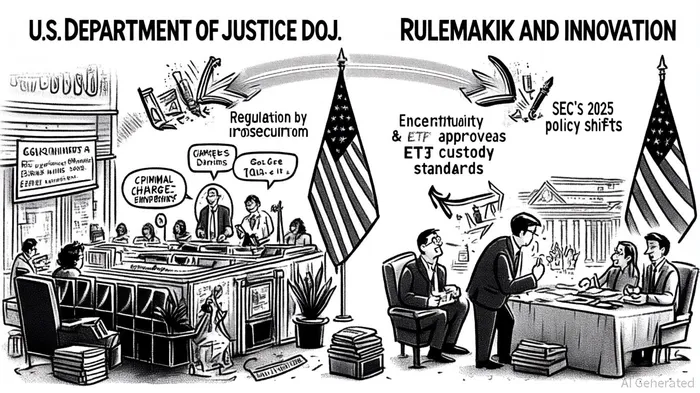
The DOJ's New Playbook: From Prosecution to Prioritization
In April 2025, the DOJ dismantled its National Cryptocurrency Enforcement Team and issued a memo titled Ending Regulation By Prosecution, according to a CNBC report. The new policy explicitly states that the DOJ will no longer target neutral platforms like crypto exchanges or mixing services for user actions or "unwitting" regulatory violations, as the DOJ memo explains. Instead, it focuses on prosecuting individuals who use digital assets to facilitate crimes like fraud, narcotics trafficking, or hacking, per a Sidley update. This move aligns with the Trump administration's broader deregulatory agenda, aiming to position the U.S. as the "crypto capital of the world."
The implications are profound. By deprioritizing enforcement against infrastructure providers, the DOJ has reduced legal uncertainty for startups and incumbents alike. For example, venture capital investment in compliance-focused crypto infrastructure surged to $6.7 billion in Q2 2025, according to CoinLaw data, as developers and exchanges gained confidence in operating without the threat of sudden criminal charges. This stability is critical for scaling infrastructure like decentralized finance (DeFi) protocols and custody solutions, which require long-term capital and regulatory predictability.
The SEC's Rulemaking Renaissance
While the DOJ focused on criminal enforcement, the SEC under Chair Paul Atkins has shifted from litigation to rulemaking. In 2025, the agency dissolved its Crypto Assets and Cyber Unit and replaced it with a Crypto Task Force, signaling a focus on structured regulation, as noted in a Smarsh post. High-profile cases against Binance, Ripple, and CoinbaseCOIN-- were dismissed or paused, according to an SCCG article, and the SEC approved generic listing standards for commodity-based trust shares, paving the way for spot crypto ETFs in line with a Latham tracker.
This pivot has unlocked institutional access to crypto. BlackRock's iShares BitcoinBTC-- Trust ETF, for instance, attracted $57.4 billion in inflows by mid-2025, per a Gate report, as the SEC's Spring 2025 agenda introduced modernized rules for trading and custody, according to a Coinpaper summary. These reforms have made it easier for pension funds, endowments, and asset managers to allocate capital to crypto without navigating a minefield of litigation risks.
Institutional Adoption: From Hesitation to Hypergrowth
The regulatory clarity post-2025 has triggered a surge in institutional interest. A January 2025 survey by Coinbase and EY-Parthenon found that 86% of institutional investors either have existing crypto exposure or plan to allocate capital in 2025, as reported in a ChainUp post. Notably, 59% intend to allocate more than 5% of their Assets Under Management (AUM) to digital assets, according to a Forbes piece. This shift is driven by three factors:
1. Regulated Investment Vehicles: Spot ETFs and stablecoin-backed products provide compliant on-ramps for traditional investors.
2. Utility Expansion: Stablecoins are now used for yield generation and cross-border transactions, with nearly half of surveyed institutions leveraging them, per an Observer article.
3. Diversification: 73% of institutional investors hold tokens beyond Bitcoin and EthereumETH--, signaling a move toward tokenized assets and altcoins, as shown in a CryptoToolsHub overview.
The result? Crypto markets are evolving from speculative trading to systematic strategies. Basis trades, yield capture, and structured products are now mainstream, tightening bid-ask spreads and improving liquidity, according to a RiskWhale analysis.
Investment Opportunities in Crypto Infrastructure
The post-2025 regulatory environment has created a "Goldilocks" scenario for investors: enough oversight to attract institutions but not so much to stifle innovation. Key opportunities include:
- Custody Solutions: With $7.42 billion in SEC penalties since 2013, as reported in a CoinLive report, secure custody is a must-have for institutional adoption.
- Compliance Tech: Firms offering anti-money laundering (AML) and know-your-customer (KYC) tools are seeing demand surge.
- Tokenized Assets: Real estate, art, and equities are being tokenized, creating new markets for fractional ownership.
However, challenges remain. Regulatory fragmentation (e.g., state vs. federal rules) and security risks (e.g., smart contract vulnerabilities) could slow adoption. Yet, the DOJ's focus on victim compensation and the SEC's emphasis on investor protection suggest these issues will be addressed through policy rather than panic.
Conclusion: The New Gold Rush
The 2025 regulatory shifts are not just about reducing enforcement-they're about building a framework for sustainable growth. By focusing on criminal misuse and streamlining rules, the DOJ and SEC have created a fertile ground for innovation. For investors, this means crypto infrastructure is no longer a speculative bet but a strategic asset class. As institutional capital pours in, the next decade will likely see digital assets become as integral to portfolios as gold or real estate.





Comentarios
Aún no hay comentarios