
SEI: Undervalued Infrastructure for the Future of DeFi
The cryptocurrency market in late 2025 is a study in contrasts. While macroeconomic headwinds and bearish sentiment have dragged many tokens into a slump, SeiSEI-- Network (SEI) stands out as a case of asymmetric value: a project with robust fundamentals and institutional-grade infrastructure trading at a significant discount to its intrinsic worth. This article unpacks why SEI's price action fails to reflect its foundational role in the evolution of decentralized finance (DeFi), and why this dislocation presents a compelling long-term opportunity.
Quiet Fundamentals: A DeFi Infrastructure Powerhouse
Sei Network's 2025 infrastructure upgrades have positioned it as a critical backbone for onchain markets. The launch of the Data & Transparency System within its Market Infrastructure Grid has enabled real-time execution aligned with institutional-grade pricing, leveraging partnerships with ChainlinkLINK-- and Nansen. These tools provide granular observability for traders and developers, a feature increasingly demanded by institutional participants.
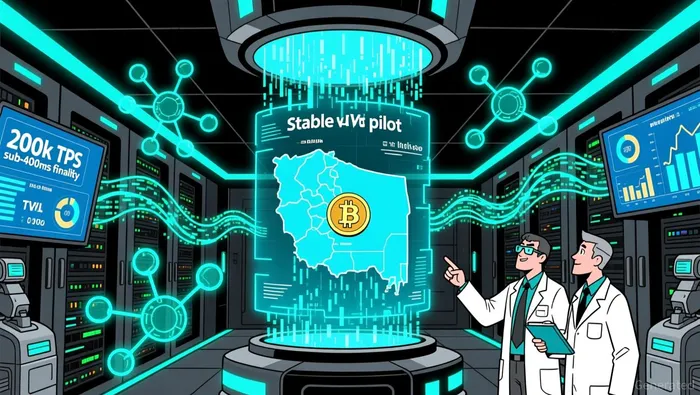
The network's technical performance further cements its value proposition. Sei's Giga devnet now supports 200,000 transactions per second (TPS) and sub-400ms finality, metrics that rival traditional exchanges and outpace most EVM chains. This scalability is not theoretical-it has translated into tangible adoption. By December 2025, Sei had become a leading EVM chain by active addresses, with P2P stablecoin supply surging 157% to an all-time high of $78.4 million. Such growth reflects the token's utility in trading, liquidity provisioning, and settlement, particularly in high-velocity markets.
Institutional validation has also accelerated. The Wyoming state-issued stablecoin pilot, powered by Sei's protocol, marked a watershed moment for regulatory adoption. Meanwhile, Circle's balance sheet now holds 6.25 million SEI tokens, the largest crypto asset on its books, signaling confidence in the network's stability and governance. These developments are not isolated-they are part of a broader trend where Sei's infrastructure is becoming a default layer for modern financial markets.
Asymmetric Value: Fundamentals vs. Price Action
Despite these strides, SEI's price has lagged. As of December 31, 2025, the token trades at $0.110866, with a market cap of $740.45 million according to Coinbase data, far below its $1.14 billion fully diluted valuation (FDV) as reported by MarketCapOf. This gap is striking given the project's performance:
- Trading Volume: Sei recorded $4.6 billion in spot trading volume in a single quarter according to MEXC data, driven by institutional investors like BlackRock and Apollo.
- DeFi Growth: Protocols like Takara Lend achieved 80,000 unique users in 2025 according to Sei's ecosystem report, while total value locked (TVL) surged 67.8% quarter-on-quarter to $609.4 million according to Messari research.
- Market Cap Trends: While SEI's market cap dipped 38% in December 2025 according to Gate research, it had grown 337.57% in 2024 according to Public data, reflecting prior recognition of its potential.
The disconnect between these metrics and the token's price is partly due to broader market conditions. The Fear & Greed Index sits at 26 according to DL News, and the crypto market cap has fallen to $3.16 trillion, down 0.77% in a week according to DL News. However, SEI's fundamentals suggest it is being unfairly punished by macro trends. For instance, its Relative Strength Index (RSI) of 46.53 according to DL News indicates neutrality, while open interest has collapsed from $160 million to $63 million according to Gate research, signaling reduced speculative activity. This suggests the price decline is more about market sentiment than intrinsic weakness in the project.
Macroeconomic Headwinds and Sector-Specific Tailwinds
Late 2025 macroeconomic conditions have been a double-edged sword for SEI. Global inflation is easing toward 4%, but trade tensions and a strong U.S. dollar threaten emerging markets according to IFM Investors. Central banks are expected to ease monetary policy, though the path remains uncertain according to IFM Investors. These factors have created a risk-off environment, with investors favoring cash and bonds over crypto.
Yet, within this context, Sei's DeFi ecosystem has shown resilience. The Wyoming pilot and Circle's holdings according to DL News have injected institutional credibility, while protocols like Yei Finance and Takara Lend according to Messari research continue to drive TVL growth. Additionally, Sei's alignment with real-time execution and high-velocity trading as detailed in the ecosystem roundup positions it to benefit from the ongoing migration of traditional finance (TradFi) onto blockchain infrastructure.
Investment Thesis: A Contrarian Play on DeFi's Infrastructure Layer
The case for SEI hinges on its role as a foundational layer for the future of DeFi. While the token's price has been dragged down by market-wide pessimism, its fundamentals tell a different story:
- Infrastructure Leadership: Sei's technical capabilities (200k TPS, sub-400ms finality) make it a critical player in high-velocity onchain markets according to MEXC data.
- Institutional Adoption: Wyoming's stablecoin pilot and Circle's holdings according to DL News signal growing trust in the network.
- DeFi Ecosystem Growth: TVL and user metrics according to Sei's ecosystem report indicate sustained demand for Sei's protocols.
- Valuation Dislocation: At $0.11, SEI trades at a 38% discount to FDV, offering asymmetric upside if the market reprices its value.
For investors with a 12–24 month horizon, SEI represents a high-conviction bet on the convergence of TradFi and DeFi. The risks-continued macroeconomic volatility and regulatory uncertainty-are real but not unique to Sei. Given its infrastructure-first approach and institutional traction, the project is well-positioned to outperform as the sector recovers.
Conclusion
The asymmetric value in SEI lies in its ability to deliver institutional-grade infrastructure while trading at a discount to its intrinsic worth. As DeFi continues to evolve from speculative experiments to real-world financial tools, projects like Sei will form the bedrock of this new ecosystem. For those willing to look beyond short-term volatility, SEI offers a compelling opportunity to invest in the infrastructure of the future.





Comentarios
Aún no hay comentarios