
Sei Network's SIP-3 Migration: A Strategic Opportunity in EVM-Only Blockchain Infrastructure
The blockchain industry is witnessing a pivotal shift as projects increasingly align with EthereumETH-- Virtual Machine (EVM) standards to streamline development and interoperability. SeiSEI-- Network's SIP-3 migration, which transitions the network from a hybrid CosmWasm/EVM architecture to a fully EVM-only model, represents a bold strategic move with profound implications for liquidity, wallet adoption, and DeFi growth. For investors, this transition is not merely a technical upgrade but a calculated step toward positioning Sei as a high-performance, scalable infrastructure for the next phase of onchain finance.
Technical Transition: Simplifying Complexity for Scalability
Sei's decision to deprecate CosmWasm and native CosmosATOM-- accounts via SIP-3 is rooted in the need to eliminate architectural complexity and align with Ethereum's dominant ecosystem. By focusing exclusively on EVM compatibility, Sei reduces the overhead of maintaining dual execution environments, enabling developers to leverage the vast tooling, libraries, and developer expertise already established in the Ethereum space. This simplification is critical for attracting enterprise-grade applications and institutional participants, who prioritize interoperability and proven security models.
The migration also mandates a critical asset transition: users must swap legacy USDCUSDC--.n tokens for native USDC to avoid liquidity loss post-deprecation. This requirement, while disruptive in the short term, ensures that DeFi protocols like Yei Finance and Takara Lend retain functional liquidity, preserving the network's utility as a hub for stablecoin-driven finance. The urgency of this swap underscores Sei's commitment to maintaining a robust, trustless ecosystem, even at the cost of temporary user friction.
Liquidity and DeFi Growth: A Surge in Onchain Activity
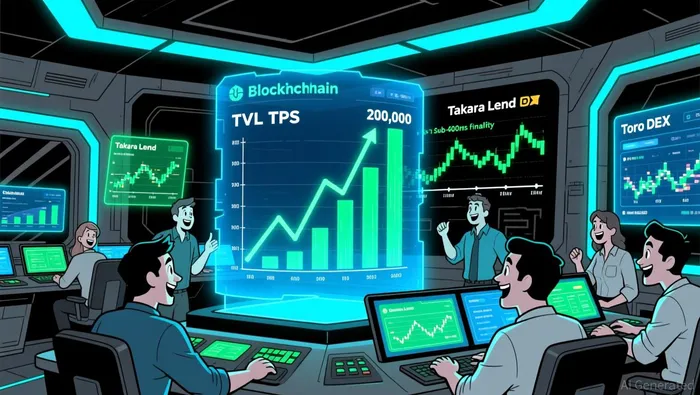
Post-SIP-3, Sei's liquidity metrics have demonstrated explosive growth. By late 2025, the network's total value locked (TVL) reached $687 million, while daily active wallets surged to nearly 900,000. These figures are bolstered by the Giga Upgrade, which enables Sei to process 200,000 transactions per second (TPS) with sub-400ms finality, making it one of the most performant EVM chains in production. The surge in P2P stablecoin supply- peaking at $78.4 million in December 2025-further highlights the network's role as a settlement layer for high-frequency trading and liquidity provision.
DeFi protocols on Sei have capitalized on this momentum. Takara Lend, for instance, attracted 80,000 unique users and distributed $16 million in rewards, while Toro DEX achieved $1 million in trading volume. These successes are not isolated; they reflect a broader trend of EVM-native projects leveraging Sei's low-latency infrastructure to deliver user experiences that rival centralized exchanges. For investors, this growth trajectory signals a maturing ecosystem where liquidity retention and user stickiness are increasingly aligned with the network's technical capabilities.
Wallet Adoption: Bridging the Cosmos-EVM Divide
The migration to EVM-only architecture has also reshaped wallet adoption dynamics. Users of Cosmos-native wallets like Keplr and Leap must migrate assets to EVM-compatible addresses (e.g., MetaMask, Compass) to maintain access to Sei's ecosystem. While this transition initially posed a barrier, the Sei App's Asset Transfer tool and Astroport's recovery flow have streamlined the process, minimizing user churn. As of Q3 2025, daily active addresses on Sei grew by 93.5%, and daily transactions increased by 87%, driven largely by gaming and DeFi activity.
This shift is particularly significant for institutional adoption. By aligning with EVM standards, Sei opens the door to integration with major custodians and institutional-grade infrastructure providers, who often prioritize EVM compatibility for compliance and operational efficiency. The network's partnerships with MetaMask and Chainlink further reinforce its appeal to both retail and institutional participants.
Ecosystem Alignment and Long-Term Value Creation
Sei's EVM-only strategy is not just about technical efficiency-it's a strategic play to capture a larger share of the DeFi market. By deprecating CosmWasm, the network avoids the fragmentation that has plagued other multi-chain ecosystems, ensuring a unified developer and user experience. This alignment with Ethereum's ecosystem also positions Sei to benefit from cross-chain synergies, such as bridging with Ethereum's Layer 2 solutions and leveraging Ethereum's security guarantees through shared tooling and auditing practices.
For investors, the long-term value proposition lies in Sei's ability to scale without compromising decentralization. The Giga Upgrade's 200,000 TPS throughput and sub-400ms finality address a critical pain point in DeFi-slow, expensive transactions-making Sei an attractive alternative for applications requiring high throughput, such as P2P trading and gaming. Additionally, the network's focus on institutional-grade infrastructure, including the Data & Transparency System, ensures that it can cater to both retail and enterprise use cases, broadening its addressable market.
Conclusion: A Strategic Bet on EVM's Future
Sei Network's SIP-3 migration is a masterclass in strategic infrastructure design. By embracing EVM-only architecture, the network simplifies complexity, accelerates developer adoption, and aligns with the dominant force in blockchain innovation. The resulting surge in liquidity, wallet adoption, and DeFi growth- evidenced by $687 million TVL, 900,000 daily active wallets, and $78.4 million in P2P stablecoin supply-demonstrates that Sei is not just surviving the transition but thriving.
For early investors and developers, this migration represents a unique opportunity to participate in a network poised to redefine the boundaries of onchain finance. As Sei's ecosystem continues to mature, its focus on scalability, interoperability, and institutional readiness will likely cement its position as a cornerstone of the EVM-first future.






Comentarios
Aún no hay comentarios