
Seedify's $SFUND Staking Launch and Platform Update: A Catalyst for DeFi Adoption and Token Value Appreciation
The launch of Seedify's PhoenixPHB-- Raise on October 9, 2025, marks a pivotal moment in the evolution of decentralized finance (DeFi). By introducing institutional-grade staking features and a permissionless launchpad, Seedify is notNOT-- only addressing critical gaps in blockchain security and accessibility but also positioning $SFUND as a linchpin for broader DeFi adoption. This analysis explores how these updates-ranging from high-yield staking mechanisms to robust compliance frameworks-could drive both network utility and token value appreciation.
Institutional-Grade Staking: A Magnet for Capital and Confidence
Seedify's tiered staking system, which grants higher allocations to early-stage projects and governance rights based on lock duration, directly targets institutional investors seeking yield optimization and governance influence, according to the CoinMarketCap overview. The platform's 24-hour bonding-curve sale, offering staking rewards of up to 523% APY, has already demonstrated strong demand, with rapid fund collection signaling confidence in the model, per a Kanalcoin report. Such high returns, while volatile, are a double-edged sword: they attract liquidity but also necessitate structural safeguards. Seedify's cross-chain functionality-enabling $SFUND to operate on EthereumETH--, BNB Chain, and others-further broadens accessibility, reducing friction for institutional onboarding, as CoinMarketCap notes.
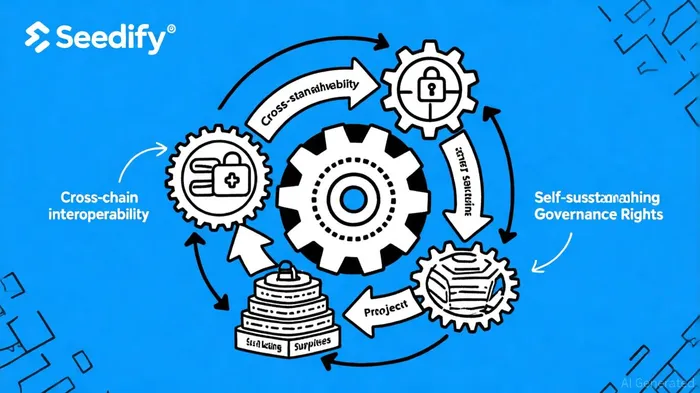
The introduction of the $SFUND Flywheel-a self-sustaining system where every project launch locks supply and enhances token utility-adds a deflationary layer. By tying staking rewards to supply reduction, Seedify creates a virtuous cycle where increased participation directly correlates with higher token scarcity, a key driver of value appreciation, as outlined in a TrustNet analysis.
Permissionless Innovation and Curated Quality
The Phoenix Raise's permissionless launchpad, which allows external curators to vet projects, addresses a persistent pain point in DeFi: the lack of reliable project due diligence. By decentralizing curation, Seedify incentivizes high-quality initiatives to surface while aligning curator incentives with platform growth, according to CoinMarketCap updates. This model not only democratizes access but also mitigates the risk of low-utility tokens diluting the ecosystem-a critical factor for institutional trust.
Moreover, the platform's smart bonding curves automate price discovery, ensuring fair and transparent token allocations. This institutional-grade feature reduces the risk of front-running and market manipulation, two barriers that have historically hindered DeFi's mainstream appeal, as covered by the Kanalcoin report.
Security and Compliance: A Foundation for Long-Term Trust
Following a 2025 breach involving unauthorized $SFUND minting by a DPRK-affiliated group, Seedify's response has been exemplary. The platform paused cross-chain bridges, blacklisted attacker wallets, and implemented multi-sig security layers, demonstrating a commitment to resilience, as reported by Kanalcoin. Looking ahead, plans for triple audits of smart contracts and a vulnerability bounty program align with 2025's tightening cybersecurity regulations, such as the EU's Digital Operational Resilience Act (DORA), as detailed in the TrustNet analysis. These measures are not just defensive-they are proactive signals to institutional investors that Seedify prioritizes compliance as a competitive advantage.
The Road Ahead: DeFi's Next Frontier
Seedify's updates position $SFUND as more than a governance token-it is becoming a utility token with embedded scarcity and institutional-grade infrastructure. The Phoenix Raise's rapid adoption and the Flywheel's deflationary mechanics suggest a future where $SFUND's value is increasingly decoupled from speculative cycles and instead driven by network fundamentals. For investors, this represents a rare convergence of high yield, security, and long-term value creation.
However, risks remain. The 523% APY, while attractive, is unsustainable in the long term and could lead to volatility. Additionally, the success of the permissionless model hinges on curators' ability to maintain quality control. Seedify's triple-audit commitment and bounty program will be critical in mitigating these risks.






Comentarios
Aún no hay comentarios