
Securities Litigation and Governance at Dow Inc.: Assessing the Impact on Investor Confidence and Valuation
Corporate Governance: A Shield or a Liability?
Dow Inc. has long emphasized robust corporate governance, touting a diverse board with an Independent Lead Director and a commitment to ESG priorities, as shown on Dow's corporate governance page. The company's governance framework, as outlined on its corporate website, includes stakeholder engagement initiatives and ethical sourcing programs, detailed in its ESG resources. However, the current lawsuit challenges the credibility of these claims. Plaintiffs argue that Dow's leadership understated the severity of global sales declines, competitive pressures, and product oversupply, leading to materially false disclosures, according to a Levi & Korsinsky press release. This discrepancy between governance rhetoric and operational reality could erode trust in the board's oversight capabilities.
The lawsuit also highlights a potential governance gap: while Dow's board has emphasized transparency, the alleged misstatements suggest a failure to accurately communicate risks to investors. This misalignment may prompt regulatory scrutiny and could pressure the board to implement stricter internal controls.
Stock Valuation: A Perfect Storm of Legal and Operational Risks
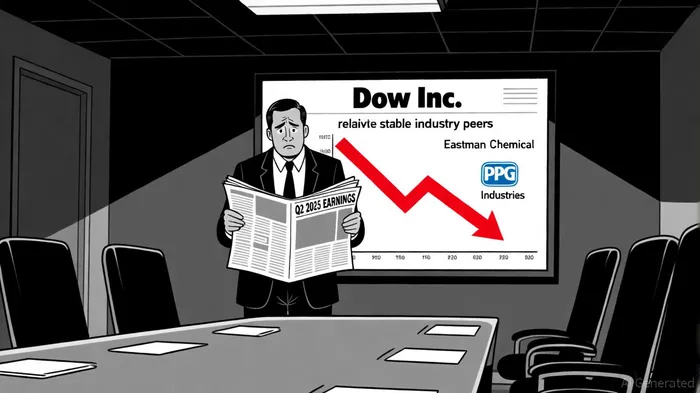
Dow's stock valuation has been battered by a confluence of factors. Following the Q2 2025 earnings report-a non-GAAP loss of $0.42 per share and a 7.3% sales decline-the stock plummeted by 17.45%, according to a TradingView report. The subsequent class-action lawsuit, filed on October 25, 2025, further exacerbated investor anxiety; a Lezelard report covered investor implications and filing details. By this point, Dow's P/E ratio had turned negative (–$1.4), reflecting its unprofitable status, per FullRatio's P/E analysis. In contrast, industry peers like Eastman Chemical Co. (EMN) and PPG Industries Inc. (PPG) traded at P/E ratios of 9.4 and 24.69, respectively, underscoring Dow's valuation discount.
Analysts have also tempered their outlooks. BMO Capital downgraded Dow to "Underperform" in June 2025, citing oversupply in the chemical sector and weak demand. While B of A Securities' Matthew DeYoe raised the price target to $26 from $24, he cautioned that margin recovery remains uncertain due to U.S. polyethylene (PE) export pressures, according to a Benzinga note. These mixed signals have left investors in a quandary, balancing optimism over cost-cutting measures against skepticism about Dow's ability to sustain profitability.
Investor Sentiment: Legal Overhang and Operational Headwinds
Investor sentiment has been further complicated by the lawsuit's timing. The class period (January 30–July 23, 2025) coincided with a 50% dividend cut and facility closures in Europe aimed at reducing costs. While these moves were framed as strategic, the lawsuit suggests that investors may have been misled about the company's financial flexibility. This has led to a reevaluation of Dow's fair value, with community estimates ranging widely and reflecting caution about margin pressures.
The legal deadline for lead plaintiff appointments (October 28, 2025) adds urgency to these concerns. If the lawsuit proceeds to trial, potential compensatory damages and defense costs could further strain Dow's balance sheet. For now, the law firm Levi & Korsinsky has assured plaintiffs that compensation could be pursued without out-of-pocket fees, but the reputational damage may already be done.
Conclusion: A Test of Resilience
Dow Inc.'s current predicament underscores the fragility of investor confidence in the face of governance missteps and operational headwinds. While the company's governance framework remains a cornerstone of its identity, the lawsuit exposes vulnerabilities in its risk communication strategies. For investors, the key question is whether Dow can reconcile its governance commitments with the realities of a challenging market. Until then, the stock's valuation will remain a barometer of both legal and operational resilience.





Comentarios
Aún no hay comentarios