
Securities Class Actions: A Double-Edged Sword for Investor Rights and Corporate Accountability in the AI and Crypto Eras
The Rising Tide of AI-Related Litigation
The surge in AI-related securities class actions underscores the risks of overhyping technology. In the first half of 2025 alone, 12 AI-related lawsuits were filed-a figure that already exceeds the 2024 annual total of 15, according to a GlobeNewswire report. This trend is fueled by practices like "AI washing," where companies exaggerate their AI capabilities to inflate stock prices. For instance, BigBear.ai (BBAI), a defense-focused AI firm, has faced scrutiny for its volatile stock performance and low gross margins (~20–30%), raising questions about its ability to sustain growth compared to peers like PalantirPLTR-- Technologies (PLTR), which boasts 70%+ margins and a $400 billion market cap, as Tech2 notes.
Palantir's meteoric rise-driven by $10 billion in U.S. Army contracts and a 100× sales valuation-has drawn skepticism from analysts, while BigBear's partnerships with entities like Tsecond for edge computing and its deployment of biometric systems at Chicago O'Hare Airport highlight the sector's dual-edged nature: innovation paired with unproven scalability, as Tech2 reports. When these companies fail to meet inflated expectations, shareholders often turn to class actions.
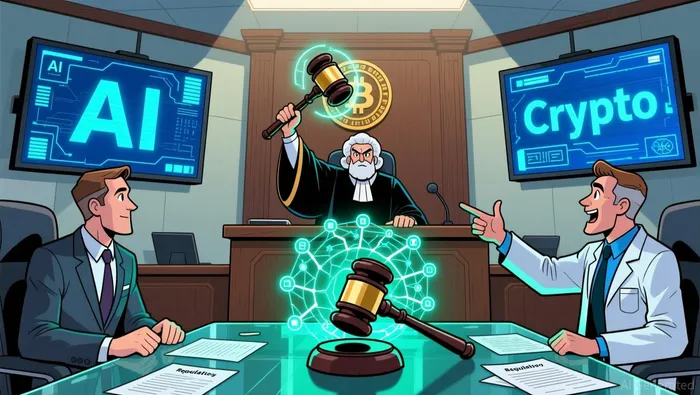
Crypto's Legal Quagmire: Regulatory Battles and Investor Fallout
The cryptocurrency sector remains a legal battleground, with the SEC's aggressive enforcement actions reshaping the industry. Cases like SEC v. Ripple Labs and SEC v. Coinbase have forced courts to grapple with whether digital assets qualify as securities under the Howey test. In Risley v. Universal Navigation, courts clarified that centralized crypto exchanges-but not decentralized ones-could face liability under Section 12(a)(1) of the Securities Act, as a Duanemorris article notes. These rulings create a patchwork of obligations for crypto firms, complicating compliance and investor trust.
Meanwhile, the Blockchain Association v. IRS case highlights broader regulatory challenges, as industry groups argue that the IRS's "broker" reporting rules impose untenable compliance costs on decentralized finance (DeFi) platforms, as Katten reports. For investors, the fallout is tangible: in 2024, median investor losses in crypto-related cases reached $1.76 billion, the highest in a decade, according to a Tech2 article.
The Calculus of Corporate Accountability: Do Class Actions Work?
Academic studies affirm that securities class actions exert meaningful pressure on corporate behavior, as ResearchGate notes. Firms facing litigation often see increased capital costs, reduced investment efficiency, and reputational damage. In 2025, the Disclosure Dollar Loss (DDL) Index hit $403 billion, while the Maximum Dollar Loss (MDL) Index soared to $1,851 billion in the first half of the year, according to a Cornerstone report. These figures reflect the growing scale of mega-litigation against major corporations, particularly in high-growth sectors like AI and crypto.
However, the effectiveness of these lawsuits is not without criticism. Critics argue that the median settlement amount in 2024-$14 million-fell short of historical highs, despite a 6% increase in settlements, according to a GlobeNewswire report. This suggests that while class actions deter misconduct, their financial penalties may not always align with the magnitude of investor harm.
The Path Forward: Balancing Innovation and Accountability
For investors, the takeaway is clear: securities class actions remain a vital tool for holding corporations accountable, but their efficacy depends on adapting to the complexities of emerging technologies. In the AI sector, vigilance against "AI washing" is essential, while crypto investors must navigate a regulatory minefield where legal clarity is still evolving.
As the SEC and courts continue to define the boundaries of securities law in the digital age, one thing is certain: the intersection of investor rights and corporate accountability will remain a focal point for markets, regulators, and shareholders alike.





Comentarios
Aún no hay comentarios