
Securing Geopolitical Supply Chains: Strategic Investment Opportunities in Critical Minerals and Democratic Alliances
Germany's strategic pivot toward multilateral cooperation in securing critical mineral supply chains, green technology, and defense infrastructure is reshaping the global investment landscape. As Europe's largest economy grapples with geopolitical uncertainty and the urgent need for energy transition, Berlin's partnerships with democratic allies like Canada and its domestic fiscal reforms are unlocking opportunities in sectors ranging from rare earths to hydrogen infrastructure. This analysis explores how Germany's coordinated approach to supply chain resilience is creating a fertile ground for investors.
Critical Minerals: A Transatlantic Partnership for Resilience
Germany's collaboration with Canada, formalized in August 2025 through a Joint Declaration of Intent, underscores its commitment to diversifying critical mineral supply chains. Canada's Critical Minerals Production Alliance, launched at the G7 Summit, positions the country as a strategic partner for Germany, leveraging its responsible mining practices and abundant resources in rare earths, lithium, and cobalt. Specific corporate agreements, such as Troilus Gold Corporation's supply deal with Aurubis AG and Torngat Metals' partnership with Vacuumschmelze for rare earths, highlight the tangible progress in this alliance. These partnerships not only reduce reliance on volatile regions but also align with Germany's industrial needs for electric vehicles and aerospace technologies. For investors, this signals growing demand for Canadian mining firms and German processing companies, creating a dual opportunity in extraction and downstream innovation.
Green Technology: A EUR 500 Billion Bet on Climate and Infrastructure 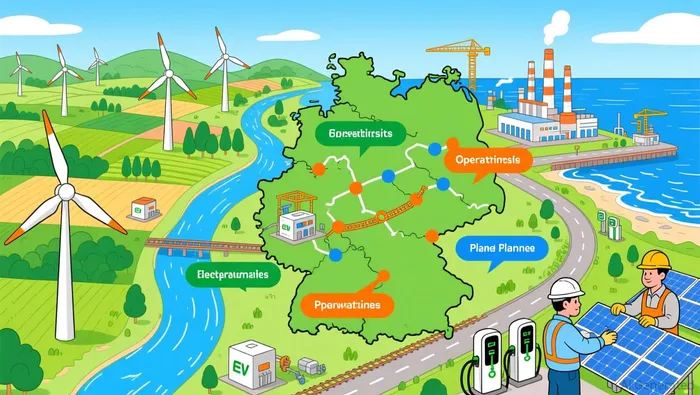
Germany's EUR 500 billion special fund for infrastructure, announced in March 2025, is a cornerstone of its green transition strategy. A significant portion of this funding is directed toward renewable energy projects, hydrogen infrastructure, and electric vehicle (EV) manufacturing. The government's focus on climate resilience and decarbonization aligns with its broader goal of achieving climate neutrality by 2045. For example, hydrogen infrastructure development-critical for both industrial decarbonization and energy storage-is expected to attract private investment alongside public funding. Similarly, the expansion of EV supply chains, supported by joint ventures like the Canada-Germany critical minerals partnership, offers opportunities in battery production and recycling. Investors should prioritize firms involved in renewable energy grid modernization, hydrogen electrolyzer technology, and EV component manufacturing, as these sectors are central to Germany's green industrial strategy.
Defense Infrastructure: Modernization and Supply Chain Integration
Germany's defense spending surge, now projected to reach €152.8 billion by 2029 (3.5% of GDP), reflects a strategic shift toward military readiness and technological sovereignty. The 2025 defense budget of €86 billion includes investments in advanced technologies like AI, cybersecurity, and space-based systems, as well as modernization of land, naval, and air capabilities. However, the Bundeswehr's readiness challenges-such as maintenance backlogs and underfunded repair networks-have prompted a reevaluation of supply chain strategies. Germany is adopting civilian-sector practices like predictive maintenance and multi-sourced supplier networks to enhance resilience. This shift creates opportunities for companies specializing in digital inventory systems, agile logistics, and advanced materials. Additionally, Germany's collaboration with Sweden and other European partners to strengthen defense industrial bases could drive cross-border investments in joint production facilities and R&D hubs.
Democratic Alliances: A Geopolitical Hedge Against Fragility
Germany's partnerships with like-minded democracies are not merely economic but geopolitical. The Canada-Germany critical minerals alliance, for instance, is part of a broader effort to counter overreliance on non-democratic suppliers and align with the G7's push for secure supply chains. Similarly, Germany's defense cooperation with Sweden and its participation in EU-wide initiatives like the National Security and Defense Industry Strategy aim to reduce dependencies on raw materials and enhance technological self-sufficiency. These alliances are underpinned by shared democratic values and a mutual interest in stabilizing global supply chains. For investors, this means prioritizing firms that operate within or support these alliances, such as those involved in ethical mining, green hydrogen, and defense-tech innovation.
Conclusion: A Strategic Window for Investors
Germany's dual focus on green technology and defense infrastructure, coupled with its multilateral partnerships, is creating a unique investment window. The EUR 500 billion infrastructure fund, the €152.8 billion defense budget, and transatlantic alliances like the Canada-Germany critical minerals pact are all signals of a nation repositioning itself for a multipolar world. Investors who align with Germany's priorities-resilient supply chains, decarbonization, and technological sovereignty-stand to benefit from both policy tailwinds and growing demand in critical sectors. As Berlin continues to balance its economic and security imperatives, the opportunities in critical minerals, green energy, and defense infrastructure will only expand.







Comentarios
Aún no hay comentarios