
Sectors to Watch After the Fed's Rate Cut: Capital Reallocation Opportunities in High-Growth Tech and Small-Cap Equities
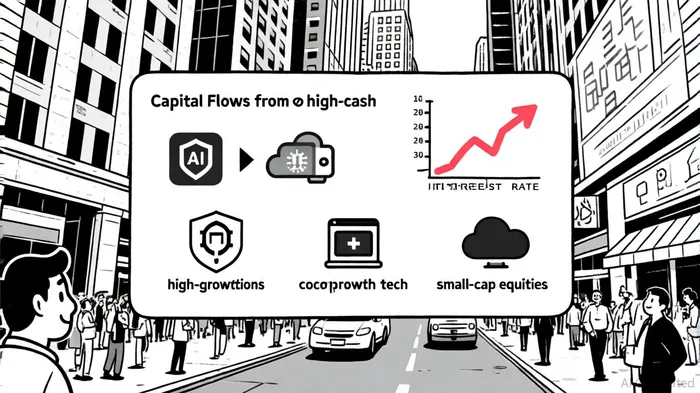
The Federal Reserve's September 2025 rate cut—marking the first reduction in its benchmark interest rate since 2023—has ignited renewed interest in capital reallocation strategies, particularly within high-growth technology and small-cap equity markets. By lowering the federal funds rate by 0.25 percentage points to a target range of 4.00%-4.25%, the Fed signaled a proactive stance to mitigate slowing labor market momentum while balancing inflationary pressures[1]. This decision, framed as a “risk management” measure[2], has created a fertile ground for sectors highly sensitive to borrowing costs and discount rate dynamics.
High-Growth Tech: A Magnet for Capital in a Lower-Rate Environment
The Magnificent Seven—Apple, MicrosoftMSFT--, NvidiaNVDA--, and their peers—stand to benefit disproportionately from the Fed's easing cycle. These firms, which rely heavily on long-term capital for innovation and expansion, see their valuations buoyed by reduced discount rates applied to future cash flows[3]. For instance, AI-focused companies like Nvidia are poised to capitalize on declining chip manufacturing costs and surging demand for computational infrastructure[4].
Historical precedents reinforce this trend. During prior rate-cut cycles, tech giants with high earnings growth multiples have outperformed broader markets by margins exceeding 15% within six months of policy shifts[5]. The current environment, with inflation inching closer to the 2% target and GDP growth projected at 1.6% for 2025[1], suggests a continuation of this pattern.
Small-Cap Equities: Undervalued Gems in a Monetary Easing Cycle
Small-cap stocks, particularly those in the Russell 2000 index, are emerging as prime beneficiaries of the Fed's pivot. These companies, often reliant on floating-rate debt for operations and R&D, face reduced interest burdens in a lower-rate environment[6]. Analysts project earnings growth of 22% for small-cap stocks in 2025 and 42% in 2026, outpacing large-cap counterparts[7].
The Russell 2000's historical performance during monetary easing cycles further underscores its appeal. Between 2009 and 2015, small-cap equities outperformed large-cap benchmarks by an average of 8% annually during periods of rate cuts. This trend is likely to repeat as investors seek higher-growth opportunities amid a flattening yield curve.
Capital Reallocation: From Cash to Innovation
The Fed's rate cut has also triggered a strategic shift in capital allocation. Investors are increasingly divesting from high-cash holdings and reallocating to equities and high-yield bonds. This shift is particularly pronounced in sectors like AI hardware, cybersecurity, and niche cloud solutions, where small-cap firms are leveraging lower borrowing costs to fund R&D and market expansion.
However, risks persist. A 60% probability of recession in 2026, coupled with inflationary pressures from tariffs, could temper the full impact of rate cuts. Savers, meanwhile, face reduced returns on high-yield savings accounts and CDs as banks adjust to lower rate environments.
Conclusion: Strategic Entry Points in a Shifting Landscape
For investors, the Fed's rate cut presents a dual opportunity: capitalizing on the Magnificent Seven's valuation tailwinds while identifying undervalued small-cap innovators. Yet, success hinges on balancing growth potential with macroeconomic risks. As the Fed signals up to two additional cuts in 2025[1], the window for strategic reallocation remains open—but not without vigilance.





Comentarios
Aún no hay comentarios