
Sectoral Divergence in U.S. PPI Highlights Strategic Shifts for Investors
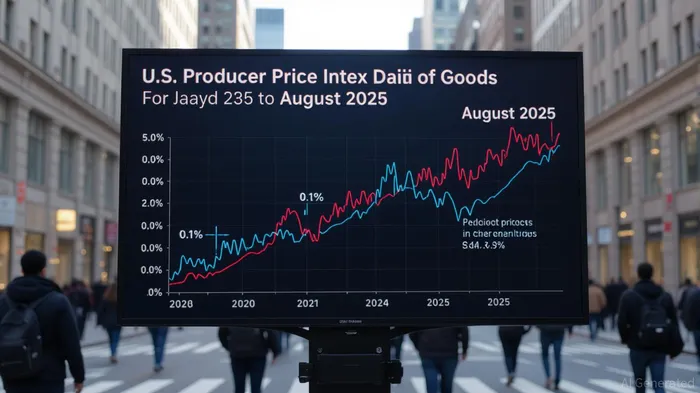
The latest U.S. Producer Price Index (PPI) data for August 2025 reveals a striking divergence between goods and services sectors, offering critical insights for investors navigating inflationary pressures and central bank policy trajectories. According to a report by the Bureau of Labor Statistics (BLS), the overall PPI fell by 0.1% month-on-month, driven by a 0.2% decline in services prices—the largest drop since April 2025—while goods prices edged up 0.1% for the fourth consecutive month [1]. This sectoral split underscores a complex inflationary landscape, with implications for asset allocation and macroeconomic expectations.
Goods Sector: Persistent Inflationary Momentum
The goods component of the PPI has shown resilience, with tobacco products surging 2.3% and beef and veal prices rising 0.3% in August [1]. These gains, coupled with increases in processed poultry and electric power, suggest ongoing supply-side pressures in manufacturing and energy. Data from Trading Economics indicates that the year-over-year PPI for goods remains elevated at 3.1%, outpacing the broader 2.6% annual increase [2]. Such stickiness in goods prices could prolong inflationary risks, particularly if global supply chains remain fragile or energy markets experience volatility.
Services Sector: Deflationary Pressures Intensify
In contrast, the services sector has entered a deflationary phase, with margins for machinery and vehicle wholesaling plummeting 3.9% in August—a sharp reversal from earlier gains [1]. Professional and commercial equipment wholesaling, chemicals, and retailing categories also saw price declines, signaling softening demand and margin compression. As stated by a Reuters analysis, the 0.2% monthly drop in services prices marks the first outright deflation since the pandemic era, reflecting businesses' struggles to pass on tariff costs to consumers [3]. This trend could accelerate if labor market conditions weaken further, amplifying downward pressure on producer margins.
Central Bank Policy: A Tightrope Between Goods and Services
The Federal Reserve faces a challenging balancing act as divergent sectoral trends complicate inflation forecasts. While goods inflation persists, services deflation may offset broader price pressures, potentially easing the case for further rate hikes. A CNBC report highlights that the services sector's decline hints at “ongoing challenges for businesses in absorbing tariff costs,” which could constrain consumer spending and GDP growth [3]. If the Fed interprets this as a sign of moderating inflation, it may prioritize rate cuts in 2026, even as goods prices remain stubbornly high.
Strategic Rebalancing: Inflation-Protected Assets and Service-Sector Equities
For investors, the August PPI data argues for a strategic rebalancing toward inflation-protected assets and service-sector equities. Treasury Inflation-Protected Securities (TIPS) and real estate investment trusts (REITs) offer hedges against residual goods inflation, while undervalued service-sector stocks—particularly in transportation, logistics, and professional services—may benefit from stabilizing demand. The BLS notes that services account for over two-thirds of U.S. economic output, making its recovery a critical driver of long-term growth [1].
In conclusion, the August PPI underscores a bifurcated inflationary environment. While goods prices remain a concern, services deflation signals broader economic fragility. Investors who position portfolios to capitalize on these dynamics—by hedging against goods inflation and capitalizing on service-sector rebounds—may gain an edge in a market increasingly defined by sectoral divergence.







Comentarios
Aún no hay comentarios