
Sector Resilience During Government Shutdowns: Defensive Stocks and Market Volatility Dynamics
Sector Resilience During Government Shutdowns: Defensive Stocks and Market Volatility Dynamics
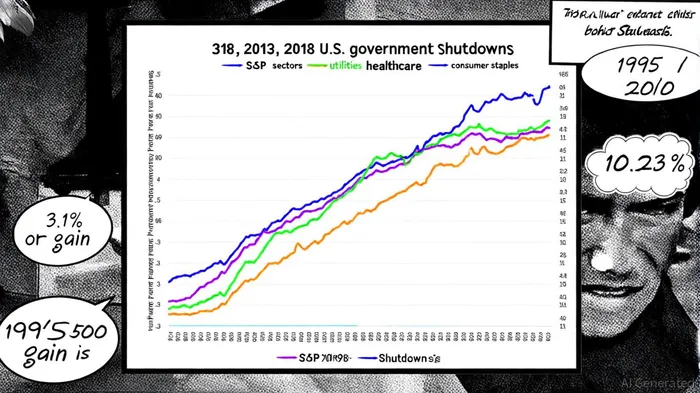
Government shutdowns, though politically charged and economically disruptive, have historically had limited long-term impact on financial markets. Yet, for investors, the question remains: which sectors offer resilience during such periods of uncertainty? Defensive stocks-those in utilities, healthcare, and consumer staples-have consistently demonstrated stability, even as broader markets grapple with short-term volatility. This analysis examines historical patterns, volatility dynamics, and the role of beta and standard deviation to assess the viability of defensive positioning during government shutdowns.
Historical Performance: A Pattern of Resilience
The U.S. stock market has shown remarkable resilience during past government shutdowns. For instance, during the 16-day shutdown in October 2013, the S&P 500 rose by 3.1%, as investors focused on macroeconomic fundamentals rather than political gridlock, according to a Landmark Wealth report. Similarly, the 35-day 2018–2019 shutdown, the longest in modern history, coincided with a 10.3% gain for the S&P 500, driven largely by the Federal Reserve's dovish monetary policy signals. Even the 1995–1996 shutdowns, which lasted 27 days combined, saw the S&P 500 recover quickly, with gains in the following months, as documented in the same Landmark Wealth report.
Defensive sectors, in particular, have fared well. During the 2013 shutdown, utilities and consumer staples outperformed the broader market, reflecting their non-cyclical nature, as noted in a Campaign for a Million article. The 1995–1996 shutdowns also saw healthcare and utilities maintain positive returns, even as the S&P 500 dipped by 3.7% during the 21-day period, according to a Nemo Money analysis. These sectors provide essential goods and services, making them less sensitive to economic contractions or political disruptions.
Volatility Dynamics: Beta and Standard Deviation
While specific beta and standard deviation metrics for defensive sectors during shutdowns are not readily available in academic studies, historical data on sector behavior offers insights. Defensive sectors are generally characterized by lower betas-measuring sensitivity to market movements-compared to the S&P 500. For example, from 1994 through May 2020, the betas of consumer staples, healthcare, and utilities were consistently lower than the benchmark, with risk-adjusted returns exceeding those of the S&P 500, according to a S&P Global analysis. This suggests that during periods of heightened volatility, such as government shutdowns, defensive sectors are likely to exhibit lower volatility.
During the 2018–2019 shutdown, for instance, the S&P 500's gains were partly attributed to broader economic factors, but defensive sectors like healthcare and utilities likely maintained stability due to their low beta profiles, as described in the Landmark Wealth report. Similarly, during the 1995–1996 shutdowns, these sectors' resilience may have been reinforced by their inherent lower volatility, as discussed in the Nemo Money analysis. While direct metrics for shutdown periods are scarce, the general trend of defensive sectors acting as safe havens during market stress supports their role in mitigating portfolio risk.
Market Rebound and Investor Implications
Historically, markets have rebounded swiftly after shutdowns. The S&P 500 averaged gains of 1.2% one month post-resolution and 2.9% three months later across shutdowns since 1976, based on the Landmark Wealth report. Defensive sectors, with their lower volatility and stable cash flows, are well-positioned to benefit from this rebound. For example, during the 2013 shutdown, healthcare and utilities not only maintained stability but also outperformed the broader market, as noted in the Campaign for a Million article.
Investors seeking to hedge against short-term uncertainty may find defensive positioning advantageous. However, it is critical to recognize that while defensive sectors offer resilience, they are not immune to broader market trends. For instance, during the 2018–2019 shutdown, defense and aerospace firms faced disruptions due to federal contract delays, a vulnerability highlighted by the Campaign for a Million article, underscoring sector-specific risks.
Conclusion
Government shutdowns, though disruptive, are often treated as temporary interruptions by markets. Defensive sectors-utilities, healthcare, and consumer staples-have historically demonstrated resilience, driven by their essential nature and lower volatility profiles. While specific beta and standard deviation metrics during shutdowns remain under-researched, the broader trend of defensive sectors outperforming the S&P 500 during periods of uncertainty underscores their strategic value. For investors, a balanced approach that incorporates defensive positioning can mitigate risks while capitalizing on post-shutdown rebounds.







Comentarios
Aún no hay comentarios