
The SEC's Text Messaging Fiasco and Its Implications for Crypto Market Transparency
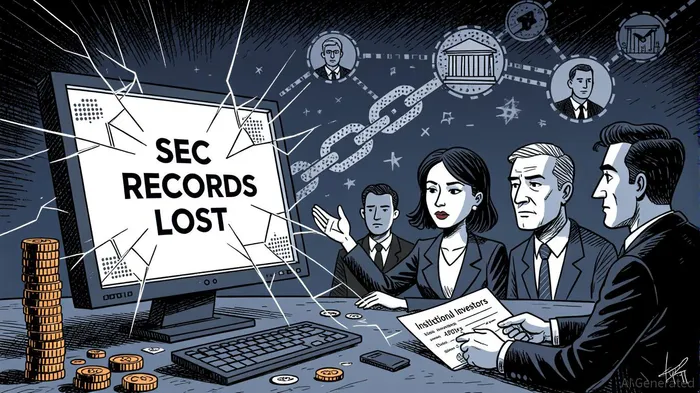
The U.S. Securities and Exchange Commission’s (SEC) 2025 text messaging fiasco—marked by the permanent deletion of nearly a year’s worth of Gary Gensler’s communications—has ignited a firestorm of debate about regulatory competence and its cascading effects on the crypto market. This incident, occurring during a critical period for crypto enforcement actions, settlement discussions with major banks, and White House coordination, has exposed systemic vulnerabilities in institutional recordkeeping while simultaneously accelerating institutional scrutiny of crypto infrastructure. The fallout raises a pivotal question: does this crisis signal growing institutional confidence in private crypto systems, or does it underscore the fragility of regulatory accountability in an increasingly decentralized financial landscape?
Regulatory Missteps and the Erosion of Trust
The SEC’s botched IT wipe, which erased messages from October 2022 to September 2023, has drawn sharp criticism from industry stakeholders and lawmakers. According to a report by Crypto in America, the lost records included sensitive discussions on enforcement actions against crypto firms, a major bank settlement, and interagency coordination on commissioner appointments [1]. The agency’s response—disabling texting on employee devices and implementing records training for senior officials—has been widely perceived as reactive rather than proactive, exacerbating concerns about transparency.
This incident aligns with broader trends of regulatory overreach and inconsistency. For instance, the SEC’s aggressive enforcement of recordkeeping rules against firms using WhatsApp and personal text messages has resulted in over $2 billion in penalties by early 2025, with major banks like SantanderSAN-- and LPL FinancialLPLA-- facing charges for systemic compliance failures [1]. While these actions highlight the SEC’s commitment to accountability, they also reveal a regulatory framework struggling to adapt to the realities of digital communication. The irony is stark: an agency tasked with overseeing financial transparency has itself become a case study in institutional fragility.
Institutional Crypto Adoption: A Double-Edged Sword
The SEC’s missteps have paradoxically accelerated institutional interest in private crypto infrastructures. As traditional financial institutionsFISI-- grapple with regulatory ambiguity, they are increasingly turning to blockchain-based solutions to streamline operations and reduce reliance on opaque regulatory systems. By early 2025, institutions hold approximately 15% of Bitcoin’s supply, and nearly half of hedge funds allocate to digital assets, driven by the emergence of regulated crypto investment vehicles like U.S. spot BitcoinBTC-- and Ether ETFs [2].
This shift is not without justification. The tokenization of real-world assets (RWA) and the integration of permissioned DeFi platforms—smart contracts with KYC/AML compliance—offer institutional investors structured, auditable alternatives to traditional systems [2]. For example, major banks are experimenting with blockchain custody solutions and decentralized lending protocols to bypass regulatory bottlenecks. According to the Bank for International Settlements, these innovations are laying the groundwork for a “next-generation monetary system” that prioritizes transparency and programmability [3].
However, the SEC’s data loss incident has also amplified concerns about regulatory overreach. The agency’s refusal to establish clear frameworks for digital assets—exemplified by its protracted legal battle with Coinbase—has created a patchwork of enforcement actions that prioritize retroactive punishment over proactive guidance [4]. This ambiguity has forced institutions to adopt a “wait-and-see” approach, hedging their crypto exposure through diversified portfolios and AI-driven risk management tools [5].
Investment Strategies in a Post-SEC Landscape
For investors navigating this volatile terrain, the key lies in balancing opportunism with caution. The following strategies emerge as critical:
Prioritize Regulated Crypto Vehicles: The approval of Bitcoin and Ether ETFs in 2024 has provided institutional investors with compliant avenues to access digital assets. These products, backed by custodial infrastructure and transparent reporting standards, mitigate regulatory risks while offering exposure to crypto’s growth potential [2].
Leverage Tokenization of Real-World Assets (RWA): The tokenization of real estate, art, and corporate debt on blockchain platforms is gaining traction as a way to combine the efficiency of DeFi with the security of traditional finance. Investors should target platforms that integrate permissioned blockchains with regulatory compliance frameworks [2].
Adopt AI-Driven Compliance Tools: Given the SEC’s focus on communication governance, firms must invest in AI-powered archiving and monitoring systems to avoid penalties. These tools not only ensure compliance but also provide auditable trails that enhance institutional trust in crypto infrastructure [1].
Diversify Across Permissioned and Public DeFi: While public DeFi remains speculative, permissioned platforms—where smart contracts are governed by trusted nodes—offer a middle ground for institutions seeking innovation without sacrificing oversight. This hybrid model is particularly appealing in emerging markets, where traditional financial infrastructure is lacking [2].
The Path Forward: Trust or Crisis?
The SEC’s text messaging fiasco is a microcosm of the broader tension between regulatory authority and technological disruption. On one hand, the incident has exposed critical weaknesses in institutional data management, eroding public confidence in regulatory bodies. On the other, it has catalyzed a shift toward private crypto infrastructures that prioritize transparency, programmability, and resilience.
For investors, the lesson is clear: the crypto market’s future will be shaped not by regulatory perfection but by the ability of institutions to adapt to its imperfections. As the SEC grapples with its own vulnerabilities, the rise of blockchain-based systems offers a compelling alternative—one where trust is not assumed but engineered into the protocol itself.
Source:
[1]
Senate Banking Finalizes Details on Market Structure
[2]
The Crypto Market In 2025: Are Crypto Demand Trends
[3] III. The next-generation monetary and financial system, [https://www.bis.org/publ/arpdf/ar2025e3.htm]
[4] CoinbaseCOIN-- Inc v. Securities and Exchange Commission, No. [https://law.justia.com/cases/federal/appellate-courts/ca3/23-3202/23-3202-2025-01-13.html]
[5] Future of Crypto in the Next 5 Years - Complete Analysis [https://www.tokenmetrics.com/blog/future-of-crypto-in-the-next-5-years?0fad35da_page=3&74e29fd5_page=18]





Comentarios
Aún no hay comentarios