
The SEC's Strategic Retreat from Crypto Enforcement and Its Implications for Market Growth
The U.S. Securities and Exchange Commission (SEC) has undergone a dramatic pivot in its approach to cryptocurrency regulation between 2023 and 2025, shifting from aggressive enforcement to a more measured, framework-driven strategy. This "strategic retreat" has significant implications for market growth, particularly for institutional investors who are now navigating a landscape with reduced regulatory ambiguity and emerging opportunities.
A Shift in Priorities: From Enforcement to Framework Building
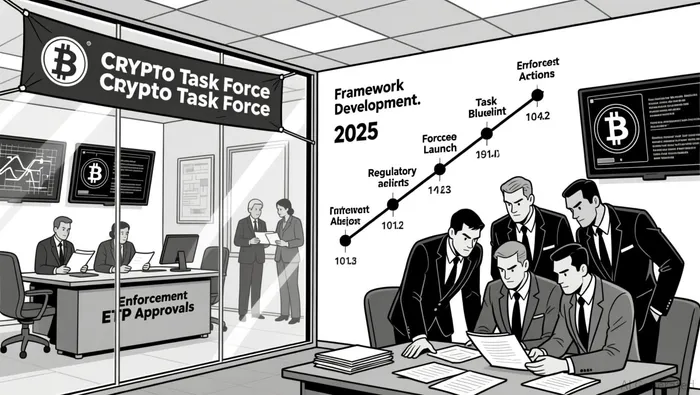
Under Chair Gary Gensler, the SEC launched 33 cryptocurrency-related enforcement actions in 2024, signaling a hardline stance on crypto market conduct. However, the agency's leadership changed in 2025 with the appointment of Chairman Paul Atkins and the reappointment of Commissioner Hester Pierce, known as "Crypto Mom." This new administration prioritized clarity over confrontation, establishing the Crypto Task Force and the Cyber and Emerging Technologies Unit (CETU) to develop a comprehensive regulatory framework.
A key milestone came in October 2025, when the SEC approved orders permitting in-kind creations and redemptions for crypto asset exchange-traded products (ETPs), aligning them with traditional commodity-based ETPs. This move not only signaled regulatory acceptance of crypto's infrastructure but also demonstrated a willingness to adapt existing frameworks to new asset classes.
Risk Mitigation for Institutional Investors
The SEC's recalibration has directly reduced regulatory risks for institutional investors. Nearly half (47%) of surveyed institutional investors now cite U.S. regulatory developments as a key factor in increasing their digital asset allocations. This confidence is bolstered by the SEC's Project Crypto initiative, which categorizes digital assets into distinct classes-digital commodities, digital collectibles, and tokenized securities-clarifying that only the latter are subject to securities laws under the Howey test.
Custody regulations for broker-dealers have also evolved. In 2025, the SEC issued guidance clarifying that broker-dealers must maintain direct access to private keys and implement robust risk-mitigation policies for crypto asset custody. These rules, while stringent, provide a clear pathway for institutions to engage in crypto custody without fear of regulatory overreach. Additionally, the SEC's dismissal of several enforcement actions from the prior administration has created a more predictable environment.
Emerging Opportunities in a Structured Market
The SEC's focus on framework-building has unlocked new opportunities for institutional participation. The approval of spot Bitcoin ETFs in Q4 2025, coupled with the repeal of SAB 121 via SAB 122, has streamlined registration and disclosure processes for crypto-related products. This has led to a surge in institutional adoption: 55% of traditional hedge funds now have exposure to digital assets, up from 47% in 2024.
The GENIUS Act, which created a federal regulatory framework for stablecoin issuance, has further spurred innovation. By addressing cross-border regulatory gaps and fostering collaboration with international bodies like the UK's Transatlantic Taskforce for Markets of the Future, the U.S. is positioning itself as a global leader in crypto regulation. Financial institutions are now more willing to engage in tokenization, stablecoin issuance, and custody services under these clearer guidelines.
Conclusion: A New Era for Crypto Markets
The SEC's strategic retreat from enforcement-driven regulation marks a pivotal shift in the crypto landscape. By prioritizing clarity, innovation, and investor protection, the agency has laid the groundwork for a more mature and institutional-grade market. For investors, this means reduced regulatory risk, enhanced access to crypto products, and a clearer path to participation in one of the most transformative asset classes of the 21st century.






Comentarios
Aún no hay comentarios