
The SEC's Move to Allow State-Chartered Trusts for Crypto Custody: How Regulatory Clarity Drives Institutional Adoption and Crypto Asset Allocation
The U.S. Securities and Exchange Commission's (SEC) 2025 decision to grant no-action relief for state-chartered trust companies to act as crypto custodians marks a pivotal shift in the regulatory landscape. By permitting these entities to safeguard digital assets under the Investment Advisers Act and the Investment Company Act, the SEC has addressed longstanding ambiguities that previously deterred institutional participation in crypto markets, as detailed in a RiskWhale analysis. This move, coupled with the rescission of SAB 121-a rule that forced banks to treat crypto as balance-sheet liabilities-has catalyzed a surge in institutional adoption, reshaping asset allocation strategies and accelerating the integration of digital assets into mainstream finance, according to ACA Global.
Regulatory Clarity as a Catalyst for Institutional Adoption
The SEC's no-action letter provides a critical framework for institutional investors, allowing them to use state-chartered trusts as custodians for crypto assets without facing enforcement risks. This relief requires custodians to meet stringent conditions, including audited financial statements, segregation of client assets, and robust private key security protocols, which remove prior uncertainties about compliance and enable institutions to allocate capital to crypto with greater confidence.
Data from a joint CoinbaseCOIN-- and EY-Parthenon survey in January 2025 underscores this trend: 86% of institutional investors either have existing exposure or plan to allocate to crypto in 2025, with 59% intending to allocate more than 5% of their assets under management (AUM) to cryptocurrencies, according to the EY-Parthenon survey. The rescission of SAB 121, which removed the requirement for banks to list crypto as liabilities, has further lowered barriers to entry. U.S. Bancorp, for instance, relaunched its crypto custody services in early 2025, signaling a broader willingness among traditional financial institutions to engage with digital assets, as reported in the U.S. Bancorp relaunch.
Market Expansion and the Rise of Institutional Custody Solutions
The regulatory shift has directly fueled growth in the crypto custody market. Previously valued at $2.9 billion in 2025, the market is projected to reach $7.7 billion by 2032, driven by institutional demand for secure and compliant storage solutions. State-chartered trusts, including affiliates of major crypto firms like Coinbase and Kraken, now compete with traditional custodians, fostering innovation and competition. This expansion is not limited to the U.S.: the EU's Markets in Crypto-Assets (MiCA) regulation, fully effective in 2025, has created a parallel framework for tokenized securities and custody services, reinforcing global institutional confidence.
Institutional adoption is also evident in product development. The launch of BitcoinBTC-- and EthereumETH-- exchange-traded funds (ETFs) in 2024, followed by the SEC's 2025 regulatory clarity, has spurred inflows into crypto ETPs. According to industry reporting, 69% of institutional investors plan to allocate to crypto ETPs in 2025, citing regulatory alignment as a key factor. JPMorgan's entry into the custody space further illustrates this trend, as the bank builds infrastructure to support ETFs and wealth management products.
Challenges and Criticisms
Despite the momentum, the SEC's approach has drawn criticism. Commissioner Caroline Crenshaw warned that the no-action relief creates a "50-state regulatory roulette," as state-chartered trusts may lack the uniform oversight of federally chartered banks. Critics also highlight risks of market concentration, with a handful of custodians potentially dominating the projected $7.7 billion market by 2032, a point raised in an AllianceBernstein report. Additionally, the absence of formal rulemaking leaves the regulatory framework vulnerable to future changes, as the SEC has emphasized the possibility of revisiting custody rules.
The Future of Crypto Asset Allocation
As regulatory clarity continues to evolve, crypto is increasingly viewed as a strategic asset class. A Citigroup report notes that 83% of institutional investors plan to increase digital asset allocations in 2025, driven by innovations in tokenized assets and decentralized finance (DeFi). The integration of crypto into traditional portfolios is further supported by its role as an inflation hedge, though its volatility remains a barrier to widespread adoption.
The SEC's 2025 rulings, alongside global regulatory advancements, have laid the groundwork for a more mature crypto market. While challenges persist, the alignment of institutional infrastructure with regulatory frameworks suggests that digital assets will play an increasingly prominent role in asset allocation strategies in the years ahead.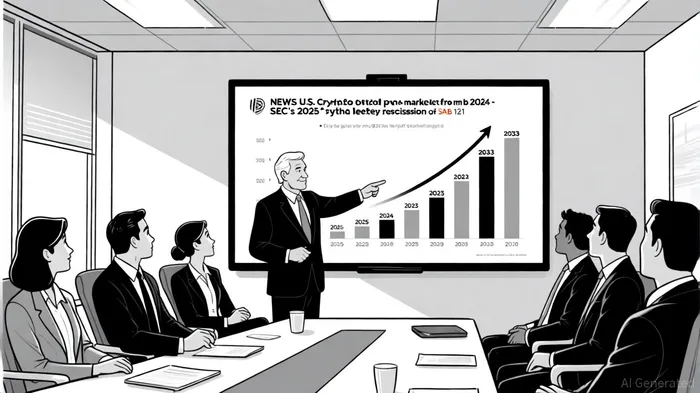







Comentarios
Aún no hay comentarios