
The SEC's Miami Crypto Engagement: A Catalyst for U.S. Digital Asset Innovation?
The U.S. Securities and Exchange Commission's (SEC) recent pivot toward a collaborative regulatory approach has sparked renewed optimism in the crypto sector. At the heart of this shift lies the SEC's engagement with Miami's burgeoning crypto ecosystem, a strategic move to bridge the gap between regulators and innovators. This article evaluates how the SEC's efforts-particularly its Miami outreach and 2025 regulatory reforms-have catalyzed institutional capital inflows and startup growth in crypto infrastructure, positioning the U.S. as a leader in digital asset innovation.
Regulatory Clarity as a Foundation for Growth
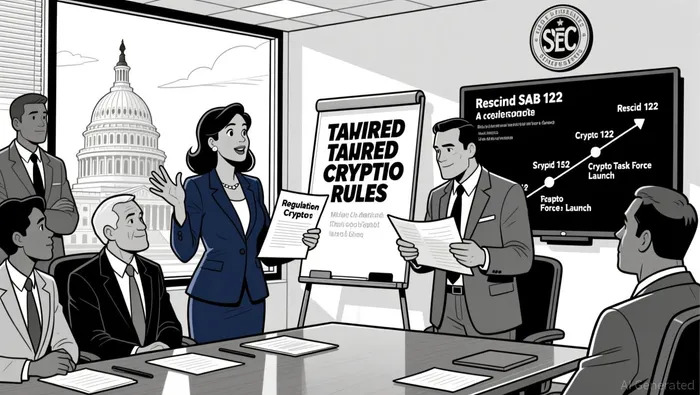
The SEC's Crypto Task Force, launched in January 2025 under Chair Paul Atkins, marked a departure from the enforcement-heavy strategies of its predecessor. By prioritizing dialogue with industry stakeholders, the agency has sought to craft a regulatory framework that balances investor protection with innovation. A pivotal step was the rescission of Staff Accounting Bulletin No. 122, which had previously forced banks to classify crypto assets as liabilities, stifling institutional participation. This reversal, coupled with updated guidance on custody requirements for crypto securities, has created a more predictable environment for market participants.
The SEC's Miami engagement on January 27, 2026, further underscored this collaborative ethos. By directly engaging with early-stage crypto builders, the agency signaled its intent to understand the sector's challenges and opportunities before finalizing rules. This approach aligns with broader efforts to refine the Howey test for securities classification and develop a tailored "Regulation Crypto" framework, which could introduce safe harbors for token offerings. Such clarity is critical for startups, reducing legal ambiguity and enabling them to secure funding without fear of retroactive enforcement actions.
Institutional Adoption and the Rise of Stablecoins
Regulatory clarity has directly spurred institutional interest in crypto infrastructure. The passage of the GENIUS Act in July 2025, which established a federal framework for stablecoins, has been a game-changer. By legitimizing stablecoins as a foundational asset class, the law has encouraged traditional financial institutions to integrate them into their offerings. As of late 2025, institutions hold nearly 8% of circulating bitcoinBTC--, a testament to growing confidence in digital assets.
The SEC's no-action letters-such as those for the DTC's tokenization pilot and the Fuse crypto token-have further de-risked institutional participation. These measures, combined with the SEC's emphasis on global regulatory alignment (e.g., with Europe's MiCA framework), have created a more stable environment for cross-border investment. Goldman Sachs has even projected that regulation will drive the next wave of institutional adoption, with stablecoins and tokenization leading the charge.
Startup Funding and Ecosystem Expansion
The regulatory tailwinds of 2025 have also invigorated crypto infrastructure startups. Venture capital dealmaking in the sector surged in the first half of 2025, with $904 million raised-a 47% increase from 2024. Seed-stage valuations stabilized at a median pre-money value of $21.7 million, while early-stage and late-stage rounds saw valuations rise by 159% and 34%, respectively. This growth is partly attributable to the SEC's Project Crypto initiative, which introduced a taxonomy for digital assets, distinguishing tokenized securities from non-securities and fostering innovation in tools and collectibles.
Miami's emergence as a crypto hub has amplified these trends. The city's strategic location, combined with the SEC's engagement and the presence of figures like Peter Thiel, has attracted both capital and talent. The SEC's Miami meeting in January 2026, for instance, coincided with a surge in local crypto events, reinforcing the city's role as a nexus for innovation.
Looking Ahead: A Maturing Market
While the SEC's efforts have laid a strong foundation, challenges remain. The agency's coordination with Congress on market structure legislation-expected to pass by mid-2026-will be critical in addressing gaps in the current framework. Additionally, global regulatory harmonization will be essential to prevent arbitrage and ensure the U.S. maintains its competitive edge.
For now, the data is clear: regulatory clarity has unlocked a new era of institutional participation and startup growth. As the SEC continues to refine its approach, the U.S. digital asset market is poised to mature into a robust, institutional-grade ecosystem.






Comentarios
Aún no hay comentarios