
The SEC's Green Light for Altcoin ETFs: A New Era for Diversified Crypto Exposure
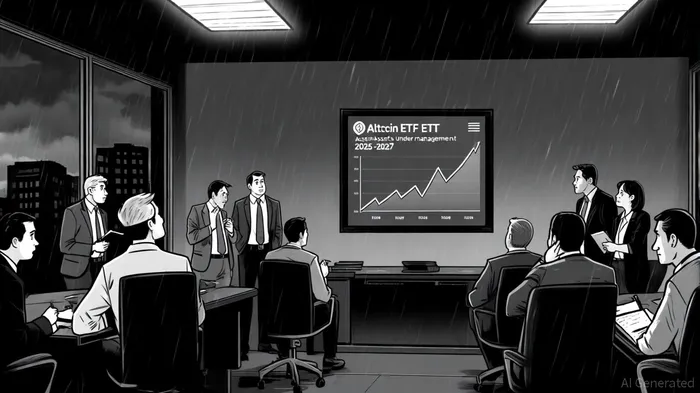
The U.S. Securities and Exchange Commission (SEC) has catalyzed a seismic shift in the crypto asset landscape with its recent adoption of generic listing standards for spot crypto ETFs. By slashing approval timelines from 240 days to 60–75 days, the agency has effectively opened the floodgates for institutional capital to flow into altcoin markets[1]. This regulatory pivot, coupled with the success of BitcoinBTC-- and EthereumETH-- ETFs in 2024, marks the dawn of a new era where diversified crypto exposure is no longer a niche pursuit but a strategic imperative for institutional portfolios[2].
Regulatory Efficiency as a Catalyst
The SEC's streamlined process eliminates the need for individualized reviews of commodity-based ETFs, enabling exchanges to list products tied to cryptocurrencies like SolanaSOL-- (SOL) and XRPXRP-- as early as October 2025[1]. This efficiency is notNOT-- merely procedural; it signals a broader acknowledgment of crypto's legitimacy as an asset class. For asset managers, the requirement of having regulated futures contracts for six months before seeking approval creates a clear pathway to market entry[1]. As a result, firms like VanEck, WisdomTreeWT--, and Bitwise are poised to launch altcoin ETFs with a 90–95% approval probability by mid-2025[2].
Institutional Adoption: Beyond Bitcoin and Ethereum
Institutional investors, long cautious about crypto's volatility, are now recalibrating their strategies to include altcoins. Nearly half of institutional asset managers with crypto exposure are actively researching or planning allocations to Ethereum, with similar interest emerging for large-cap altcoins and Layer-1 protocols[1]. This shift is driven by the recognition that altcoins like Solana and XRP offer distinct value propositions—high throughput, cross-chain interoperability, and decentralized finance (DeFi) infrastructure—that Bitcoin and Ethereum alone cannot replicate[2].
The infrastructure to support this diversification is already in place. Institutions are deploying advanced custody solutions, compliance frameworks, and portfolio analytics to mitigate risks associated with altcoin volatility[1]. For example, major banks are integrating blockchain-based smart contracts to automate risk hedging, while third-party analytics platforms provide real-time liquidity monitoring. These tools enable institutions to allocate 5–10% of their portfolios to altcoins—a move that mirrors traditional asset allocation strategies for emerging markets[2].
Strategic Asset Allocation in a Post-ETF World
The approval of altcoin ETFs transforms crypto from a speculative bet into a regulated, liquid asset class. For strategic asset allocators, this means crypto can now be treated as a diversifier akin to gold or real estate. Altcoins, with their lower correlations to traditional assets, offer a unique hedge against macroeconomic shocks[1]. For instance, Solana's focus on decentralized applications (dApps) and XRP's cross-border payment use cases position them to benefit from distinct economic drivers compared to Bitcoin's store-of-value narrative[2].
Moreover, the institutional appetite for altcoins is not indiscriminate. Firms are prioritizing projects with robust governance, active developer ecosystems, and real-world adoption metrics. This selective approach mirrors the due diligence applied to venture capital investments, ensuring that allocations are grounded in fundamentals rather than hype[1].
The Road Ahead
While the SEC's actions have removed a critical regulatory barrier, challenges remain. Market volatility, regulatory scrutiny of individual projects, and the risk of regulatory rollbacks in future administrations could temper growth. However, the infrastructure and institutional momentum built in 2025 suggest that altcoin ETFs will become a cornerstone of diversified portfolios by 2026[2].
For investors, the key takeaway is clear: the era of crypto as a monolithic asset class is over. With the SEC's green light, altcoin ETFs are set to redefine strategic asset allocation, offering institutions—and eventually retail investors—a scalable, regulated way to participate in the next phase of digital asset innovation.





Comentarios
Aún no hay comentarios