
The SEC's Generic Listing Standards and the Impending Crypto ETF Explosion: Strategic Entry Points for Investors
The SEC's Generic Listing Standards: A New Framework
The SEC's generic listing standards, finalized in late 2025, streamline the approval process for commodity-based exchange-traded products (ETPs), including those tied to digital assets. These rules allow qualifying crypto ETFs to list without individual SEC reviews, provided they meet predefined criteria. Key requirements include:
- The underlying asset must trade on an Intermarket Surveillance Group (ISG) member market.
- It must underlie a futures contract on a designated contract market with at least six months of trading history.
- Alternatively, it must be part of an ETF with at least 40% net asset value (NAV) exposure to the commodity.
This rules-based approach reduces regulatory friction, cutting approval timelines from 240 days to as little as 75 days for tokens meeting the criteria. The result? A more efficient market for both issuers and investors.
Tokens in the Pipeline: Who's Next?
As of July 2025, 10 tokens-including DOGEDOGE--, BCH, LTCLTC--, and SOL-already satisfy the SEC's criteria. Meanwhile, ADAADA-- and XRPXRP-- are on the cusp of eligibility, with their futures markets nearing the six-month seasoning threshold. Canary Capital, a major player in the space, has already submitted applications for all currently eligible tokens and plans to pause further filings until new assets qualify or regulations evolve.
This creates a clear roadmap for investors: tokens with strong market infrastructure and decentralization are primed for ETF inclusion. For example, SolanaSOL-- (SOL) and CardanoADA-- (ADA) have seen significant institutional interest, driven by their robust ecosystems and growing futures liquidity. 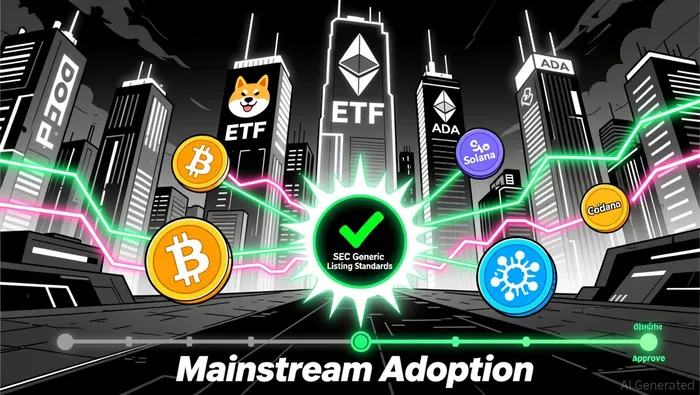
Strategic Entry Points: Timing the ETF Wave
The SEC's fast-track mechanism, inspired by Rule 6c-11 for equity ETFs, is a game-changer. By reducing regulatory uncertainty, it incentivizes issuers to launch ETFs for newly eligible tokens quickly. Investors should focus on pre-launch opportunities in the following areas:
- Early-Mover ETFs: Tokens like DOGE and LTC, already approved, are likely to see ETFs in early 2026. Investors can position themselves before these products launch, capitalizing on the liquidity boost they bring to the underlying assets.
- Upcoming Eligibles: ADA and XRP are strong candidates for Q1 2026 approvals. Given their market capitalizations and growing futures volumes, these tokens could see ETF inflows as soon as their eligibility is confirmed.
- Diversified Crypto ETFs: Broad-market funds that aggregate multiple qualifying tokens (e.g., a "crypto 10" ETF) offer a lower-risk entry point for investors seeking exposure without picking individual winners.
Risks and Considerations
While the regulatory environment is improving, risks remain. The SEC's Project Crypto and the CFTC's Crypto Sprint aim to enhance market surveillance, but volatility and regulatory shifts could still disrupt momentum. Additionally, quantitative metrics like minimum market capitalization thresholds may further refine eligibility, potentially excluding smaller tokens.
Investors should also consider liquidity dynamics. As ETFs launch, they may drive up demand for underlying assets, creating short-term price spikes. However, this could also lead to overvaluation if fundamentals don't justify the surge.
The Bigger Picture: A Regulated Crypto Future
The SEC's actions align with broader legislative efforts like the Digital Asset Market Clarity Act, which seeks to harmonize crypto regulation and foster innovation. For investors, this signals a shift toward a more institutional-grade market, where crypto ETFs serve as on-ramps for mainstream capital.
Conclusion: Positioning for the ETF Explosion
The SEC's generic listing standards and fast-track framework are catalysts for a crypto ETF boom. Investors who act early-targeting tokens on the cusp of eligibility and diversifying across ETF structures-can capitalize on this inflection point. As Canary Capital's strategy illustrates, patience and timing are key: the next wave of approvals is likely just months away, and the market is already pricing in the potential.






Comentarios
Aún no hay comentarios