
SEC Delays and Regulatory Clarity: Implications for the 21Shares Spot SUI ETF and Altcoin Market Access
The U.S. Securities and Exchange Commission (SEC) has long been a pivotal force in shaping the institutional adoption of cryptocurrencies. Its recent actions—particularly the strategic delays in approving the 21Shares Spot SUISUI-- ETF—highlight a dual role as both a barrier and a catalyst for market access. While prolonged regulatory scrutiny creates uncertainty, the eventual clarity it provides could unlock unprecedented institutional capital for altcoins like SUI, SolanaSOL-- (SOL), and XRPXRP--. This analysis examines the SEC’s evolving stance, its implications for the 21Shares SUI ETF, and the broader altcoin market.
The SEC’s Strategic Delay: A Barrier to Institutional Adoption
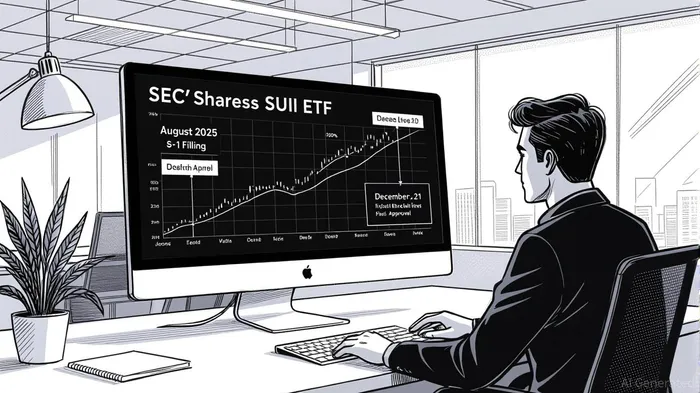
The SEC’s decision to extend its review of the 21Shares SUI ETF until October 2025, with a final ruling potentially delayed until December 21, 2025, underscores its cautious approach to crypto ETFs [4]. This delay is part of a broader pattern: the agency is currently evaluating over 90 crypto ETF applications, with altcoin-related proposals facing heightened scrutiny due to concerns around custody practices, staking mechanics, and investor protection [3]. For institutional investors, this uncertainty acts as a significant barrier.
Regulatory ambiguity discourages capital allocation to assets perceived as high-risk. For instance, the SEC’s prolonged review of the Grayscale Cardano ETF has contributed to market volatility and hesitancy among institutional players [1]. Similarly, the SUI ETF’s inclusion of staking benefits—while innovative—has raised questions about how the SEC will address the complexities of yield generation in a regulated framework [5]. These delays also create a fragmented market environment, where investors struggle to differentiate between speculative assets and those with real-world utility.
Regulatory Clarity: A Catalyst for Institutional Confidence
Despite these challenges, the SEC’s delays are not inherently negative. When regulatory clarity is achieved, it often acts as a catalyst for institutional adoption. A prime example is the August 2025 ruling that classified XRP as a non-security, which removed long-standing barriers and triggered a $1.2 billion inflow into the ProShares Ultra XRP ETF (UXRP) within its first month [1]. This precedent demonstrates how regulatory resolution can transform uncertainty into opportunity.
The SEC’s work on generic listing standards for spot crypto ETFs—collaborating with exchanges like Nasdaq and NYSE—aims to create a consistent framework that could accelerate future approvals [4]. For altcoins like Solana and LitecoinLTC--, this clarity is critical. Solana’s high-throughput infrastructure and partnerships with firms like Stripe and SpaceX have already attracted institutional interest, but broader adoption hinges on regulatory validation [3]. Similarly, XRP’s role in cross-border payments has gained traction with banks like SantanderSAN--, yet its full potential remains untapped until the SEC finalizes its stance [1].
Legislative developments, such as the CLARITY Act and the GENIUS Act, further reinforce this trend. By classifying BitcoinBTC-- as a commodity under CFTC oversight, these acts have enabled fiduciaries to legally allocate capital to digital assets, legitimizing crypto as a strategic asset class [3]. The success of Bitcoin and EthereumETH-- ETFs—drawing over $132.5 billion in institutional and sovereign fund holdings by Q2 2025—provides a blueprint for altcoin ETFs [5].
The 21Shares SUI ETF: A Case Study in Regulatory Balancing
The 21Shares SUI ETF exemplifies the SEC’s balancing act. While its staking benefits and use of CoinbaseCOIN-- Custody represent innovation, the agency’s focus on custody solutions and market manipulation risks has slowed its approval [5]. However, the ETF’s potential to generate yield for investors—unlike traditional ETFs—could position it as a unique offering once cleared.
The SEC’s delays also reflect a broader institutional shift. As of late August 2025, 21Shares filed an S-1 registration for the SUI ETF, joining a wave of filings for leveraged and actively managed crypto funds [3]. This surge indicates growing demand for diversified crypto exposure, but institutions remain cautious until regulatory frameworks solidify.
Looking Ahead: Market Access and the Path to Maturation
The SEC’s dual role as both a barrier and catalyst will define the next phase of altcoin market access. While delays in October 2025 could temporarily dampen investor sentiment—evidenced by SUI’s 0.5% decline in the past 24 hours [1]—the eventual approval of the SUI ETF and others could unlock $3.8–$7.2 billion in institutional capital for Solana and $4.3–$8.4 billion for XRP by 2028 [3].
For now, the market remains in a holding pattern. Institutional investors are closely monitoring the SEC’s Spring 2025 agenda, which emphasizes the need for clear rules on custody and market structure [3]. The outcome of these deliberations will determine whether altcoins transition from speculative assets to core components of institutional portfolios.
Source:
[1] The Catalysts Behind XRP's Price Momentum in 2025, [https://www.bitget.com/news/detail/12560604951262]
[2] Altcoin ETF Season: How Institutional Adoption Could..., [https://www.okx.com/learn/altcoin-etf-season-institutional-adoption]
[3] SEC Announces Spring 2025 Agenda, [https://coincentral.com/sec-announces-spring-2025-agenda-to-provide-regulatory-framework-for-crypto-assets/]
[4] SEC Delays 21Shares SUI ETF Decision Amid Ongoing..., [https://coincentral.com/sec-delays-21shares-sui-etf-decision-amid-ongoing-crypto-etf-rules/]
[5] SEC Approves Spot Ether ETF Options: A New Era for..., [https://pinnacledigest.com/blog/sec-approves-spot-ether-etf-options-new-era-crypto-investing]





Comentarios
Aún no hay comentarios