
The SEC's Acknowledgment of the Canary Staked SEI ETF: A Game-Changer for Institutional Exposure to Staked Assets
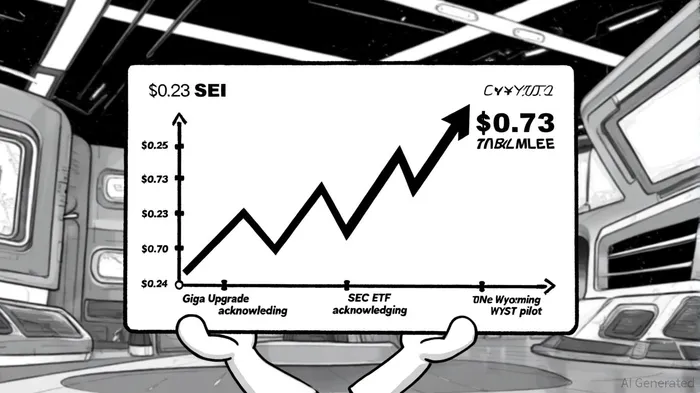
The U.S. Securities and Exchange Commission's (SEC) acknowledgment of the Canary Staked SEISEIC-- ETF filing on September 8, 2025, marks a pivotal moment in the evolution of institutional crypto adoption. This development, submitted by Cboe BZX Exchange and Canary Capital Group LLC, represents the first U.S.-listed exchange-traded product (ETP) offering exposure to staked SEI tokens, the native asset of the Sei Network[2]. By structuring the ETF as a Delaware statutory trust, the proposal aims to bridge the gap between traditional finance and the rapidly expanding staking economy, potentially unlocking new avenues for institutional capital to access yield-generating crypto assets[2].
Strategic Implications for Institutional Adoption
The Canary Staked SEI ETF's regulatory filing aligns with a broader industry shift toward institutional-grade crypto products. Sei, a high-performance layer-1 blockchain optimized for decentralized finance (DeFi) and trading applications, has seen surging network activity, including a 3,600% increase in daily transactions and a total value locked (TVL) of $682 million[2]. The proposed ETF not only provides exposure to SEI's price performance but also incorporates staking rewards, offering investors a dual benefit of capital appreciation and passive income[2]. This dual utility could attract risk-averse institutional players seeking diversified crypto exposure without the operational complexities of direct token management.
The competitive landscape further underscores the strategic significance of this filing. 21Shares, a leading crypto asset manager, submitted its own SEI ETF proposal to the SEC in late August 2025, following Canary Capital's initial April 30 filing[2]. This parallel effort highlights growing institutional confidence in Sei's ecosystem, particularly its Giga Upgrade—a technological enhancement set to boost throughput to 50x EthereumETH-- Virtual Machine (EVM) levels and reduce finality times to sub-400ms[2]. Such upgrades position Sei as a scalable alternative for DeFi and gaming applications, potentially driving demand for its native token[2].
Regulatory Hurdles and Market Dynamics
While the SEC's acknowledgment signals progress, regulatory uncertainty remains a critical risk. The agency has yet to approve ETFs for cryptocurrencies beyond BitcoinBTC-- and Ethereum, and its 45- to 240-day review period for the Canary Staked SEI ETF introduces volatility into market expectations[2]. However, the filing itself has already generated momentum. Wyoming's selection of Sei for its WYST stablecoin pilot in July 2025 has further elevated the token's institutional credibility, anchoring it in real-world financial applications[2].
From a market dynamics perspective, the potential approval of the Canary Staked SEI ETF could mirror the inflow patterns observed in Bitcoin ETFs. According to a report by Phoenix Global, institutional inflows into Bitcoin ETFs surged by $332 million in the quarter preceding September 2025, ending Ethereum ETFs' dominance[1]. If the SEC follows a similar approval trajectory for the SEI ETF, it could catalyze a new wave of altcoin rotation, particularly as macroeconomic conditions—such as the U.S. government's tariff war—create volatility in traditional markets[3].
Price Predictions and Long-Term Outlook
Analysts project SEI's price to average $0.47 in 2025, with a maximum of $0.73 and a minimum of $0.23, driven by regulatory milestones and technological advancements[3]. These predictions factor in the Giga Upgrade's potential to enhance Sei's utility and the institutional traction gained through ETF filings. However, the token's performance will also depend on broader market sentiment, including Bitcoin dominance and macroeconomic stability[3].
Conclusion
The Canary Staked SEI ETF represents a strategic inflection pointIPCX-- for institutional exposure to staked assets. By offering a regulated vehicle for accessing Sei's high-speed blockchain and staking rewards, the ETF could democratize participation in the staking economy while mitigating operational risks for institutional investors. However, its success hinges on the SEC's regulatory decision and broader market conditions. As the crypto industry navigates this pivotal moment, the interplay between innovation, regulation, and institutional demand will define the next chapter of digital asset adoption.





Comentarios
Aún no hay comentarios