
SEB's Outlook Cuts and the Resilience of European Banking: Assessing Long-Term Investment Value Amid Macroeconomic Headwinds
The European banking sector is navigating a complex web of macroeconomic headwinds and regulatory pressures in 2025, with Sweden's SEB Group serving as a case study in both vulnerability and resilience. As global growth slows to under 3% amid U.S.-China trade tensions and aggressive tariff policies, SEB's Nordic Outlook warns, and the bank has slashed its annual profit forecast, citing weaker demand in key markets like Europe and the U.S., an Archyde report notes. Yet, the broader European banking landscape reveals a sector that, while strained, remains structurally robust-bolstered by strong capital buffers, digital transformation, and a pivot toward sustainable finance. For investors, the challenge lies in balancing short-term uncertainties with long-term strategic strengths.
Macroeconomic Headwinds: Trade Tensions and Growth Downturns
SEB's 2025 outlook cuts reflect a broader global malaise. The bank's revised profit forecasts underscore the ripple effects of U.S. trade policies, which have disrupted supply chains and dampened cross-border commerce, the Archyde report observed. Global GDP is now projected to grow at less than 3% for 2025 and 2026, with the U.S. and China-the world's two largest economies-bearing the brunt of the slowdown, according to SEB's Nordic Outlook. In Sweden, growth is expected to lag initial forecasts, compounded by high inflation and cautious consumer behavior, as detailed in SEB's Nordic Outlook: Global tensions. These dynamics have forced SEB to recalibrate its business model, with the Riksbank's anticipated rate cuts in 2025 and 2026 offering a tentative lifeline as inflation eases (as noted in SEB's Nordic Outlook on global tensions).
The U.S.-led trade war has also reshaped corporate strategy. Companies across industries are reengineering supply chains to mitigate risks, a trend that has directly impacted SEB's exposure to export-dependent sectors, the Nordic Outlook explains. For instance, the bank's weaker demand in U.S. and European markets has been attributed to delayed corporate investments and reduced consumer spending, both symptoms of prolonged trade uncertainty highlighted in the Archyde report.
European Banking Resilience: Stress Tests and Strategic Adaptation
Despite these challenges, European banks have demonstrated resilience. The 2025 EU-wide stress test, conducted by the European Banking Authority (EBA), revealed that banks maintained a CET1 capital ratio of 12% under severe downturn scenarios, even after simulated losses of EUR 547bn, a point echoed in SEB's Nordic Outlook. This robustness is a testament to years of regulatory tightening under Basel III, which has forced institutions to build stronger capital buffers. SEB, for its part, reported a CET1 ratio of 17.5% in Q1 2025-a 5.5 percentage point buffer above the stress test threshold, according to the Nordic Outlook-suggesting the bank is well-positioned to weather further shocks, even as interest rate volatility and trade tensions persist.
Strategic adaptations are also key. European banks are accelerating digital transformation to cut costs and enhance compliance, with SEB leveraging AI-driven platforms to streamline operations, as reported in the Archyde piece. Meanwhile, consolidation is on the rise, as seen in BNP Paribas' recent expansion in investment banking, another trend the Archyde report discusses. These moves reflect a sector-wide recognition that scale and technological agility are critical to long-term survival.
SEB's Sustainability-Driven Strategy: A Long-Term Edge
SEB's 2030 sustainability strategy stands out as a differentiator. The bank has committed to reducing fossil fuel credit exposure while expanding green finance, aligning with the UN Sustainable Development Goals and the Paris Agreement, according to the Nordic Outlook. Its Carbon Exposure Index and Transition Ratio frameworks are designed to quantify progress, while partnerships with Morningstar and Sustainalytics ensure regulatory readiness under evolving ESG standards like SFDR, the Archyde report notes.
Financially, SEB's Q1 2025 results show a 20% year-over-year revenue increase, driven by cost optimization and operational efficiency. However, the bank revised its full-year outlook in May 2025, citing softer demand in Europe and cautious U.S. consumer behavior, as detailed in the Archyde report. Despite this, its capital health-bolstered by a 280-basis-point buffer-provides flexibility to invest in digital infrastructure and sustainable projects, the Nordic Outlook emphasizes.
The sustainable finance market itself is a growth engine. In 2025, green bond issuance surged in hard-to-abate industries like steel and cement, with SEB playing a pivotal role in funding net-zero transitions, the Nordic Outlook notes. The market's USD 1.45tn in new issuances (as of August 2025) underscores its potential to offset traditional lending declines, the Nordic Outlook adds.
Assessing Long-Term Investment Value
For investors, SEB's long-term appeal hinges on its ability to balance risk mitigation with innovation. While trade tensions and regulatory costs remain headwinds, the bank's capital strength, ESG leadership, and digital investments position it to outperform peers in a post-crisis environment. The Riksbank's rate-cut trajectory and Sweden's projected outperformance of the eurozone also offer tailwinds, as discussed in SEB's Nordic Outlook on global tensions.
However, risks persist. The EU's push for decarbonization, while aligned with SEB's strategy, requires significant capital reallocation-a challenge for smaller banks with limited liquidity. Additionally, geopolitical shifts, such as U.S. policy reversals or China's economic recalibration, could further disrupt trade flows and corporate demand, a risk flagged in SEB's Nordic Outlook.
Conclusion
SEB's outlook cuts are a symptom of broader macroeconomic fragility, but the bank's resilience-rooted in capital strength, sustainability, and digital innovation-suggests a path to long-term value creation. For European banking as a whole, the 2025 stress test results and strategic pivots indicate a sector capable of withstanding turbulence. Investors who prioritize ESG alignment and regulatory foresight may find SEB's strategic direction compelling, even as they remain cautious about near-term volatility.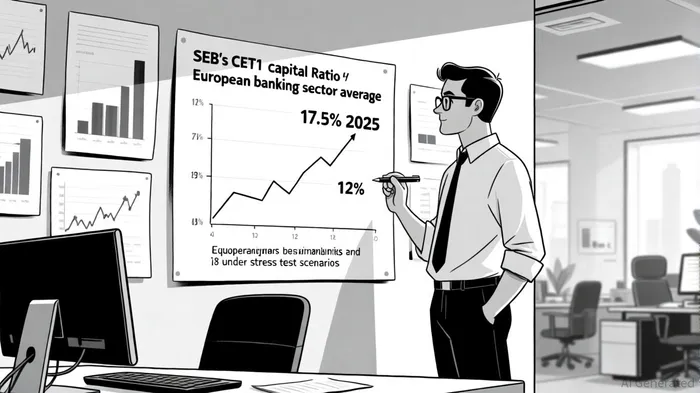







Comentarios
Aún no hay comentarios