
Why Seagate's Earnings Beat Wasn't Enough to Sustain Bullish Momentum
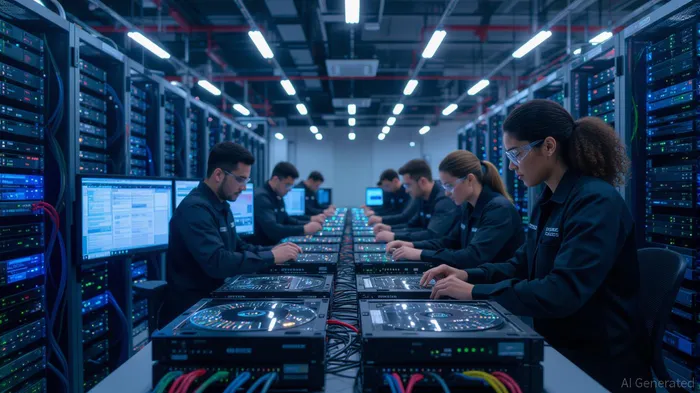
In the ever-evolving landscape of global finance, the interplay between short-term performance and long-term strategic positioning often defines market outcomes. Seagate TechnologySTX-- (NASDAQ: STX) exemplifies this dynamic. For the fiscal fourth-quarter 2025, SeagateSTX-- delivered a robust earnings beat, with adjusted earnings per share (EPS) of $2.59 (exceeding the $2.44 estimate) and revenue of $2.44 billion (slightly above the $2.42 billion consensus). Non-GAAP gross margin expanded to 37.9%, a 700-basis-point increase from the prior year. These metrics underscore Seagate's operational discipline and its ability to capitalize on the AI-driven storage boom. Yet, despite these accomplishments, the stock fell 8% post-earnings, revealing a critical disconnect between short-term results and investor concerns about near-term guidance.
Historical context from a backtest of STX's performance after earnings beats and misses from 2022 to the present further highlights this pattern. When Seagate has beaten expectations, the stock has shown mixed short-term outcomes: a 28.57% win rate over 3 days and a 42.86% win rate over 30 days, with average returns of -0.80% and -3.16%, respectively. This suggests that even when Seagate outperforms, the market often reacts cautiously, with gains eroding over time.
Short-Term Strength: A Snapshot of Resilience
Seagate's fourth-quarter performance reflects its strategic alignment with the AI era. The company's HAMR (Heat-Assisted Magnetic Recording) technology, which enables 30TB hard drives, is now in volume production, addressing the exabyte-scale storage demands of cloud providers and hyperscalers. Mass capacity revenues surged 39.5% year-over-year to $2 billion, driven by nearline storage adoption for AI workloads. Free cash flow generation of $425 million further highlights its financial health, with operating margins expanding to 26.2% from 17.3% in the prior-year period.
Long-Term Guidance: A Shadow Over Optimism
The market's skepticism, however, emerged when Seagate projected first-quarter revenue of $2.5 billion (±$150 million) and adjusted EPS of $2.30 (±$0.20), falling slightly below analyst expectations of $2.527 billion and $2.32, respectively. This guidance shortfall, though modest, triggered a sharp selloff. The disconnect stems from two key factors:
- Supply Constraints and Seasonality: Seagate acknowledged production bottlenecks in meeting demand for its HAMR-based drives, which are critical for AI infrastructure. Seasonal declines in video surveillance and legacy markets further clouded the outlook.
- Macro-Economic Pressures: Currency fluctuations (a weak euro and pound) and global macroeconomic uncertainty, including rising tariffs, dampened international revenue visibility.
While Seagate's CEO, Dave Mosley, emphasized the company's “commitment to profitable growth,” the guidance shortfall exposed vulnerabilities in scaling production to match the rapid acceleration of AI-driven storage demand.
The AI Storage Sector: A Double-Edged Sword
Seagate's strategic positioning in the AI storage sector remains compelling. The company is the sole provider of 3TB-per-disk drives, with its Mozaic 3+ platform enabling hyperscalers to store and process massive datasets for machine learning. The AI storage market is projected to reach $23 billion by 2028, and Seagate's roadmap—targeting 10TB-per-disk by 2028 and 100TB+ by 2032—positions it to dominate this growth.
However, the sector's rapid evolution introduces risks. Competitors are accelerating R&D in alternative storage technologies (e.g., SSDs and hybrid solutions), and the shift toward on-premises AI infrastructure could fragment demand. Seagate's reliance on HAMR for areal density growth, while innovative, faces scrutiny over cost efficiency and adoption timelines.
Investor Implications: Balancing Optimism and Caution
For investors, Seagate's earnings beat and guidance shortfall highlight the importance of distinguishing between operational strengths and execution risks. The company's long-term prospects in the AI era are robust, but near-term volatility may persist due to:
- Execution Risks: Scaling HAMR production to meet surging demand while managing supply chain constraints.
- Margin Pressures: Competing on price in a market where cost per gigabyte is a key metric.
- Macroeconomic Sensitivity: Currency fluctuations and global economic slowdowns could pressure international revenue.
Positioning in AI-driven storage plays requires a nuanced approach. While Seagate's technological leadership and market alignment with AI growth are compelling, investors should:
1. Monitor Guidance Closely: Assess whether production bottlenecks improve in Q1 and whether margins hold.
2. Diversify Exposure: Pair Seagate with other AI infrastructure players (e.g., NVIDIANVDA--, AMD) to hedge against sector-specific risks.
3. Evaluate Valuation Metrics: Seagate's forward P/E ratio of 12.3x is attractive, but its earnings growth potential must be validated through consistent execution.
Conclusion: A Test of Resilience
Seagate's earnings beat underscores its ability to thrive in the AI storage era, but the post-earnings selloff reflects investor wariness about near-term execution. The company's long-term roadmap—anchored by HAMR innovation and AI-driven demand—remains intact, yet the path to realizing this potential is not without hurdles. For investors, the key lies in balancing optimism for Seagate's transformative role in the data storage landscape with prudence in navigating near-term uncertainties. In a world where AI reshapes industries, Seagate's ability to adapt and execute will ultimately determine whether its earnings momentum can be sustained.
"""





Comentarios
Aún no hay comentarios