
Seagate's 2025 Outperformance: Assessing Its Position on the AI Infrastructure S-Curve
The numbers tell a clear story of an infrastructure shift. While Nvidia's shares rose nearly 39% in 2025, Seagate's stock surged 225% over the past year. This dramatic divergence frames the early, exponential phase of the AI buildout. The rally is not a speculative bubble but a direct signal of a fundamental shortage in a critical layer of the stack: storage.
The demand is explosive and specific. SeagateSTX-- generates 80% of its revenue from data center storage, and that market is being reshaped by AI. As AI models grow larger and data centers expand, the need for massive storage capacity has exploded. This isn't just incremental growth; it's a paradigm shift in data generation. Market research estimates global data generation could increase by more than fivefold between 2020 and 2028, with data center storage needs more than doubling between 2024 and 2028. The result is a powerful supply-demand imbalance.
This imbalance is creating a pricing tailwind. The industry-wide shortage is boosting prices, with HDD contract prices jumping an estimated 4% in the fourth quarter. Seagate's production capacity for 2026 is close to sold out, and management has long-term agreements with global data center customers providing visibility through calendar 2027. This visibility, combined with a favorable pricing environment, has driven a 21% year-over-year revenue increase and a 65% jump in earnings in its latest quarter.
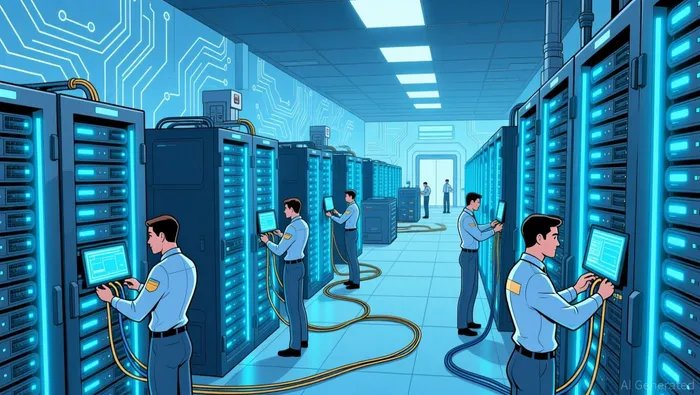
The bottom line is that the AI infrastructure S-curve is not just about chips. It's about the entire stack, and storage is emerging as a critical, early bottleneck. Seagate's outperformance is a market signal that the exponential adoption of AI is hitting a physical constraint at the data layer. The company is positioned at the inflection point where demand has decisively outstripped supply, a setup that typically fuels powerful, multi-year growth cycles.
The Infrastructure Layer: Growth Drivers and Financial Metrics
The growth story is now a financial reality. Seagate's first-quarter fiscal 2026 results show the AI demand surge translating directly to the income statement. Revenue climbed 21% year-over-year to $2.63 billion, while earnings per share exploded 65% from the year-ago period to $2.61. This isn't just a beat; it's a confirmation that the company is capturing the full benefit of the supply-demand imbalance in data center storage.
The drivers are clear and structural. The company gets 80% of its revenue from data center storage, and that segment is being reshaped by AI. The demand is so intense that management stated its production capacity for 2026 is close to sold out. More importantly, it has secured long-term visibility, with longer term agreements with its global data center customers providing clear visibility through calendar 2027. This locks in a multi-year revenue stream, de-risking the near-term outlook.
Financially, the company is in a strong position to capitalize. The favorable pricing environment, with HDD contract prices up an estimated 4% last quarter, is boosting margins. The non-GAAP operating margin jumped nearly 9 percentage points to 29% in the quarter. This operational leverage, combined with the secured demand, is fueling the earnings acceleration. Analysts are forecasting a 42% increase in Seagate's earnings in the current fiscal year, with healthy growth to follow.
The market is pricing in this premium growth. Seagate trades at a forward P/E ratio of 25x, which is in line with the Nasdaq-100 but represents a clear premium to the broader market's expected earnings growth. This valuation reflects the company's dominant position in the AI data center storage market and the visibility of its long-term agreements. The setup is classic for an infrastructure layer at an inflection point: high margins, locked-in demand, and exponential growth ahead.
Valuation and the S-Curve Adoption Rate
The valuation question now is whether Seagate's premium reflects the trajectory of the AI adoption curve. The stock trades at a forward P/E of 25x, a multiple that looks reasonable given its explosive growth. Analysts project earnings per share will jump 42% in the current fiscal year, with healthy double-digit increases to follow. This growth profile suggests the current multiple is not a bubble but a bet on sustained demand. In fact, some analysts see a path to a $455 stock price, implying nearly 50% upside from recent levels. That target is based on the company's growth trajectory and its dominant position in a market where data center storage needs are set to more than double by 2028.
The key risk, however, is a deceleration in the AI infrastructure buildout. Seagate's growth is tied to the physical deployment of data centers, a phase that may have a longer, more stable adoption curve than the compute-centric model of a company like NvidiaNVDA--. While Nvidia's momentum is tied to the next generation of chips, Seagate's demand is driven by the need to store the data those chips generate. This creates a different kind of vulnerability. If the pace of data center expansion slows, the industry-wide shortage that is boosting prices and margins could unwind. The current premium valuation would then be exposed.
Viewed another way, Seagate's setup is less about a short-term speculative surge and more about capturing a fundamental, multi-year infrastructure need. The company's production capacity is sold out for 2026, and it has long-term agreements with global data center customers providing visibility through 2027. This locks in demand and de-risks the near-term outlook. The valuation reflects not just 2026 growth, but the confidence that the AI storage bottleneck will persist for years. For an investor on the S-curve, this is the sweet spot: a company positioned at the inflection point where demand has decisively outstripped supply, with a financial model that captures the full benefit of that imbalance. The risk is that the curve flattens sooner than expected, but the current visibility suggests it has a long way to climb.
Catalysts, Risks, and What to Watch in 2026
The path forward for Seagate hinges on executing through the next phase of the AI infrastructure buildout. The company's current momentum is built on three key catalysts. First, it must successfully deliver against its longer term agreements with its global data center customers, which provide visibility through 2027. This locks in demand and de-risks the near-term financial model. Second, Seagate needs to ramp its next-generation storage technologies to maintain its technological edge as data center requirements evolve. Finally, the company must continue to expand its production capacity to meet the surging demand, a challenge given its production capacity for 2026 is close to sold out.
The primary risk to this trajectory is a slowdown in hyperscaler spending on data centers. This would directly impact the near-term demand that is currently driving the industry-wide shortage and price hikes. If the pace of data center expansion decelerates, the favorable supply-demand balance that is boosting margins could unwind. The market has priced in sustained growth, so any sign of demand normalization would be a major catalyst for a correction.
Investors should monitor quarterly guidance closely for early signals of this shift. Management's commentary on order books and capacity utilization will be critical. More broadly, watch for any change in the industry's pricing environment. The recent 4% jump in HDD contract prices is a key indicator of tight supply; a reversal would signal a fundamental change in the adoption curve. The bottom line is that Seagate's story is now about infrastructure execution. The company is positioned at a powerful inflection point, but its ability to sustain outperformance depends on its flawless delivery against locked-in demand while navigating the maturing phase of the AI buildout.





Comentarios
Aún no hay comentarios