
Scott Bessent's Fiscal Assurance: Assessing the Treasury's Capacity for Tariff Refunds
The immediate market fear of a sudden liquidity shock has been effectively dismissed. The U.S. Treasury possesses a formidable financial buffer, with government cash balances currently standing near $774 billion. Officials project this reserve will grow toward $850 billion by the end of March 2026. This deep well of cash provides a clear backstop, making it a non-issue for the government to fund any potential refunds if the Supreme Court rules against the tariffs.
Crucially, Treasury Secretary Scott Bessent has characterized the refund process itself as a prolonged and complex administrative task, not a sudden outflow. He stated that refunds would go over some time if the court rules against the tariffs, specifying they would likely be distributed over weeks, months, may take over a year. This gradual timeline is the key to containing any market impact. The Treasury is not planning to pay out billions in a single day; instead, the money would flow back through the system incrementally, reducing the risk of a disruptive liquidity surge.
Bessent's skepticism adds another layer of realism. He dismissed the refund process as a corporate boondoggle, questioning whether companies that initially paid the tariffs would pass the money back to consumers. Citing large retailers like Costco as an example, he noted there was very, very little, if any, pass-through of the tariff costs. This implies the economic effect of refunds, if they occur, would be muted and filtered through corporate balance sheets rather than directly boosting consumer spending or inflation. 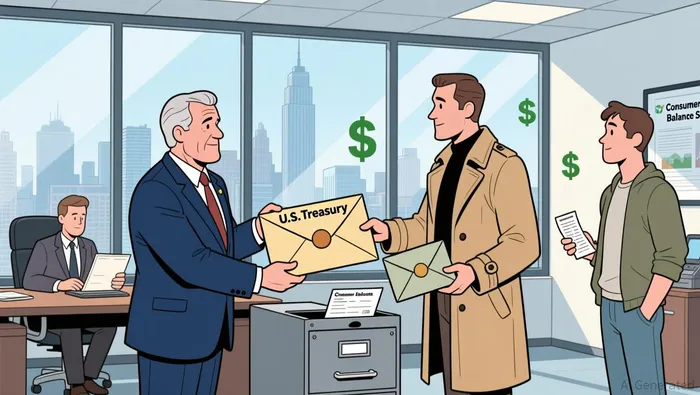 The bottom line is that while the refund mechanism is complex and may take over a year, the Treasury's massive cash position and planned slow rollout make a sudden fiscal or market crisis highly unlikely.
The Legal and Economic Mechanism: Who Pays, Who Gets Refunded?
The Supreme Court's decision will hinge on a narrow legal question: whether President Trump had the authority to impose these tariffs under the International Emergency Economic Powers Act (IEEPA). The court is scheduled to rule on this matter, with the outcome dictating the refund process. If the court finds the tariffs unlawful, the legal mandate is clear-the Treasury must repay those who paid the duties. Yet the practical distribution of that money, and the resulting economic impact, is far less certain.
Treasury Secretary Scott Bessent has cast serious doubt on the narrative of a simple corporate windfall. He argued that there was "very little, if any, pass-through" of tariff costs to consumers. This is a critical point. If companies absorbed the tariff burden rather than raising prices, then the refund mechanism becomes a corporate boondoggle. The Treasury would be repaying importers, but those companies may have no obligation-or incentive-to pass the money back to the end users who ultimately bore the cost. Bessent's skepticism questions the scale of any consumer benefit, suggesting the economic effect would be muted and filtered through corporate balance sheets.
The court itself may further complicate the picture. Analysts note the high court has the option to issue a "mishmash" ruling, granting limited powers under the IEEPA or requiring only limited repayment. This leaves room for a nuanced outcome that doesn't mandate a full refund of all $195 billion in fiscal 2025 tariff revenue. Even if a refund is ordered, the process would be administratively complex and drawn out, as Bessent has indicated it could take "weeks or even up to a year" to distribute. The bottom line is that while the legal pathway to refunds is established, the economic mechanism is fraught with uncertainty. The money flows to importers first, and whether it ever reaches consumers-or simply boosts corporate profits-remains a major open question.
Market and Policy Implications: From Bond Yields to Trade Strategy
The Treasury's capacity to manage refunds gradually transforms a potential fiscal shock into a manageable administrative task. This slow rollout directly reduces the risk of a sudden bond market sell-off or liquidity shock. Markets had initially feared a disruptive injection of cash, but officials have made it clear the money would flow back over weeks or months, not all at once. This timeline provides ample time for the Federal Reserve and Treasury to coordinate, ensuring the incremental outflows do not destabilize short-term funding markets or pressure yields. The bottom line is that the refund mechanism, while complex, is designed to be non-disruptive.
The ruling's outcome will also have a direct and immediate impact on the U.S. trade deficit, which hit its lowest level since 2009 in October. A Supreme Court decision against the tariffs would likely reverse this trend. With the duty wall removed, import volumes could accelerate, widening the deficit. This would complicate the administration's stated goal of reshoring manufacturing and correcting trade imbalances. The market implication is clear: a ruling in favor of the challengers would signal a shift away from the aggressive trade policy that has been a pillar of the current administration's economic strategy.
More broadly, the court's decision could signal a broader judicial skepticism of expansive executive authority. The justices have already shown doubt about the president's power under the IEEPA, and their ruling may set a precedent for future regulatory actions. A "mishmash" outcome, as Treasury Secretary Scott Bessent anticipated, could grant limited powers or require only limited repayment. This would not only affect tariffs but could embolden challenges to other emergency powers used by the executive branch. For investors, this introduces a new layer of uncertainty around the durability of future policy initiatives, particularly those relying on broad statutory authority. The court's hand is not just on the tariff case; it may be reshaping the very boundaries of administrative power.
Catalysts, Risks, and What to Watch
The immediate catalyst is now in motion. The Supreme Court is scheduled to release decisions this week, with the tariff case a key focus. While the court has not yet issued its ruling, the anticipation itself is a powerful market force. The primary risk is no longer a sudden liquidity shock, but the political and economic fallout from a complex, drawn-out refund process. Treasury Secretary Scott Bessent has already framed the outcome as a "mishmash," suggesting a nuanced ruling that could grant limited powers or require only partial repayment. This uncertainty is the central driver of volatility.
The real market test will be in the mechanics of any refund program and the Treasury's communication. Officials have emphasized that refunds would be distributed gradually over weeks or even a year, which is designed to be non-disruptive. Yet, as Justice Amy Coney Barrett noted, the process could be a "mess." The Treasury must now translate that warning into clear, credible operational plans. Watch for any details on eligibility, timing, and administrative hurdles. The market will scrutinize these for signs of friction or delay.
In the meantime, monitor Treasury yields and risk assets for reactions. A clean, limited ruling may see yields stabilize as the liquidity risk is confirmed as low. A more expansive "mishmash" decision, however, could introduce fresh uncertainty about the refund scope and timing, potentially spooking markets. The same applies to risk assets like equities and crypto, which remain sensitive to shifts in fiscal and trade policy expectations. The bottom line is that the Supreme Court's decision is the trigger, but the Treasury's follow-through on the refund mechanics will determine the final impact.







Comentarios
Aún no hay comentarios