
Is the Schwab U.S. Dividend Equity ETF (SCHD) a Prudent Haven Amid Today's Overvalued Market?
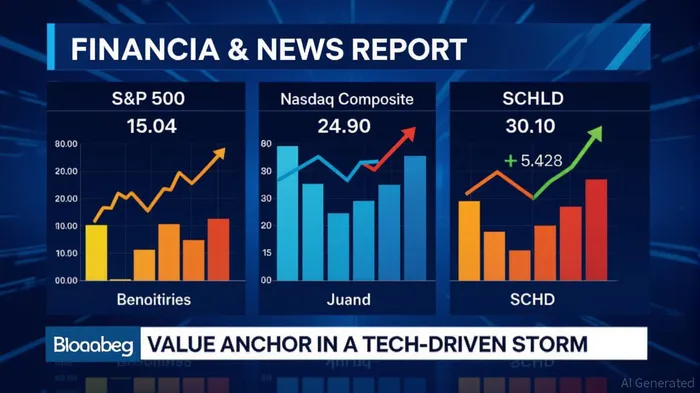
In the summer of 2025, the U.S. equity market finds itself in a precarious position. The S&P 500 trades at a trailing P/E ratio of 24.90, while the Nasdaq Composite soars to 30.10—both figures well above their 10-year averages of 19.32 and 25.81, respectively. These metrics signal a market priced for perfection, with speculative fervor concentrated in high-growth tech stocks. For income-focused investors, the question looms: Can a value-oriented, dividend-driven strategy like the Schwab U.S. Dividend Equity ETF (SCHD) offer a counterbalance to today's overvalued, tech-centric environment?
The Case for SCHD: A Value-Based Counterpoint
SCHD's 3.76% dividend yield stands out in a landscape where the S&P 500's yield hovers near 1.2%. This disparity is not accidental. The ETF's 15.04 P/E ratio—a full 40% below the S&P 500's 24.90—reflects its focus on mature, cash-generative companies in sectors like Energy (19.34%), Consumer Staples (18.92%), and Health Care (15.70%). These industries, often sidelined in a growth-obsessed market, provide a buffer against volatility and a steady income stream.
Consider the contrast: while the Nasdaq Composite's 8.42% allocation to Information Technology amplifies its exposure to speculative AI-driven stocks, SCHD's 8.42% tech stake is dwarfed by its 38% commitment to defensive sectors. This structural bias positions SCHD as a natural hedge against the fragility of overvalued growth stocks.
Historical Resilience in Overvalued Markets
SCHD's track record in high-valuation environments is instructive. Over the past decade, it has delivered an annualized return of 11.11%, outperforming the S&P 500 during periods of market stress. For example, during the 2020 market crash, SCHD's -21.55% three-month drawdown was in line with the broader market but cushioned by its lower beta of 0.88. This lower volatility, combined with a 0.06% expense ratio, makes it an efficient vehicle for long-term capital preservation.
The Dividend Premium: A Buffer Against Earnings Volatility
SCHD's 3.76% yield is more than a number—it's a testament to its portfolio's quality. The ETF screens for companies with at least 10 years of consecutive dividend growth, a criterion that weeds out speculative names. In a market where tech stocks trade at 30x+ P/E ratios, these dividend champions offer a tangible return, even if their growth trajectories are less explosive.
Strategic Allocation in a Tech-Driven World
While SCHD may lag in a pure tech bull market, its role in a diversified portfolio is irreplaceable. For investors wary of the Nasdaq's 30.10 P/E ratio—1.71 standard deviations above its 10-year average—SCHD provides a counterweight. By allocating a portion of one's portfolio to value-based income assets, investors can mitigate the risks of a potential tech sector correction while maintaining exposure to growth.
Final Verdict: A Prudent Haven, Not a Silver Bullet
SCHD is not a magic bullet for navigating today's overvalued market, but it is a prudent haven for those prioritizing income stability and downside protection. Its low P/E, defensive sector tilt, and robust dividend history make it a compelling choice for value-based investors. However, it should not be viewed in isolation. Pairing SCHD with tactical allocations to high-growth tech ETFs or individual stocks can balance the portfolio's risk-reward profile.
In a world where the S&P 500's 24.90 P/E ratio whispers of complacency, SCHD's 15.04 P/E ratio speaks to discipline. For income investors, the message is clear: in a market priced for perfection, the imperfection of value may be the ultimate safeguard.







Comentarios
Aún no hay comentarios