
SCHQ vs. VGLT: Which Long-Term Treasury ETF Offers Better Value for 2026?
Investors seeking exposure to long-term U.S. Treasury bonds in 2026 face a critical decision: choosing between the Schwab Long-Term USCHQ--.S. Treasury ETF (SCHQ) and the Vanguard Long-Term Treasury ETFVGLT-- (VGLT). Both funds offer low-cost access to the same asset class, but subtle differences in risk-adjusted returns, liquidity, and strategic fit for diversified portfolios could tip the scales for cost-conscious and performance-oriented investors.
Cost Efficiency: A Tie at 0.03%
Cost efficiency remains a cornerstone of long-term investing, and both SCHQ and VGLT deliver identical expense ratios of 0.03% in 2025. This parity eliminates cost as a differentiator for investors prioritizing fee transparency. However, the broader implications of cost efficiency extend beyond the expense ratio. For instance, both funds' low fees align with the passive management strategies of their respective providers, Schwab and Vanguard, which minimize active trading and associated transaction costs. While this ensures affordability, investors must weigh cost against other metrics-such as risk-adjusted returns and liquidity-to determine which fund better aligns with their portfolio goals.
Risk-Adjusted Returns: VGLT's Slight Edge
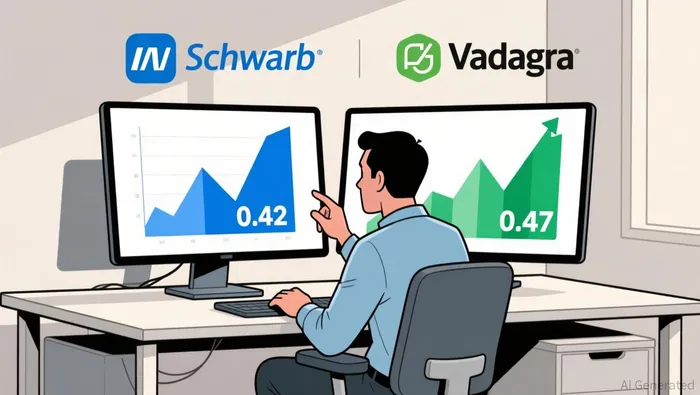
When evaluating risk-adjusted performance, VGLTVGLT-- demonstrates a marginal advantage over SCHQSCHQ--. As of December 2025, VGLT's Sharpe ratio stands at 0.47, compared to SCHQ's 0.42 according to portfolio analysis. This suggests that VGLT generates slightly better returns per unit of risk over the past 12 months, a critical consideration for investors seeking to optimize their bond allocations in a low-yield environment.
Historical performance over the past five years, however, tells a different story. Both funds have delivered nearly identical total returns, with a $1,000 investment growing to $586 in SCHQ and $588 in VGLT. Maximum drawdowns also mirror each other at approximately -46% according to market data. These similarities underscore the fungible nature of long-term Treasury exposure provided by both ETFs, though VGLT's longer track record (launched in 2009 versus SCHQ's 2019 debut) may offer greater confidence in its resilience during market stress.
Strategic Fund Selection: Liquidity and Diversification Considerations
For investors constructing diversified bond portfolios, liquidity metrics and strategic fit take precedence. Here, the two ETFs diverge meaningfully.
Liquidity Metrics:
- AUM and Trading Volume: VGLT's $14.3 billion in assets under management (AUM) dwarfs SCHQ's $1.0 billion, providing greater liquidity and depth in trading. However, SCHQ outperforms in daily trading volume, averaging 3 million shares higher than VGLT.
- Bid-Ask Spreads: SCHQ exhibits a narrower bid-ask spread than VGLT, making it more efficient for frequent traders or those seeking to minimize transaction costs.
Strategic Implications:
While VGLT's larger AUM and longer history may appeal to long-term investors prioritizing stability, SCHQ's tighter spreads and higher volume could benefit tactical allocators or those rebalancing portfolios frequently. Additionally, SCHQ's marginally higher dividend yield (4.5% vs. VGLT's 4.4%) may attract income-focused investors, though the difference is negligible.
Conclusion: Balancing the Trade-Offs
For 2026, the choice between SCHQ and VGLT hinges on investor priorities. Cost efficiency is a tie, but VGLT's superior Sharpe ratio and larger AUM position it as a marginally better option for risk-averse, long-term investors. Conversely, SCHQ's liquidity advantages and higher dividend yield may appeal to active traders or those seeking incremental yield.
Ultimately, both ETFs offer robust, low-cost access to long-term Treasuries. Investors should align their selection with their liquidity needs, risk tolerance, and portfolio rebalancing frequency. For most diversified bond portfolios, VGLT's slight edge in risk-adjusted returns and liquidity makes it the more compelling choice in 2026.





Comentarios
Aún no hay comentarios