
SCHD as a Defensive Equity Play in a Volatile Market
In an era marked by geopolitical tensions, inflationary pressures, and rapid shifts in investor sentiment, defensive equity strategies have gained renewed relevance. The Schwab U.S. Dividend Equity ETF (SCHD) has emerged as a compelling option for investors prioritizing income preservation and downside protection. By analyzing its historical performance, sector allocations, and fundamental strengths, this article evaluates SCHD's role as a defensive equity play in volatile markets.
Historical Performance: Resilience in Downturns
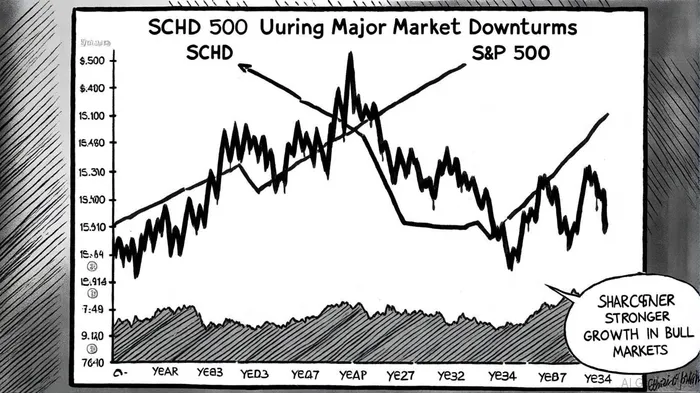
SCHD's track record during major market corrections underscores its defensive characteristics. During the 2020 pandemic crash, the fund experienced a drawdown of -35.7%, significantly less severe than the S&P 500's -55.3% decline, according to the SCHDTools recession performance calculator. Crucially, it recovered to pre-crash levels within six months, outperforming the broader market during the recovery phase, according to a Finance Key analysis. Similarly, in the 2022 bear market, when the S&P 500 fell by -18.11%, SCHD posted a modest loss of -3.26%, per the FinanceCharts performance history. This resilience stems from its focus on high-quality dividend-paying companies with strong balance sheets and consistent cash flows, as detailed in a Viking Trading Group deep dive.
While SCHD is not immune to losses-its 2008-2009 backtested drawdown of -45.2% was still less severe than the S&P 500's -55.3%-its ability to maintain dividend payments (with a maximum year-over-year reduction of -5.8% during the 2020 crisis, as SCHDTools reports) further reinforces its appeal for income-focused investors.
Sector Allocations: A Defensive Tilt
SCHD's portfolio is concentrated in defensive sectors such as Energy (19.53%) and Consumer Defensive (19.70%), which together account for nearly 40% of its holdings, according to the SCHDTools sector exposure calculator. This contrasts sharply with the S&P 500, where Energy represents only 5.30% and Consumer Defensive 10.40% (SCHDTools data). By underweighting volatile sectors like Technology (9.78% vs. S&P 500's 28.50%, per SCHDTools), SCHD reduces exposure to growth stocks that often underperform during downturns.
This sector concentration, while raising concerns about diversification (as reflected in its Herfindahl Index of 0.137, reported by SCHDTools), aligns with defensive investing principles. Defensive sectors like healthcare and utilities, which comprise 12.30% and 8.10% of SCHD's portfolio, are noted by the SCHD Dividend Calculator to tend toward inelastic demand and stable earnings, providing a buffer during economic stress, as highlighted in a Kiplinger list of defensive ETFs.
Company Fundamentals: Quality Over Growth
SCHD's selection criteria prioritize companies with at least 10 consecutive years of dividend payments and strong fundamentals, including robust cash flows and sustainable payout ratios, according to a Motley Fool article. While specific debt-to-equity ratios for its holdings are not publicly disclosed, the fund's emphasis on high-quality dividend payers suggests lower leverage compared to the broader S&P 500, per a FinanceCharts comparison. This focus on earnings stability-evidenced by consistent revenue growth over five-year periods-reduces volatility and enhances predictability for income seekers, as discussed in a FasterCapital article.
However, the 2025 reconstitution of SCHD, which increased energy exposure to over 20%, was noted in a DiviStockChronicles report and has raised concerns about sector-specific risks, such as oil price fluctuations. Despite this, the fund's 5-year dividend growth rate of 11.68% (noted by DiviStockChronicles) highlights its commitment to long-term income preservation.
Dividend Yield and Income Preservation
SCHD's current dividend yield of approximately 3.9%, according to an Invezz article, significantly outpaces the S&P 500's yield of 1.23% (per SCHDTools). This premium is achieved by targeting companies with strong cash flow generation and conservative payout ratios. During the 2022 downturn, for instance, SCHD's dividend cuts were minimal, preserving income for investors when growth stocks faltered (FinanceCharts performance history).
Compared to other defensive ETFs, SCHD offers a balance of yield and stability. While alternatives like JPMorgan's JEPQ provide higher yields, they come with elevated expense ratios and complex structures, as noted in the Invezz article. For conservative investors, SCHD's 0.06% expense ratio (per SCHDTools) and tax-efficient structure make it a more accessible option.
Conclusion: A Complementary Defensive Strategy
SCHD is not a panacea for market volatility, but its defensive tilt, consistent income stream, and historical resilience make it a valuable component of a diversified portfolio. While it may lag behind the S&P 500 in growth-centric environments, its ability to mitigate downside risk and preserve capital during downturns aligns with the goals of income-focused investors. In uncertain macroeconomic conditions, SCHD's combination of quality, stability, and yield positions it as a robust defensive equity play.







Comentarios
Aún no hay comentarios