
SCHD: A Defensive Anchor in an Age of AI Volatility
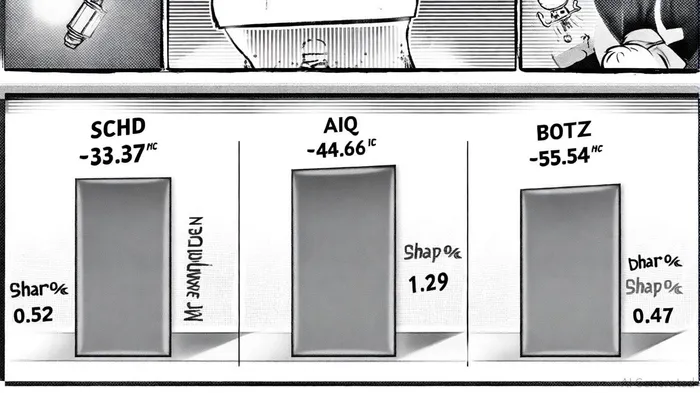
In an investment landscape increasingly dominated by speculative AI-driven assets, the Schwab U.S. Dividend Equity ETF (SCHD) emerges as a compelling counterbalance for risk-conscious investors. While artificial intelligence and robotics ETFs like BOTZBOTZ-- and AIQ have captivated markets with their high-growth narratives, their volatility and drawdown risks underscore the enduring value of dividend-focused equities in stabilizing long-term portfolios.
SCHD's Proven Resilience
Over the five years ending September 2025, SCHDSCHD-- delivered a total return of 79.54%, translating to a compound annual growth rate (CAGR) of 12.59% [1]. This performance, while robust, is equally notable for its risk-adjusted efficiency. With a standard deviation of 15.33% and a Sharpe ratio of 0.52 [2], SCHD balances growth and volatility, rewarding investors with consistent returns relative to its moderate risk profile.
The fund's defensive characteristics were starkly tested during the 2020 market crash, when it experienced a maximum drawdown of -33.37% [4]. This figure, while significant, pales in comparison to the -35.41% drop in the S&P 500 during the same period. Crucially, SCHD recovered from this downturn in just 3.8 months, a testament to its focus on high-quality, dividend-paying companies with strong balance sheets [4].
AI ETFs: High Rewards, Higher Risks
By contrast, AI-focused ETFs exhibit a far more precarious risk profile. According to PortfoliosLab data, BOTZ—a fund heavily weighted toward speculative AI and robotics stocks—endured a maximum drawdown of -55.54% between 2020 and 2025, the most severe of the three funds analyzed [3]. AIQ, while slightly less volatile (-44.66% drawdown), still lags behind SCHD in downside protection.
Risk-adjusted returns further highlight the divergence. AIQ's Sharpe ratio of 1.29 outperforms SCHD's 0.52, suggesting superior returns per unit of risk [3]. However, this metric must be contextualized with its daily standard deviation of 25.69%, nearly double SCHD's 15.33% [2]. BOTZ, with a Sharpe ratio of 0.47 and volatility of 26.99%, underperforms both SCHD and AIQ, illustrating the perils of overconcentration in high-beta sectors [3].
Strategic Implications for Portfolio Construction
The juxtaposition of these metrics reveals a critical insight: while AI ETFs may offer alluring upside potential, their volatility and drawdown risks make them unsuitable as core holdings for long-term investors. SCHD, by contrast, serves as a stabilizing force. Its focus on dividend-paying equities—companies with predictable cash flows and lower leverage—provides a buffer during market stress, as evidenced by its quicker recovery post-2020 [4].
For investors seeking to balance growth and stability, a strategic allocation to SCHD can mitigate the sequence-of-returns risk inherent in AI-driven portfolios. This is particularly relevant for retirees or those with intermediate time horizons, where preserving capital during downturns is as critical as capturing upside.
Conclusion
As AI-driven assets continue to dominate headlines, SCHD reminds investors of the enduring value of disciplined, income-focused strategies. Its combination of moderate growth, lower volatility, and superior downside protection positions it as a defensive alternative in an era of speculative excess. For those prioritizing long-term portfolio stability, SCHD is not merely a complement to AI ETFs—it is an essential counterweight.





Comentarios
Aún no hay comentarios