
Scallop's Token Lockup Strategy: A Blueprint for Investor Confidence and Protocol Stability
In the fast-evolving world of decentralized finance (DeFi), tokenomics design is a critical determinant of long-term success. Scallop's (SCA) token lockup strategy, implemented in 2025, stands out as a masterclass in aligning incentives between the protocol, its community, and institutional stakeholders. By locking over 34 million $SCA tokens-roughly one-third of the circulating supply-for an average of 3.7 years, Scallop has not only mitigated short-term sell pressure but also signaled a profound commitment to its strategic vision, according to a Chainwire report. This article dissects how Scallop's structured lockup and vesting mechanisms are fortifying investor confidence and protocol stability, offering a compelling case for DeFi skeptics and optimists alike.
The Mechanics of Scallop's Token Lockup
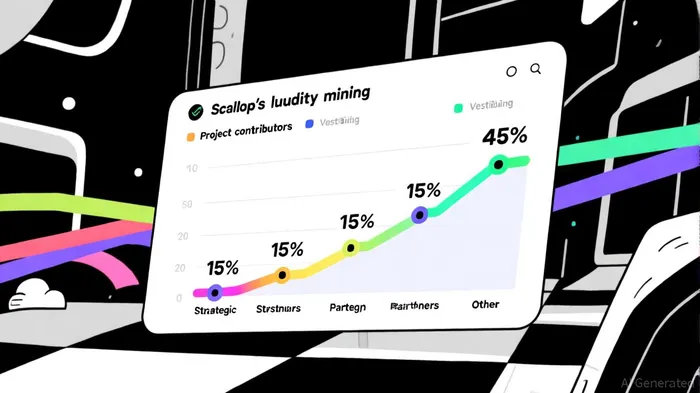
Scallop's tokenomics are built on a 250 million total supply, with allocations tailored to balance growth, governance, and sustainability. Key components include:
- 45% to Liquidity Mining, distributed via decreasing monthly emissions (1.5% reduction each month) to incentivize early participation, per Scallop's token docs.
- 15% to Project Contributors (founding team), locked for one year before linear unlocking over three years, as outlined in Scallop's documentation.
- 7.5% to Ecosystem/Community/Marketing, linearly unlocked over five years to fund long-term growth according to Scallop's documentation.
- 38.84% of circulating supply locked in veSCA contracts, granting governance rights and yield boosts for extended periods, per a TradeACrypto analysis.
These mechanisms ensure that no single category floods the market with tokens, preserving scarcity and aligning token holder interests with the protocol's success. For instance, strategic partners and investors face vesting schedules spanning 1–5 years, as noted in a JU blog post, while liquidity providers benefit from compounding incentives tied to prolonged participation.
Investor Confidence: A Data-Driven Perspective
Scallop's lockup strategy has directly translated into measurable gains in investor trust. As of Q3 2025, Total Value Locked (TVL) in the protocol surged past $150 million, capturing 66% of the SuiSUI-- ecosystem's DeFi market, per Scallop's documentation. This growth is underpinned by the community's willingness to lock tokens for extended durations: 50 million $SCA tokens (20% of total supply) are currently locked, with an average duration of 3.71 years, as reported by Chainwire. Such figures are not mere numbers-they represent a vote of confidence in Scallop's governance model and technical infrastructure.
Expert analyses reinforce this narrative. A TradeACrypto analysis highlights that Scallop's institutional-grade compliance and integration with Sui's high-performance blockchain have further solidified trust, attracting both retail and institutional capital. Additionally, the protocol's AI-powered dynamic interest rate model and CosmosATOM-- IBC integration-announced in 2025-demonstrate a forward-looking approach to liquidity management and cross-chain interoperability, according to Scallop's documentation.
Protocol Stability: Mitigating Risks Through Design
Token lockups inherently reduce volatility by curbing short-term dumping. Scallop's strategy takes this a step further. For example, the 3.7-year average lockup duration for veSCA holders ensures that governance power remains concentrated among long-term stakeholders, minimizing the risk of rapid shifts in protocol direction, as noted in a TradeACrypto analysis. Meanwhile, the treasury's 7% allocation-fully unlocked at TGE-provides immediate liquidity without compromising future stability, per Scallop's documentation.
However, risks persist. A 15% token unlock in Q3 2025, while strategic, introduced short-term liquidity pressures, according to Scallop's documentation. Yet, Scallop's robust infrastructure-bolstered by $80 million in market-making support from Jump Trading-kept slippage below 0.1%, showcasing the protocol's resilience, as detailed in Scallop's documentation. This balance between controlled unlocks and liquidity safeguards is a hallmark of Scallop's stability-first ethos.
Conclusion: A Model for Sustainable DeFi
Scallop's token lockup strategy exemplifies how thoughtful tokenomics can drive both investor confidence and protocol stability. By locking a significant portion of its supply for multi-year durations, the protocol has created a flywheel effect: sustained community participation fuels TVL growth, which in turn attracts further investment. As DeFi matures, Scallop's approach offers a replicable framework for projects seeking to balance innovation with long-term value retention.
For investors, the message is clear: Scallop's lockup design isn't just about token distribution-it's a testament to the project's commitment to building a resilient, community-driven ecosystem. In a space where hype often outpaces substance, Scallop's data-driven, incentive-aligned model is a breath of fresh air.






Comentarios
Aún no hay comentarios