
Scallop Mining Pools and the Nemo Exploit: A Deep Dive into Security Resilience and Operational Stability in DeFi Mining Infrastructure
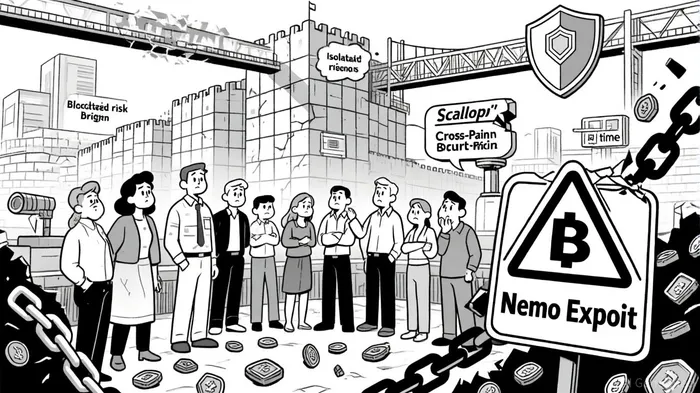
The Nemo Exploit: A Case Study in DeFi Vulnerability
In September 2025, the Nemo Protocol—a DeFi yield platform on the SuiSUI-- blockchain—became the latest victim of a sophisticated exploit, losing $2.4 million in stablecoins. The attack occurred just before scheduled maintenance, a timing that amplified community frustration over the team's lack of transparency. The hacker bridged USDCUSDC-- from Arbitrum to EthereumETH--, leveraging cross-chain operations to obscure the theft. This incident underscores a critical weakness in DeFi mining infrastructure: the inability to secure cross-chain interactions and prevent real-time asset siphoning.
According to a report by CoinCentral, the breach exposed vulnerabilities in smart contract execution and cross-chain bridging protocols. Nemo's failure to isolate risks—despite prior audits—highlights the limitations of reactive security measures in a rapidly evolving threat landscape. The protocol's TVL plummeted from $6.3 million to $1.57 million post-attack, a stark reminder of how quickly trust erodes in the absence of robust safeguards.
Scallop's Security Architecture: A Blueprint for Resilience
In contrast, Scallop—a lending and borrowing protocol on Sui—has emerged as a model of operational stability and security resilience. Its architecture is designed to mitigate systemic risks through multi-oracle consensus, dynamic risk management, and modular isolation.
Multi-Oracle Consensus: Scallop integrates price data from Pyth, Switchboard, and SupraOracles, ensuring that no single data source can manipulate asset valuations. This approach raises the cost of attacks exponentially, as adversaries would need to compromise multiple oracles simultaneously. The protocol also employs TWAP (Time-Weighted Average Price) oracles to guard against flash crashes and Byzantine faults.
Soft Liquidation Mechanism: Scallop's dynamic risk framework includes a “soft liquidation” feature, where a borrower's collateral is partially liquidated if its value dips below a threshold. This minimizes losses while maintaining protocol solvency. Unlike traditional liquidation models, which trigger abrupt asset sales, Scallop's approach reduces slippage and market volatility.
Modular Isolation: Scallop leverages Sui's unique account system, allowing users to manage multiple sub-accounts and isolate collateral/debt. This modular design prevents cross-protocol contagion, as seen in the Nemo exploit. When the Nemo breach occurred, Scallop confirmed its mining pools remained unaffected, attributing this to its risk-isolation strategy.
Proactive Audits and Governance: Scallop undergoes regular audits by Zellic, OtterSec, and MoveBit, and maintains a bug bounty program offering up to $300,000 for vulnerability reports. Transparent communication and third-party validation have reinforced user trust, even amid broader ecosystem shocks like the Cetus Protocol hack.
Cross-Chain Attack Mitigation: Scallop vs. Nemo
The Nemo exploit exemplifies the dangers of centralized oracles and unsegmented smart contracts. By contrast, Scallop's multi-oracle consensus and modular architecture create a defense-in-depth strategy that thwarts cross-chain exploits. For instance, Scallop's integration of Distributed Oracle Agreement (DORA) ensures price feeds are tamper-resistant, while its Trilinear Interest Rate Model adjusts borrowing/lending rates in real time to stabilize liquidity pools.
Data from The Block reveals Scallop's TVL reached $131 million in 2025, with $5 million in total revenue. This growth, despite a 33.9% TVL decline in the broader DeFi sector, underscores the protocol's ability to retain user confidence through structural resilience.
Implications for DeFi Mining Infrastructure
The Nemo and Scallop cases highlight a critical divergence in DeFi security paradigms. Platforms relying on monolithic smart contracts and single-oracle systems remain exposed to sophisticated attacks, while those adopting modular design, multi-oracle consensus, and proactive governance are better positioned to thrive.
For investors, Scallop's architecture represents a compelling case study in risk mitigation. Its ability to withstand the Nemo exploit—while maintaining operational stability—demonstrates the value of institutional-grade security in an industry plagued by volatility. As Chainalysis notes, over $2.17 billion was lost to DeFi exploits in 2025, making security a non-negotiable factor for long-term viability.
Conclusion
The Nemo exploit serves as a cautionary tale for DeFi protocols: security is not a one-time fix but an ongoing commitment to innovation and transparency. Scallop's success lies in its ability to anticipate threats through multi-layered defenses, dynamic risk models, and community-driven governance. For investors, this translates to a clear imperative: prioritize protocols that treat security as a core feature, not an afterthought.
As the DeFi ecosystem matures, platforms like Scallop will set the standard for resilience, proving that operational stability and security can coexist with innovation.






Comentarios
Aún no hay comentarios