
Scaling Sustainability in High-Growth Tech: How Redwood Materials Balances Capital Efficiency and Strategic Reallocation to Lead the Recycling-Energy Storage-AI Megatrend
Capital Efficiency and Strategic Reallocation: Redwood's Post-Funding Playbook
Redwood's $350 million raise, led by Eclipse Ventures and Nvidia's NVentures, values the company at $6 billion and signals investor confidence in its dual focus on energy storage and critical mineral recovery. The funds are being directed toward scaling Redwood Energy, its division repurposing end-of-life electric vehicle (EV) batteries for grid-scale storage, and expanding refining operations to meet surging demand for battery materials. This strategic pivot reflects a calculated shift from EV battery recycling to energy storage and critical minerals, a move accelerated by slower-than-expected EV adoption and global supply chain dynamics dominated by China.
The 5% staff reduction, announced in November 2025, is a key component of this reallocation. By streamlining operations-particularly in cathode materials engineering-Redwood aims to reduce overhead while accelerating its transition to high-margin energy storage projects. This lean approach aligns with broader industry trends: data centers, which now consume 2% of global electricity, are projected to drive a 57% compound annual growth rate in energy storage demand through 2030. Redwood's vertical integration model-spanning battery collection, diagnostics, and recycling-ensures cost efficiency, a critical advantage in an industry where margins are often compressed by commodity price volatility according to industry analysis.
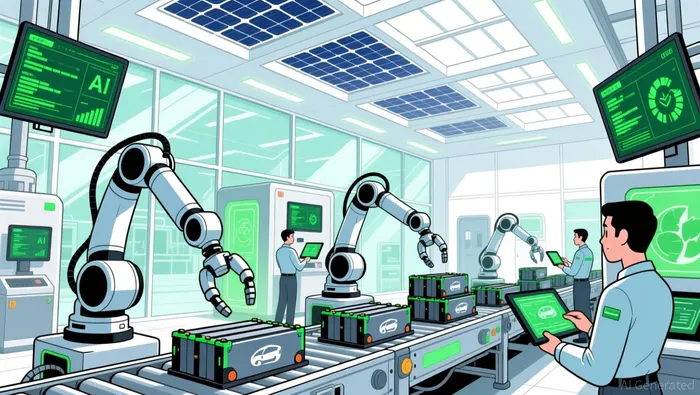
The Recycling-Energy Storage-AI Synergy: A Megatrend in Motion
Redwood's strategy is emblematic of a larger shift in infrastructure investment. The company's Nevada-based 12 MW, 63 MWh microgrid, powered by repurposed EV batteries, already demonstrates the scalability of second-life storage systems. This project, which supports a data center for Crusoe, highlights how recycled batteries can meet the energy demands of AI infrastructure while reducing reliance on new raw materials. Such innovations are gaining urgency as AI's power consumption-projected to grow 100-fold by 2030-sparks a parallel boom in energy storage demand.
Investors are taking note. The global market for data center energy storage is expected to expand from $1.6 billion in 2024 to $2.5 billion by 2030, driven by cloud operators seeking to balance AI workloads with renewable energy sources. Redwood's ability to integrate AI-driven energy management systems with its storage solutions further cements its position in this ecosystem. For instance, its South Carolina critical minerals recovery facility, operational since November 2025, is designed to extract 20,000 metric tons of materials annually, directly feeding its refining and storage operations.
Challenges and the Path Forward
Despite its momentum, Redwood's path is not without risks. The energy storage sector faces scrutiny over sustainability practices, with investors increasingly prioritizing carbon-neutral supply chains and water-efficient technologies according to industry reports. Redwood's reliance on repurposed EV batteries mitigates some of these concerns, but its success will depend on maintaining cost advantages as competition intensifies. Additionally, the company's pivot from EV recycling to energy storage requires navigating regulatory shifts and technological uncertainties in battery chemistry.
However, Redwood's strategic reallocation-coupled with its $350 million liquidity cushion-positions it to weather these challenges. By focusing on high-growth verticals like AI-driven infrastructure and grid-scale storage, the company is aligning its operations with megatrends that transcend short-term market fluctuations. As McKinsey notes, infrastructure is evolving beyond physical assets to encompass digital networks and AI systems, creating a need for integrated strategies that Redwood's model exemplifies.
Conclusion: A Blueprint for Sustainable Growth
Redwood Materials' case illustrates a broader principle: in high-growth tech sectors, capital efficiency and strategic reallocation are not just operational tactics but foundational elements of long-term value creation. By leveraging its expertise in recycling and vertical integration, Redwood is transforming end-of-life batteries into a cornerstone of the AI and energy transition eras. For investors, the lesson is clear: companies that can harmonize sustainability with scalability-while maintaining lean operations post-liquidity-will dominate the next decade of infrastructure innovation.







Comentarios
Aún no hay comentarios