
Saudi Aramco's Strategic Transactions and Market Implications: Balancing Short-Term Pains for Long-Term Gains
Let's cut to the chase: Saudi Aramco is rewriting the rules of the energy game. Since 2023, the company has embarked on a corporate restructuring that's as bold as it is controversial. For investors, the question isn't just whether this strategy will work-it's whether they're ready to stomach the short-term turbulence for the long-term payoff.
Short-Term Pains: Dividend Cuts and Capital Discipline
Aramco's 2023-2025 restructuring began with a seismic shift in its dividend policy. In 2023, the company paid out $97.8 billion in dividends-nearly 100% of its free cash flow-while reducing capital expenditures by $40 billion through 2028, according to a Visual Capitalist analysis. By 2025, however, dividends had plummeted by 30% to $85.4 billion, a move that sent ripples through the market, according to a GFMag report.
Here's the rub: Aramco is trading short-term shareholder returns for long-term resilience. The dividend cuts were paired with a strategic pivot toward gas expansion, carbon capture, and hydrogen production. While this has rattled income-focused investors, it's a calculated risk. As GFMag noted, the reduction reflects a "shift in financial priorities toward long-term growth."
Long-Term Gains: Gas, ESG, and the Energy Transition
Aramco's long-term playbook is clear: dominate the energy transition while holding its upstream crown. The company is expanding gas production by 60% by 2030, anchored by the Jafurah field, and investing $25 billion in natural gas infrastructure (Visual Capitalist). Simultaneously, it's pouring $1.5 billion into a sustainability-focused venture capital fund and scaling blue hydrogen production, according to a Substack analysis.
These moves aren't just about ESG compliance-they're about future-proofing its market position. With carbon neutrality goals by 2050 and a 50% emissions cut target by 2030, Aramco is positioning itself as a bridge between fossil fuels and renewables. As the Substack analysis notes, its ROA of 20.03% and ROE of 23.52% dwarf peers like ChevronCVX-- (6.81% ROA) and BP (0.99% ROA), proving its ability to monetize this transition.
Market Positioning: The $1.9 Trillion Question
Aramco's market cap of $1.914 trillion dwarfs ExxonMobil ($509B) and Chevron ($288B), but here's the catch: only 2% of its shares are publicly traded (Visual Capitalist). This limited liquidity raises questions about its true market relevance. Yet, its financial metrics tell a different story.
- Profitability: Aramco's operating margin of 43.59% and gross margin of 54.47% outperform all major oil peers, as detailed in the Substack analysis.
- Dividend Growth: Despite the 2025 cut, its 33.22% dividend growth rate over the period far exceeds Exxon's 4.21% (Substack analysis).
- Credit Ratings: Fitch affirmed its 'A+' rating in 2024, citing "conservative financial management" and lower leverage than Shell or TotalEnergies (Substack analysis).
Analyst Sentiment: Buy, But With Caution
Institutional investors are split. Jefferies and United Securities maintain "Buy" ratings despite trimming price targets (GFMag), while others warn of liquidity risks. A 2025 report highlights that Aramco's average daily trading volume ($51 million) pales compared to Exxon's $1.9 billion (Visual Capitalist).
Yet, the long-term bet is hard to ignore. Moody's upgraded Aramco's rating to Aa3 in 2024, crediting its "enhanced creditworthiness" and state support (Substack analysis). For patient investors, this signals a company with the scale and strategy to outlast the energy transition.
The Bottom Line: A High-Stakes Handshake
Aramco's restructuring is a masterclass in balancing short-term pain with long-term gain. While the 2025 dividend cut may test investor patience, its pivot to gas, hydrogen, and ESG-aligned projects is laying the groundwork for a dominant 2030s energy landscape.
But don't mistake this for a risk-free bet. The low public float and geopolitical sensitivities mean volatility is inevitable. For those with a 10-year horizon, however, Aramco's $1.9 trillion valuation isn't just justified-it's a testament to its unparalleled scale and strategic vision.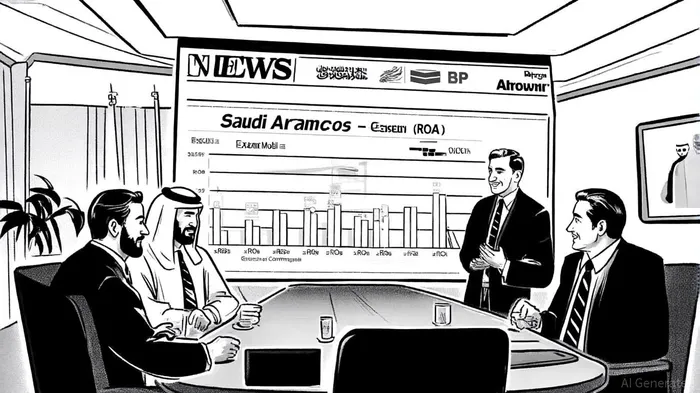





Comentarios
Aún no hay comentarios