
Saudi Arabia's Blockchain-Driven Financial Transformation: A Strategic Entry Point for Institutional Investors
Saudi Arabia's financial infrastructure is undergoing a seismic shift, driven by blockchain technology and a visionary regulatory framework. As the Kingdom accelerates its digital transformation under Vision 2030, institutional investors are presented with a unique opportunity to capitalize on a rapidly evolving ecosystem. From tokenized real estate to emerging asset classes and a robust regulatory environment, the stage is set for long-term capital gains.
Government-Driven Innovation: The Backbone of Blockchain Adoption
The Saudi government has emerged as a proactive catalyst for blockchain integration, particularly in trade finance and open banking. In 2023, the launch of the Blockchain and Distributed Ledger Technology Regulatory Framework marked a pivotal step toward digitizing 80% of government services by 2025 according to research. This initiative, part of the Financial Sector Development Program (FSDP), aims to reduce operational costs, enhance transparency, and position Saudi Arabia as a global fintech hub according to market analysis.
Complementing this is the Open Banking Program introduced by the Saudi Central Bank (SAMA), which enables collaboration between traditional banks and fintechs to deliver innovative services according to reports. These frameworks are not just theoretical-they are operational. For instance, SAMA's participation in the mBridge project with international partners has tested central bank digital currencies (CBDCs) using blockchain, signaling the Kingdom's commitment to cross-border financial innovation according to industry reports.
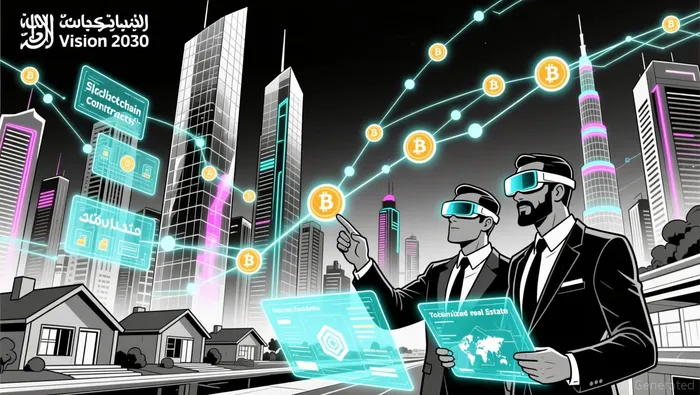
Tokenized Real Estate: Democratizing Access and Liquidity
One of the most tangible manifestations of Saudi Arabia's blockchain-driven transformation is the tokenization of real estate. A groundbreaking pilot project led by droppRWA and RAFAL Real Estate Development Company allows Saudi citizens to invest as little as 1 Riyal (~$0.27) in fractional ownership of luxury properties in Riyadh according to news coverage. This initiative, structured through Special Purpose Vehicles (SPVs) to comply with Capital Market Authority (CMA) regulations, is a national benchmark for financial inclusion according to industry experts.
The market for real estate tokenization is already gaining momentum. Valued at $96 million in 2024, it is projected to surge to $440 million by 2030 according to market projections. This growth is underpinned by government programs like the Real Estate Title Digitization Project, which enhances transparency and facilitates blockchain integration according to industry analysis. For institutional investors, this represents a scalable model for liquidity and diversification, particularly in a market where high-net-worth individuals and foreign capital are increasingly active.
Expanding Beyond Real Estate: Diversification of Tokenized Assets
While real estate remains a cornerstone, Saudi Arabia is rapidly tokenizing other asset classes. The KSA Asset Tokenization Market is expected to see the emergence of tokenized private credit, commodities, stocks, and even intellectual property between 2025 and 2030 according to market research. Fractional ownership models are also expanding to include assets like tokenized carbon credits and U.S. treasuries, driven by regulatory support and technological advancements according to industry reports.
This diversification is supported by the Kingdom's digital infrastructure. The DevOps market, valued at $1.8 billion in 2024, is projected to grow to $6.63 billion by 2030, fueled by hyperscale data centers and AI-driven systems according to market analysis. Such infrastructure ensures the scalability and security required for tokenized assets to thrive.
Institutional Investment Flows: A Shift Toward Private Credit and Equity
Institutional capital is increasingly aligning with Saudi Arabia's blockchain-driven agenda. The Saudi Venture Capital (SVC) fund, with a $3 billion mandate, is reallocating half of its investments to private credit and equity, up from a third previously according to financial reports. This shift reflects a broader trend: as liquidity tightens, SMEs are turning to alternative financing, and private credit is emerging as a critical bridge according to market analysis.
The Public Investment Fund (PIF) is also pivoting. While historically focused on real estate gigaprojects, it is now prioritizing sectors like logistics, minerals, and AI according to reports. This reallocation signals a strategic move to diversify the economy and capitalize on high-growth, blockchain-enabled sectors.
Regulatory Evolution: Mitigating Risks for Long-Term Gains
Despite the optimism, challenges persist. Regulatory uncertainty, limited awareness, and security concerns remain hurdles for institutional adoption according to market analysis. However, the Kingdom is addressing these through regulatory sandboxes, compliance-friendly licensing, and investor protection frameworks according to industry experts. For example, the CMA and Fintech Saudi are jointly overseeing real estate tokenization pilots, ensuring alignment with global standards according to industry reports.
Institutional investors must also navigate infrastructure limitations and cross-sector regulations, such as data protection and AI ethics according to regulatory analysis. Yet, the proactive approach of Saudi regulators-evidenced by the Digital Asset Laws and Token Offering Guidelines-suggests a maturing ecosystem capable of mitigating these risks according to market research.
Conclusion: A Strategic Window for Institutional Investors
Saudi Arabia's blockchain-driven financial transformation is not a speculative trend but a calculated, government-backed evolution. From digitized trade finance to tokenized real estate and diversified asset classes, the Kingdom is creating a fertile ground for institutional capital. While risks exist, the regulatory and technological infrastructure is rapidly evolving to address them. For investors with a long-term horizon, the opportunity to participate in this transformation-through real estate, private credit, or emerging tokenized assets-is both timely and strategically compelling.







Comentarios
Aún no hay comentarios