
Satoshi Nakamoto's $100B Bitcoin Move: On-Chain Signals, Institutional Dynamics, and Strategic Implications
The On-Chain Pulse: Satoshi-Era Movements as Leading Indicators
Bitcoin's price discovery mechanism has increasingly relied on on-chain data, with movements from early-era wallets serving as critical signals. In July 2025, the transfer of 80,000 BTC ($8.6 billion) from dormant Satoshi-era wallets-last active in 2011-sparked immediate market volatility, with BitcoinBTC-- dropping 1.6%, according to a CoinDesk report. Such events, while rare, historically correlate with speculative cycles. For instance, during the 2017 and 2021 bull runs, large-holder netflow and MVRV Z-Scores peaked at 8.8 and 7.1, respectively, signaling overvaluation, as noted in a Blockchain overview. Today, the MVRV Z-Score stands at 2.5, suggesting a neutral valuation range, per an OKX analysis.
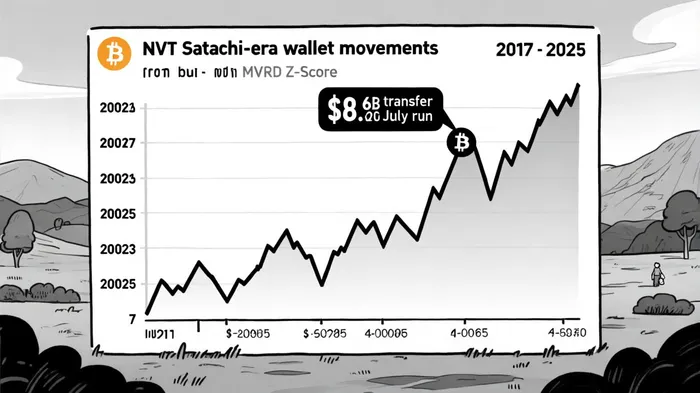
The July 2025 transfers, however, diverged from panic-driven selling. The funds were moved to SegWit addresses, indicating a strategic upgrade in storage security, according to the CoinDesk report. Institutional absorption of liquidity-evidenced by ETF inflows totaling $86 billion in July 2025-mitigated price damage, as described in an OKX report. This underscores a maturing market where institutional players act as stabilizers, contrasting with the retail-dominated 2017 cycle, as noted in a CryptoPotato analysis.
Institutional Adoption and Regulatory Clarity: A New Paradigm
The CLARITY Act of 2025 has reshaped Bitcoin's institutional landscape by defining digital assets as commodities, investment contracts, or permitted stablecoins, according to an AminaGroup explainer. This regulatory clarity has spurred $3 trillion in institutional capital inflows, with ETFs like BlackRock's IBIT dominating market share, as reported by OKX. The Act's jurisdictional clarity between the SEC and CFTC has also reduced legal ambiguity, enabling traditional custodians to offer Bitcoin services, per the AminaGroup explainer.
Historically, regulatory events have acted as catalysts for Bitcoin's price cycles. The 2021 bull run coincided with Tesla's Bitcoin investments and the rise of DeFi, while the 2025 surge followed the CLARITY Act and spot ETF approvals, as covered in the Blockchain overview. These developments suggest that institutional adoption is now a primary driver of Bitcoin's valuation, rather than speculative retail demand.
Macroeconomic Implications of a $100B Move
If Satoshi's $100B Bitcoin stash were to move, the market would face unprecedented challenges. Modeling from 2024 suggests a 20–50% price crash due to oversupply and panic selling, according to an ABC Money analysis. However, current market dynamics differ from past cycles. Institutional-grade custody solutions and OTC desks have created a buffer, as seen in the July 2025 $9 billion liquidation event, where Bitcoin recovered swiftly, as noted in the OKX report.
The broader economic impact would extend beyond price volatility. A large-scale move could trigger regulatory scrutiny, debates over Bitcoin's scarcity narrative, and shifts in market sentiment. Yet, Bitcoin's fixed supply and decentralized architecture provide long-term resilience, a point explored in the ABC Money analysis.
Strategic Entry/Exit Points: A Data-Driven Framework
For investors, historical patterns and on-chain metrics offer actionable insights:
1. Entry Points:
- NVT Ratio Dips: When the NVT ratio normalizes (e.g., below 150), it signals undervaluation. The 2021 bull run began after a 12-month NVT trough, as discussed in the CryptoPotato analysis.
- MVRV Z-Score Below 2.5: Current levels suggest a buying opportunity, as the metric is far from overvaluation thresholds, per the OKX analysis.
- Large-Holder Accumulation: ETF inflows and cold wallet transfers indicate institutional confidence, as described in the OKX report.
- Exit Points:
- MVRV Z-Score Above 5: Historical tops (e.g., 2017's 8.8) suggest caution.
- NVT Spike Above 200: Indicates speculative overvaluation, highlighted in the CryptoPotato analysis.
- Regulatory Uncertainty: A reversal in the CLARITY Act's framework could trigger risk-off sentiment, per the AminaGroup explainer.
Conclusion: Navigating the Satoshi Era
Satoshi-era wallet movements remain a double-edged sword-signals of both volatility and institutional maturation. While a $100B move would test market resilience, the current infrastructure of ETFs, custody solutions, and regulatory clarity provides a buffer. Investors should monitor on-chain metrics like MVRV and NVT, while leveraging institutional-grade tools to navigate potential shocks. As Bitcoin's role evolves from speculative asset to institutional reserve, strategic positioning will hinge on balancing historical patterns with real-time data.





Comentarios
Aún no hay comentarios