
Sasol's Strategic Turnaround Amid Global Uncertainty: Operational Improvements and Risk-Adjusted Returns in the Energy Transition
Operational Improvements: A Foundation for Resilience
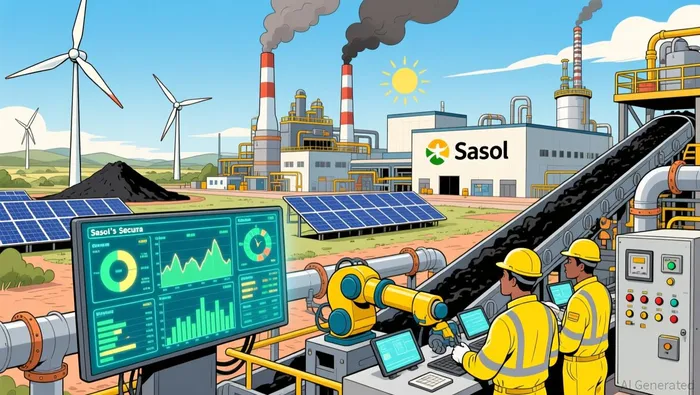
Sasol's 2025 operational strategy hinges on three pillars: process efficiency, renewable energy integration, and low-carbon technology deployment. The company's Optimised Emission Reduction Roadmap (ERR) aims to cut emissions by 30% by 2030 while sustaining production levels. Key initiatives include the commissioning of low-carbon boilers at its Natref and Sasolburg facilities and the development of renewable energy projects to supply green electricity to its Secunda plant by late 2025 according to Sasol's business performance metrics. These efforts align with South Africa's decarbonization goals and reflect Sasol's attempt to balance environmental commitments with operational continuity.
Recent financial results underscore progress. In Q3 2025, SasolSSL-- reported a 18% quarter-over-quarter increase in Southern Africa production, driven by improved coal quality and enhanced equipment availability. The Secunda plant, a cornerstone of its operations, saw a 4% QoQ production rise and a 9% year-over-year improvement according to the same report. Meanwhile, the International Chemicals segment benefited from margin optimization and higher sales volumes in the U.S. and Eurasia, despite weaker base chemical pricing according to Sasol's business performance metrics. These gains suggest that operational improvements are beginning to translate into tangible financial performance.
Risk Management: Balancing Transition Costs and Financial Stability
Sasol's energy transition, however, is not without risks. The company's carbon-intensive legacy-its emissions exceed those of Portugal-remains a focal point for ESG investors and activist groups like Just Share, which has criticized the feasibility of Sasol's roadmap. Critics argue that offsetting emissions through renewable projects and carbon credits does not fully address the environmental and health impacts of coal-based operations according to the same analysis.
Financially, Sasol faces a delicate balancing act. While it has reduced capital spending on emissions reduction from R15-25 billion to R4-7 billion over five years, it maintains its 2030 emissions target. This cost-cutting strategy has raised questions about the depth of its climate commitments. Additionally, the company's debt remains elevated, with a revised dividend policy resuming only when debt is sustainably below $3 billion according to financial analysis. Analysts note that Sasol's profitability is also tied to oil prices, requiring $60/barrel to break even on free cash flow in 2026.
Hedging strategies further highlight financial vulnerabilities. Sasol has hedged 40% of its 2026 synthetic fuels production but only 4% of 2027 output according to market analysis, exposing it to oil price volatility. This uneven hedging profile underscores the company's reliance on short-term stability while leaving long-term risks unaddressed.
Risk-Adjusted Returns: A Mixed Picture
Sasol's risk-adjusted returns reflect this duality. Operational improvements and strategic partnerships-such as its collaboration with South African business leaders to add 6,000 MW of electricity generation capacity-have bolstered infrastructure and energy security. These efforts align with broader economic recovery goals and could enhance long-term value.
Yet, persistent challenges cloud the outlook. The global chemicals market remains oversupplied, pressuring margins, while Sasol's high carbon intensity and regulatory scrutiny pose reputational and compliance risks. Analysts project that Sasol's adjusted EBITDA for the International Chemicals segment will range between $450–550 million in FY26 according to Sasol's business performance metrics, but this assumes continued operational efficiency and stable market conditions.
The nitrogenous fertilizer market, where Sasol is a key player, offers growth potential but involves trade-offs. Projected to expand at a 5.76% CAGR from 2025–2034, this sector could diversify Sasol's revenue streams. However, sustainability concerns-particularly around the carbon footprint of fertilizer production-may require additional investment, further straining financial flexibility.
Conclusion: A Strategic Tightrope
Sasol's strategic turnaround is a work in progress. Operational improvements and renewable energy integration have laid a foundation for resilience, but the company's risk profile remains elevated. Investors must weigh the potential for long-term value creation against near-term uncertainties, including regulatory pressures, market volatility, and the credibility of its climate roadmap.
For Sasol, the path to a low-carbon future is not just an environmental imperative but a financial one. Success will depend on its ability to execute its roadmap credibly, manage debt prudently, and navigate the complex interplay between energy transition and profitability. In a world of global uncertainty, Sasol's journey offers a case study in the challenges-and opportunities-of industrial transformation.





Comentarios
Aún no hay comentarios