
Sapiens' AI-Driven CoreSuite 13.0 and Its Implications for P&C Insurer Efficiency
The insurance software-as-a-service (SaaS) market is undergoing a seismic shift as artificial intelligence (AI) redefines operational efficiency and ROI for property and casualty (P&C) insurers. At the forefront of this transformation is Sapiens International Corporation, whose latest release—CoreSuite 13.0—positions the company as a leader in AI-driven insurance technology. By embedding AI into core workflows, Sapiens is addressing long-standing pain points in underwriting, claims processing, and policy management, while aligning with broader industry trends toward automation and data-driven decision-making.
Operational Transformation: AI as a Catalyst for Efficiency
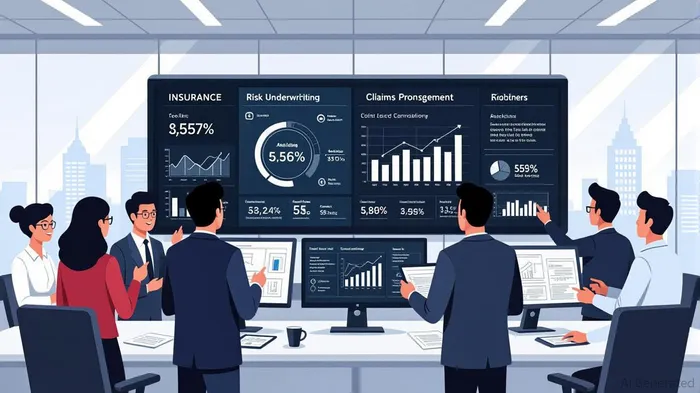
CoreSuite 13.0's AI capabilities are designed to tackle three critical inefficiencies in P&C insurance: lack of underwriting visibility, integration complexity, and slow risk evaluation[1]. The platform's enhanced underwriting workflows leverage AI for data and document summarization, enabling real-time visibility into workloads via a configurable dashboard[2]. This addresses a key industry challenge: underwriters often struggle with fragmented data and manual processes, which delay quote generation and increase operational costs. According to a report by LeewayHertz, AI can augment underwriters to process up to five times more submissions while maintaining quality, with automation reducing manual data entry by up to 80%[3]. Sapiens' solution not only accelerates underwriting but also reduces human error, a critical factor in maintaining profitability in a highly competitive market.
The claims component of CoreSuite 13.0 further underscores Sapiens' focus on operational agility. Enhanced integration flexibility and cost management tools allow insurers to adapt quickly to regulatory changes and market demands[1]. In the broader industry, AI-driven claims processing has already demonstrated significant ROI, with automation reducing processing times by up to 30% and error rates to near zero[4]. For example, AI-powered computer vision tools can analyze accident site images to generate instant claims estimates, while predictive analytics flag potential fraud[3]. Sapiens' upgrades position its platform as a scalable solution for insurers seeking to balance speed with compliance.
AI-Enabled ROI: From Cost Savings to Strategic Growth
The financial implications of AI adoption in P&C insurance are profound. Industry data suggests that AI-driven SaaS platforms can reduce claims processing costs by up to 20% and improve processing speed by 50%[5]. For Sapiens, CoreSuite 13.0's enhancements in billing and policy management—such as streamlined payable statement creation and advanced policy filters—directly contribute to these efficiency gains[2]. These features align with broader trends: a 2025 PwC report notes that nearly half of technology leaders have fully integrated AI into their core strategies, citing productivity and innovation as key drivers[6].
Beyond cost savings, AI is reshaping revenue generation. By enabling personalized policy offerings through data from IoT devices and wearables, Sapiens' platform supports insurers in capturing niche markets and improving customer retention[3]. For instance, one insurer using custom AI solutions reported a 26 percentage-point increase in retention and a 5x boost in sales funnel growth[7]. While Sapiens has not disclosed specific customer metrics for CoreSuite 13.0, its focus on scalable, modular AI tools suggests a platform capable of delivering similar results.
Competitive Positioning: Sapiens in the AI-Driven SaaS Landscape
Sapiens' CoreSuite 13.0 distinguishes itself through a combination of industry-specific expertise and next-gen SaaS architecture[1]. Competitors like GuidewireGWRE-- and Duck Creek Technologies have also invested heavily in AI, but Sapiens' emphasis on real-time analytics and integration flexibility offers a unique value proposition. For example, CoreSuite 13.0's configurable dashboard provides granular visibility into underwriting workflows—a feature that directly addresses the operational blind spots many insurers face[2]. This aligns with industry demand for platforms that balance automation with human oversight, a critical consideration given the regulatory complexity of insurance operations[3].
Moreover, Sapiens' ability to rapidly iterate based on customer feedback—evident in CoreSuite 13.0's development—positions it as a nimble competitor in a fragmented market[1]. While larger players may struggle with legacy systems, Sapiens' modern SaaS model allows for faster deployment of AI-driven updates, ensuring insurers can keep pace with evolving market dynamics.
Challenges and the Road Ahead
Despite its strengths, Sapiens faces hurdles. The lack of publicly available case studies or customer testimonials for CoreSuite 13.0 limits transparency around its real-world impact. Additionally, the insurance SaaS market remains highly competitive, with regional players tailoring solutions to local regulations and workflows[1]. Sapiens must also navigate the broader challenge of AI adoption: balancing automation with the need for human judgment in high-stakes decisions like risk assessment and claims adjudication[3].
However, the industry's trajectory is clear. A 2025 WhatFix report highlights that 67% of insurance executives believe AI will significantly reshape the sector within three years[7]. As vertical AI tools become more sophisticated—redefining sales engagement, fraud detection, and customer service—platforms like CoreSuite 13.0 will be pivotal in enabling insurers to stay ahead of the curve.
Conclusion
Sapiens' CoreSuite 13.0 represents a bold step forward in the AI-driven evolution of P&C insurance SaaS. By embedding AI into core workflows, the platform addresses critical inefficiencies while aligning with industry-wide shifts toward automation and data-centric operations. For investors, the key question is whether Sapiens can translate these technological advancements into measurable ROI for its clients—and by extension, its own financial performance. Given the broader market's embrace of AI and the platform's focus on scalability and integration, the answer appears increasingly affirmative.





Comentarios
Aún no hay comentarios