
Santander's 40 Billion Euro Credit Risk Offload: Strategic Implications for European Banking Stocks
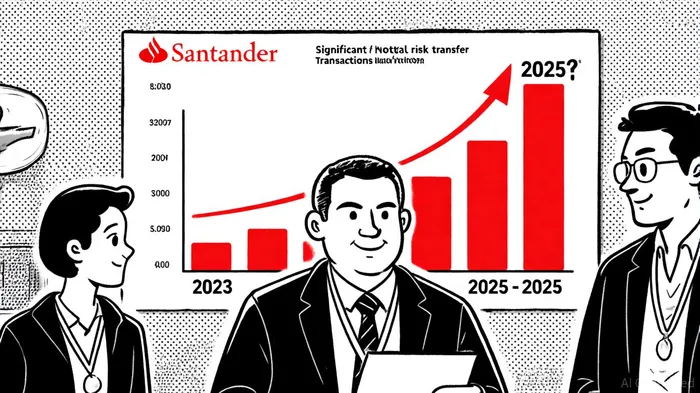
Banco Santander's €40–45 billion credit risk offload in 2026 represents a pivotal shift in European banking strategy, leveraging significant risk transfers (SRTs) to optimize capital efficiency and reshape lending dynamics. By transferring 5–15% of credit risk to investors—such as pension funds and hedge funds—Santander retains ownership of underlying assets while freeing up capital for growth[1]. This move aligns with its broader “capital-light” model, which prioritizes fee-based revenue over asset-heavy lending[3]. The implications extend beyond SantanderSAN--, signaling a sector-wide recalibration under Basel III regulations and creating opportunities for undervalued European banking stocks.
Regulatory Tailwinds and SRT Innovation
The European banking sector is navigating a transformed regulatory landscape post-Basel III. The EU's implementation of Basel III in 2025, including the output floor and standardized risk-weighted asset (RWA) calculations, has forced banks to seek alternative capital relief tools[4]. Santander's SRTs exemplify this trend, with transactions tied to Portuguese and Spanish mortgages, Latin American loans, and UK/Norwegian auto portfolios[1]. These structures allow Santander to reduce its RWA burden while maintaining client relationships—a critical advantage in a competitive lending environment.
The UK's delayed Basel III adoption until 2027 has further diversified the regulatory playing field. While the EU enforces strict STS (simple, transparent, and standardised) compliance for SRTs, the UK's openness to unfunded credit protection mirrors EU practices, fostering cross-border innovation[4]. Santander's recent €460 million Spanish mortgage deal with Goldman Sachs underscores the growing appetite for SRTs among institutional investors, who now provide €3 billion in notional protection annually[2].
Capital Efficiency and CET1 Resilience
Santander's risk offload directly enhances its Common Equity Tier 1 (CET1) ratio by reducing RWA. For every €1 of RWA shed, the bank's capital requirements decrease, allowing it to allocate resources to higher-return activities. As of Q3 2024, Santander's CET1 ratio stood at 12.5%, up from 12.3% in 2023, reflecting the success of its SRT strategy[5]. Broader sector data reveals that European banks' average CET1 ratio reached 16.1% in Q4 2024, a record high driven by similar risk-transfer initiatives[6].
The ripple effect on lending dynamics is equally significant. By freeing up capital, Santander can expand its loan book without breaching regulatory thresholds. This aligns with the ECB's stress test findings, which showed European banks maintaining strong CET1 ratios even under adverse scenarios[7]. For Santander, this means sustaining its 13% year-on-year profit growth in H1 2025 while mitigating credit risk exposure[3].
Undervalued Opportunities in the Post-Basel III Era
The SRT-driven capital efficiency race has created fertile ground for undervalued European banking stocks. HSBC, for instance, trades at a forward P/E of 7.4x and offers a 7.2% dividend yield in 2025, supported by its robust capital position and global diversification[8]. Barclays, with a projected 4.2% yield and a CET1 ratio above 12%, is another standout, leveraging its UK-focused portfolio to navigate delayed Basel III reforms[9].
Smaller banks like Intesa Sanpaolo and ING also present compelling cases. Intesa's 14.9% median CET1 ratio and aggressive share buybacks (€3 billion in 2025) position it to capitalize on Italian market consolidation[8]. ING's digital transformation and strong NIM (2.10% in March 2025) further insulate it from rate volatility[10]. These stocks trade at discounts to their long-term valuations, offering asymmetric upside as SRT adoption accelerates.
Conclusion: Rebalancing the European Financials Portfolio
Santander's €40 billion risk offload is not an isolated maneuver but a harbinger of sector-wide change. As Basel III tightens capital constraints, SRTs will become a cornerstone of European banking strategy, enabling institutions to balance regulatory compliance with growth. For investors, this creates a dual opportunity: (1) capitalizing on Santander's capital-light model and (2) identifying undervalued peers poised to replicate its success.
The data is clear: European banks are entering a new era of capital efficiency, with CET1 ratios and RWA management at the forefront. By aligning with this trend, investors can position themselves to benefit from both near-term risk offloads and long-term structural reforms.





Comentarios
Aún no hay comentarios