
Santander's 2026 Credit Risk Reduction Strategy: Implications for Asset Quality and Capital Efficiency in European Banking
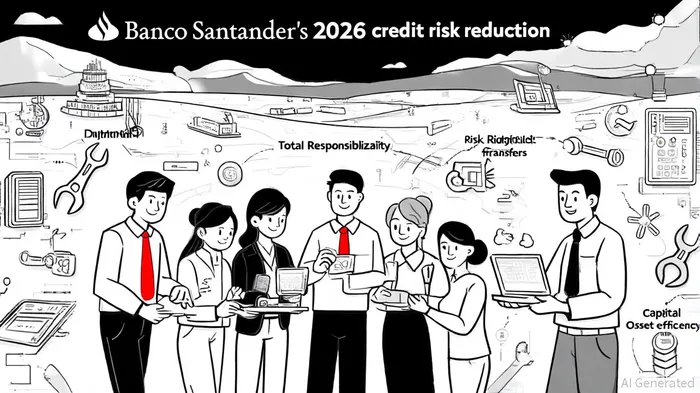
Banco Santander's 2026 credit risk reduction strategy is poised to redefine risk management paradigms in European banking, with profound implications for asset quality and capital efficiency. By targeting a reduction of €40 billion to €45 billion in credit risk through risk-weighted asset transfers and capital-relief tools like significant risk transfers (SRTs), the bank is aligning its risk profile with evolving regulatory expectations and market demands [1]. This strategic pivot not only strengthens Santander's solvency ratios but also positions it to allocate capital more dynamically toward growth opportunities.
Digital Transformation as a Catalyst for Risk Mitigation
At the core of Santander's strategy is Total Digitalization, which leverages artificial intelligence, machine learning, and open APIs to streamline operations and enhance decision-making. The bank's adoption of the FICO® Platform, for instance, has modernized credit risk assessment by enabling real-time portfolio monitoring and predictive analytics [2]. This digital-first approach reduces operational friction while improving the accuracy of risk assessments, particularly in high-growth segments like auto lending. According to a report by FICO, these advancements have already contributed to improved loan quality in key markets, a trend expected to accelerate through 2026 [2].
ESG Integration and Long-Term Resilience
Santander's Total Responsibility pillar reinforces its commitment to ethical and sustainable practices, which indirectly bolsters asset quality. By embedding environmental, social, and governance (ESG) considerations into its operations, the bank mitigates reputational and compliance-related risks while aligning with global sustainability goals [4]. Fitch Ratings has highlighted that Santander's robust credit risk framework—encompassing ESG metrics—has already driven improvements in loan quality, particularly in markets with stringent regulatory environments [3]. This alignment with ESG standards not only enhances stakeholder trust but also ensures regulatory preparedness in an era of tightening compliance requirements.
Capital Efficiency and Strategic Agility
The projected reduction in risk-weighted assets through SRTs will free up capital for strategic reinvestment, directly enhancing capital efficiency. By transferring risk exposure in portfolios such as Portuguese and Spanish residential mortgages, SantanderSAN-- can maintain a leaner balance sheet while preserving liquidity [1]. This approach mirrors broader European regulatory efforts to revitalize securitization markets, which aim to channel capital toward critical sectors like housing and energy [1]. For investors, this signals a bank that is both agile and forward-looking, capable of navigating macroeconomic volatility without compromising long-term growth.
Conclusion: A Blueprint for European Banking
Santander's 2026 strategy exemplifies how a holistic approach—combining technological innovation, ESG integration, and regulatory alignment—can optimize asset quality and capital efficiency. By reducing credit risk through SRTs and digital tools, the bank is not only strengthening its financial resilience but also setting a benchmark for peers in the European banking sector. As the industry grapples with post-pandemic challenges and evolving regulatory landscapes, Santander's model offers a compelling roadmap for sustainable growth.





Comentarios
Aún no hay comentarios