
The Santa Claus Rally's Third Consecutive Failure: A Harbinger of Market Reset and Strategic Reallocation
The Santa Claus Rally, a historically reliable seasonal market phenomenon, has faltered for the third consecutive year (2023–2025), signaling a broader shift in investor behavior and market dynamics. Traditionally, the S&P 500 has gained an average of 1.3% during the seven-day window spanning the last five trading days of December and the first two of January, with positive returns in 79% of years since 1950. However, the 2024 rally saw a 2.4% decline in the S&P 500, marking the first such failure since 2015. The 2025 rally, while supported by cooling inflation and robust corporate earnings, remains fragile amid macroeconomic uncertainty. This pattern of consecutive failures-unprecedented in modern market history-suggests a structural market reset, driven by defensive positioning and sector rotation in response to evolving economic and technological realities.
The 2024–2025 Failures: A Confluence of Macroeconomic and Policy Factors
The 2024 Santa Claus Rally's collapse was fueled by a combination of hawkish Federal Reserve signals, rising bond yields, and persistent inflationary concerns according to market analysis. Investors flocked to fixed-income assets, which offered more attractive returns than equities amid policy uncertainty. By 2025, while the Fed initiated rate cuts, the market's optimism was tempered by the "hawkish cut" narrative, which left future policy guidance ambiguous. Additionally, global liquidity conditions, including Japan's fiscal stimulus and yen carry trades, provided only partial support for U.S. equities.
The 2025 rally's fragility reflects a broader tension between easing monetary policy and lingering macroeconomic risks. For instance, the S&P 500's performance near all-time highs in early December 2025 was undermined by volatility in AI-driven sectors, which had previously fueled market euphoria. This volatility underscores a critical shift: investors are no longer prioritizing speculative growth narratives over fundamentals.
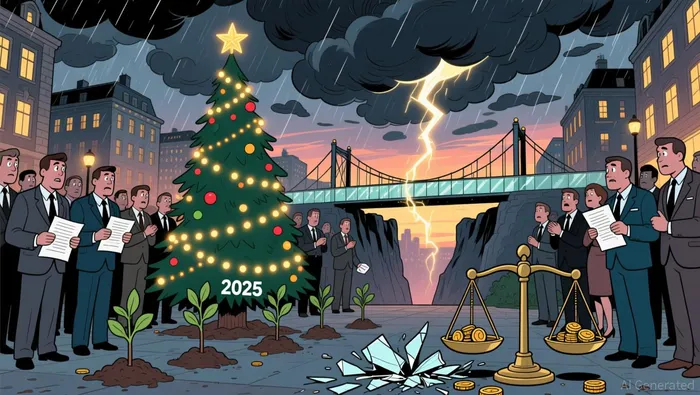 .
.
Post-AI Euphoria: A Great Rotation Toward Defensive Sectors
The AI-driven market boom of 2024–2025 has given way to a recalibration of capital flows. As skepticism grew over the return on investment (ROI) of massive AI infrastructure spending, investors began rotating out of high-flying tech stocks and into sectors with stronger earnings visibility and defensive characteristics according to market analysis. This "Great Rotation" was catalyzed by earnings reports from hyperscalers like Microsoft and Nvidia, which revealed multi-billion-dollar AI-related losses.
Defensive sectors such as consumer staples, healthcare, and financial services emerged as beneficiaries. For example, JPMorgan Chase and Eli Lilly saw significant inflows as investors sought stability amid AI-driven uncertainty according to market reports. The One Big Beautiful Bill Act (OBBBA) of 2025 further accelerated this shift by offering corporate tax cuts and bonus depreciation incentives, making capital-intensive and defensive sectors more attractive.
Strategic Reallocation: Earnings Realism and Structural Shifts
The market's pivot to defensive positioning is not merely a short-term correction but a structural realignment. Investors are now prioritizing companies with strong moats, dividend yields, and regulated returns-traits historically associated with sectors like utilities and manufacturing according to Deloitte analysis. This trend is reinforced by a broader move toward "earnings realism," where companies integrating AI for operational efficiency (rather than speculative growth) are gaining favor according to Seeking Alpha.
Moreover, the Q4 2025 earnings season will be a critical test for AI-driven firms. If these companies fail to demonstrate tangible returns on their capital expenditures, the rotation into defensive sectors is likely to intensify. Meanwhile, value-oriented strategies-such as investments in small-cap stocks, non-U.S. markets, and cyclical sectors-are gaining traction as investors seek diversified, sustainable growth according to Schwab analysis.
Implications for 2026 and Beyond
The Santa Claus Rally's consecutive failures highlight a pivotal moment in market evolution. While historical correlations between a strong Santa Rally and subsequent market performance remain relevant, the 2023–2025 exceptions demonstrate that seasonal patterns are increasingly influenced by broader economic and policy environments. For 2026, the focus will shift to whether the market can sustain its rotation into defensive sectors while balancing the long-term infrastructure demands of AI development according to market forecasts.
Investors must also contend with the K-shaped recovery, where divergent sector performances underscore the need for strategic diversification. Defensive positioning and sector rotation are no longer optional-they are essential tools for navigating a post-AI euphoria landscape defined by earnings discipline and macroeconomic recalibration according to Deloitte analysis.
Conclusion
The Santa Claus Rally's third consecutive failure is not an anomaly but a harbinger of a broader market reset. As AI-driven euphoria gives way to earnings realism, investors are reorienting their strategies toward defensive positioning and sector rotation. This shift reflects a maturing market that prioritizes fundamentals over speculative narratives, signaling a return to disciplined, long-term investing. For those navigating this new paradigm, the lessons of 2024–2025 are clear: adaptability, diversification, and a focus on sustainable growth will be the cornerstones of success in the years ahead.







Comentarios
Aún no hay comentarios