
The Santa Claus Rally and 2026 Market Outlook: A Bullish Omen or a Fleeting Reprieve?
The Santa Claus Rally, a seasonal market phenomenon observed during the year-end holiday period, has long captivated investors seeking clues about the trajectory of the new year. Defined as the performance of the S&P 500 over the last five trading days of December and the first two trading days of January, this rally has historically delivered an average return of 1.3% since 1950, with positive outcomes occurring 78% of the time-far outpacing the typical seven-day average of 0.3% and a 58% positivity rate according to research. As 2025 draws to a close, the question looms: Does a strong December rally signal a bullish 2026, or is it merely a temporary reprieve in a market still grappling with macroeconomic headwinds?
Historical Precedent and the January Barometer
The Santa Claus Rally's predictive power is often tied to the January Barometer, a concept introduced by Yale Hirsch in 1972. This theory posits that January's market performance can forecast the direction of the entire year. Data supports this link: When the S&P 500 gains in January, full-year returns have been positive 82% of the time, while losses in January correlate with negative annual returns 54% of the time. For example, the 2008 and 2009 rallies, though modest, preceded the broader recovery during the financial crisis, illustrating how seasonal patterns can align with long-term trends according to Investopedia.
However, post-2000 studies have cast some doubt on the statistical significance of these patterns. While global markets have shown higher returns during the Santa Claus Rally period, the January effect (a related phenomenon where institutional investors reinvest cash in early January) may partially explain these gains according to Nasdaq. This suggests that the rally's predictive value is not absolute but rather a probabilistic indicator that must be contextualized with broader market fundamentals. 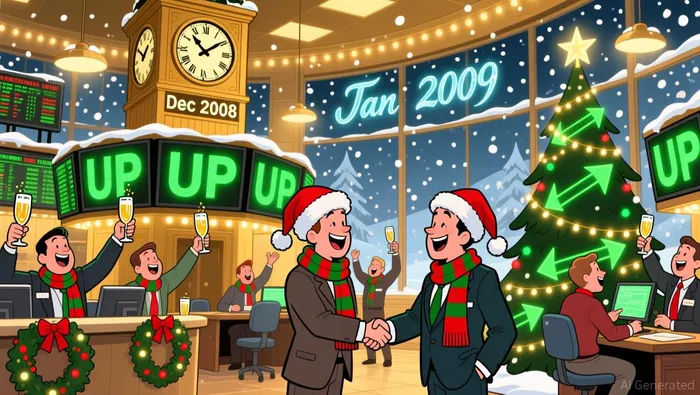
2025's Unique Context: A Test for the Rally's Relevance
The current economic landscape presents a mixed picture. Inflation has moderated from its 2022 peak, but central banks remain cautious, with the Federal Reserve signaling potential rate cuts in early 2026. Corporate earnings, meanwhile, show resilience in sectors like technology and renewable energy, yet concerns persist about a potential slowdown in consumer spending according to research. Against this backdrop, a robust Santa Claus Rally in December 2025 could reflect optimism about these rate cuts and sectoral strength.
Yet, as noted by financial analysts, such rallies can also be driven by short-term factors, such as year-end portfolio rebalancing or retail investor enthusiasm, rather than fundamental improvements according to Investopedia. For instance, the 2021 rally occurred amid a surge in meme stocks and speculative trading, which did not translate into sustained growth for the broader market. This raises the question: Is the rally a reflection of genuine confidence in 2026's prospects, or a fleeting surge fueled by liquidity and sentiment?
Balancing Technical Indicators and Fundamentals
To assess whether the Santa Claus Rally signals a bull year, investors must weigh technical indicators against macroeconomic realities. Historically, the rally's success has been more reliable in environments of low volatility and stable interest rates. Today, however, the market faces a more complex environment, including geopolitical tensions and potential shifts in monetary policy.
Academic research underscores this nuance. A 2015 study found that while the Santa Claus Rally's returns were statistically significant, their predictive power diminished in periods of high market uncertainty. Similarly, Invesco's analysis highlights that the January Barometer's accuracy declines when economic data is mixed, as it is today. This suggests that while the rally may offer a useful starting point, it should not be viewed in isolation.
Conclusion: A Signal, Not a Guarantee
The Santa Claus Rally remains a compelling barometer of market sentiment, but its ability to predict a full-year bull market is not infallible. For 2026, a strong December rally could indicate optimism about rate cuts and sectoral growth, particularly in technology and energy. However, investors must remain vigilant about macroeconomic risks, such as a potential recession or prolonged inflationary pressures.
As the market approaches year-end, the rally's performance will serve as a valuable data point-but not the definitive answer. A balanced approach, combining seasonal patterns with rigorous fundamental analysis, will be critical for navigating the uncertainties of 2026.







Comentarios
Aún no hay comentarios