
SanDisk's Volatility Amid Escalating US-China Trade Tensions: A Strategic Reassessment
The global technology sector remains a battleground for geopolitical tensions, with SanDisk's post-spin-off trajectory offering a case study in navigating supply chain volatility. As U.S.-China trade dynamics intensify, SanDisk's strategic realignment-coupled with its technological innovations-positions it at a crossroads of risk and opportunity. This analysis examines how SanDisk's operational and technological choices intersect with broader geopolitical forces, and what this means for investors.
Strategic Reassessment: From Spin-Off to Specialization
SanDisk's separation from Western DigitalWDC-- in February 2025 marked a pivotal shift. By spinning off its flash division, the company has focused on high-performance storage solutions, leveraging its BiCS8 3D NAND technology with 218 layers and High-Bandwidth Flash (HBF) as a scalable alternative to HBM, according to a TS2 analysis. This specialization aligns with growing demand for AI storage and enterprise workloads, where SanDisk's roadmap-projecting datacenter SSD capacities up to 1PB by 2027-was outlined at the SanDisk investor day.
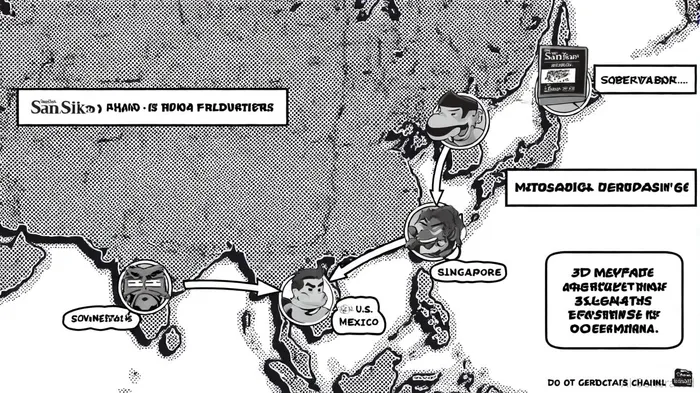
However, the spin-off also necessitated a reevaluation of supply chain resilience. With Western Digital now concentrating on HDDs and SanDiskSNDK-- on flash storage, both companies have optimized their supply chains for core markets, as noted by the TS2 analysis. SanDisk's geographic diversification-shifting final SSD assembly to the U.S. or USMCA countries like Mexico to avoid China-origin tariffs-demonstrates a proactive approach to mitigating trade policy risks, according to a SWOT analysis.
Geopolitical Risks: Tariffs, Technology Transfer, and Rare Earth Constraints
The U.S.-China trade war's 2025 de-escalation, including a temporary reduction of tariffs to 30% and 10% for U.S. and Chinese imports, respectively, has provided short-term relief, the TS2 analysis reported. Yet, the underlying volatility persists. Tariffs have forced companies to stockpile inventory, with shipping rates between Shanghai and the U.S. surging by 42% in early 2025, the SWOT analysis found. For SanDisk, this means navigating a fragmented supply chain landscape, where nearshoring and friend-shoring strategies are critical to reducing exposure to China's tightening control over rare earth materials and magnet exports, as emphasized at the investor day.
Technology transfer restrictions further complicate matters. SanDisk's 3D NAND fabrication occurs outside China, but its Chinese facilities handle testing and packaging. Under U.S. customs rules, this classifies the final product as "China-origin," subjecting it to tariffs, the SWOT analysis notes. The company's shift to U.S. or USMCA-based assembly, while logistically feasible for SSDs, highlights the broader industry challenge of balancing cost efficiency with geopolitical compliance - a theme the investor day also addressed.
Investment Implications: Balancing Risk and Innovation
SanDisk's focus on high-margin enterprise and AI storage segments offers a buffer against cyclical demand fluctuations. By prioritizing premium consumer and enterprise workloads, the company reduces vulnerability to trade-driven market swings, the SWOT analysis argues. However, the long-term viability of this strategy depends on its ability to sustain technological leadership. For instance, its roadmap to 1PB SSDs by 2027 hinges on continued advancements in HBF and 3D NAND scaling, a point reiterated at the investor day.
Investors must also weigh the costs of supply chain realignment. While nearshoring and reshoring enhance resilience, they increase production expenses and could delay time-to-market for new products, a risk highlighted at the investor day. SanDisk's collaboration potential with Kioxia or other flash manufacturers may offset these challenges, but such partnerships remain speculative, as noted in the TS2 analysis.
Conclusion: A Calculated Path Forward
SanDisk's post-spin-off strategy reflects a nuanced response to geopolitical risks. By leveraging advanced technology, diversifying supply chains, and targeting high-margin markets, the company is positioning itself to weather trade tensions. However, the path is not without pitfalls. Rising production costs, regulatory complexities, and the pace of China's self-sufficiency ambitions in semiconductors could test SanDisk's agility. For investors, the key lies in monitoring the company's ability to balance innovation with operational flexibility in an increasingly fragmented global landscape.





Comentarios
Aún no hay comentarios