
How Sanctions Are Reshaping the Role and Volatility of Cryptocurrencies in Geopolitical Conflicts
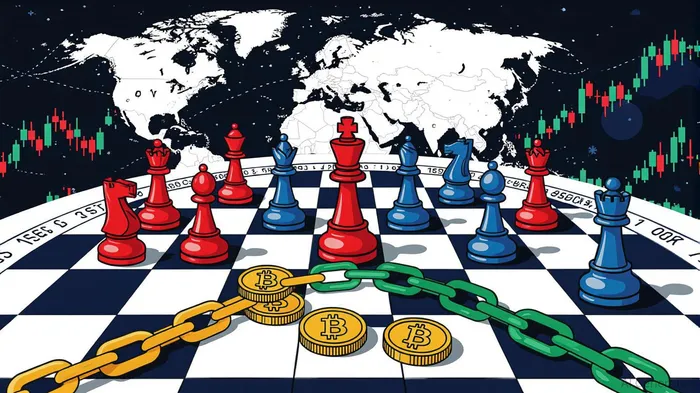
The intersection of geopolitical sanctions and cryptocurrencies has become a defining feature of the post-2022 financial landscape. As nations weaponize economic tools to enforce compliance with international norms, cryptocurrencies—once seen as a decentralized refuge from state control—have paradoxically become both a target and a tool. For crypto investors, this dynamic creates a dual-edged reality: heightened volatility from enforcement actions and emerging opportunities in compliance-focused innovation.
Sanctions as a Regulatory Weapon: Targeting Crypto Infrastructure
Global regulators have increasingly weaponized sanctions to disrupt illicit crypto activity. The U.S. Treasury’s Office of Foreign Assets Control (OFAC) has led this charge, sanctioning entire services rather than individual actors. For example, the 2022 designation of Tornado Cash—a decentralized mixer—highlighted the U.S. government’s ability to weaponize blockchain transparency against privacy tools [2]. Similarly, the disruption of the LockBit ransomware group in 2024 reduced ransomware payments by 79% within a year, demonstrating how enforcement can directly alter criminal incentives [2].
These actions are amplified by blockchain analytics firms like Chainalysis and Elliptic, which now track over 107,000 unique entities behind blockchain addresses [1]. By mapping illicit flows—such as North Korean cybercrime proceeds funneled through the ByBit hack in February 2025—regulators have turned public ledgers into tools of accountability. However, challenges persist: decentralized protocols and privacy coins like Monero remain difficult to trace, creating enforcement gaps [2].
Volatility as a Byproduct of Geopolitical Risk
Cryptocurrencies have become barometers of geopolitical instability. The Russia-Ukraine conflict, for instance, intensified cross-market correlations, with Bitcoin’s 360-day volatility spiking to 38% in 2025 compared to gold’s 17% [3]. Sanctions-driven uncertainty has also skewed transaction patterns: USD-related cross-border payments surged during periods of heightened geopolitical risk, as actors sought to evade scrutiny [2].
Stablecoins, in particular, have emerged as both a vulnerability and an opportunity. Over 80% of illicit crypto transactions in 2023 involved stablecoins, leveraging their borderless nature to circumvent traditional banking systems [2]. Yet this same feature has made them a regulatory priority. The UK’s 2025 stablecoin framework, overseen by the Bank of England, now mandates robust AML/KYC compliance, signaling a shift toward institutionalization [1].
Strategic Opportunities in Compliance-Driven Innovation
For investors, the tightening regulatory environment has created fertile ground for compliance-focused sectors. Blockchain analytics firms have seen surging demand: Chainalysis’s tools are now used by 75% of global law enforcement agencies to trace sanctioned entities [1]. Similarly, regulated stablecoins—subject to prudential oversight in the UK and Hong Kong—are gaining traction as safer alternatives to unregulated counterparts [1].
Investors are also leveraging risk assessment frameworks to quantify geopolitical exposure. Bloomberg’s 2025 geopolitical country-of-risk scores, built with Seerist’s threat intelligence, allow portfolios to map exposure to 29 country-level risks, from cyberattacks to maritime conflicts [2]. Meanwhile, the SEC’s “Project Crypto” initiative—aimed at modernizing securities laws—has clarified regulatory pathways for tokenized assets, reducing uncertainty for institutional investors [1].
Navigating the New Normal: A Risk-First Approach
The key to thriving in this environment lies in adopting a risk-first mindset. Investors must:
1. Prioritize Compliance Tech: Allocate capital to blockchain analytics, AML solutions, and regulated stablecoins.
2. Diversify Geopolitical Exposure: Use tools like Bloomberg’s country-risk scores to avoid overexposure to sanctioned jurisdictions.
3. Monitor Enforcement Trends: Track OFAC designations and regulatory shifts in key markets (e.g., the EU’s MiCA framework).
As sanctions evolve from blunt instruments to precision tools, cryptocurrencies will remain at the center of a tug-of-war between state power and decentralized innovation. For investors, the challenge—and opportunity—lies in balancing the risks of enforcement with the rewards of a maturing, institutionalized crypto ecosystem.
Source:
[1] Cryptocurrency and Sanctions Evasion: Stablecoins, Mixers, and the Role of Blockchain Forensics [https://www.researchgate.net/publication/393687826_Cryptocurrency_and_Sanctions_Evasion_Stablecoins_Mixers_and_the_Role_of_Blockchain_Forensics]
[2] How 2022 Crypto Sanctions Affected Crypto Crime [https://www.chainalysis.com/blog/how-2022-crypto-sanction-designations-affected-crypto-crime/]
[3] Where Is Bessent Pulling These Rate Models From? [https://www.bloomberg.com/opinion/newsletters/2025-08-14/where-is-bessent-pulling-these-rate-models-from]






Comentarios
Aún no hay comentarios