
Samsung's Strategic Position in AI Semiconductor Manufacturing: Nvidia's Quality Endorsement as a Catalyst for Sustained Share Growth
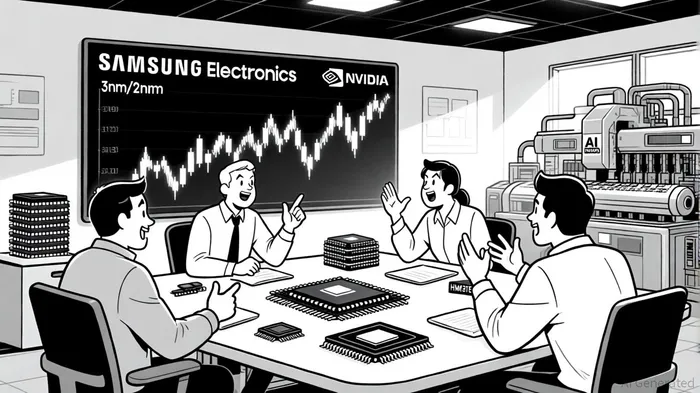
The global semiconductor industry is undergoing a seismic shift as artificial intelligence (AI) reshapes demand for high-performance computing. At the intersection of this transformation lies Samsung Electronics, whose strategic alignment with Nvidia—a leader in AI chip innovation—has positioned it as a critical player in the next phase of semiconductor manufacturing. Recent developments, including Nvidia's public endorsements of Samsung's capabilities and a deepening partnership in high-bandwidth memory (HBM) and advanced node production, suggest that the South Korean tech giant is poised to leverage these dynamics for sustained stock growth.
A Strategic Partnership: Diversification and Innovation
Nvidia's collaboration with Samsung extends beyond mere supply chain logistics. The two companies are jointly advancing AI-focused semiconductor technologies, with Samsung's 3nm and 2nm manufacturing nodes serving as the foundation for next-generation GPUs[1]. This partnership is part of Nvidia's broader strategy to diversify its manufacturing base away from sole reliance on TSMCTSM--, a move driven by geopolitical risks and the need for redundancy in critical AI chip production[1].
A pivotal component of this collaboration is Samsung's HBM3E memory, which is essential for powering Nvidia's high-end GPUs. According to a report by Business Korea, Samsung recently passed Nvidia's rigorous quality tests for its 12-layer HBM3E chips, a milestone that had eluded the company for months[3]. This certification not only secures Samsung's place in Nvidia's supply chain but also signals its ability to compete with SK hynix, which has already begun shipping HBM3E to the U.S. chipmaker[6]. Analysts estimate that Samsung could capture over 50% of Nvidia's HBM orders in the coming months, a significant win in a market where memory demand is projected to grow 30% annually through 2027[2].
Financial Resilience Amid Challenges
Samsung's semiconductor division has faced headwinds in 2025, including a 21% drop in operating profit for Q1 and ongoing losses in its foundry business[4]. However, recent quarterly results highlight a recovery. In Q3 2025, the division reported a 277% surge in operating profit to 9.18 trillion won ($6.65 billion), driven by strong demand for AI and server chips[7]. While this figure fell short of Q2 levels due to inventory adjustments and currency fluctuations, the underlying trend—expanding sales of high-density memory products like HBM3E and DDR5—points to a durable growth trajectory[7].
The partnership with NvidiaNVDA-- is a key differentiator. By securing a stable HBM order pipeline, Samsung can offset weaker demand in traditional memory markets. For instance, DDR4 DRAM prices fell 13% in Q4 2024, exacerbating margin pressures[4]. Nvidia's endorsement, however, provides a counterbalance. As Jensen Huang, Nvidia's CEO, stated at CES 2025, “I have confidence that Samsung will succeed with HBM. I have confidence like tomorrow is Wednesday”[5]. Such statements reinforce investor confidence, particularly as Samsung integrates Nvidia's “Digital Twin” technology to optimize its manufacturing processes and address yield challenges[8].
Quality Endorsement as a Growth Catalyst
Nvidia's public validation of Samsung's capabilities is more than symbolic. In a sector where quality certifications can make or break market access, passing Nvidia's HBM3E audit is a strategic win. As noted by The Korea Joongang Daily, Samsung's HBM3E received “high marks” during an audit, with potential certification as early as June 2025[6]. This development is critical because HBM is a bottleneck in AI chip production, and securing a reliable supplier is a priority for Nvidia as it scales its H100 and B100 GPU lines[2].
Moreover, the collaboration extends to advanced packaging technologies, such as 2.5D and 3D integration, which reduce data transfer bottlenecks and enhance performance[1]. These innovations align with Nvidia's roadmap for exascale computing and AI-driven data centers, further cementing Samsung's role in the ecosystem.
Risks and the Road Ahead
Despite these positives, challenges remain. Samsung lags SK hynix in HBM4 development, and geopolitical tensions could disrupt supply chains. Additionally, the foundry business—crucial for long-term growth—continues to struggle with low utilization rates at mature nodes[7]. However, the company's focus on 8th Generation V-NAND and AI-specific product lines suggests a clear strategy to regain momentum[7].
For investors, the key takeaway is that Nvidia's endorsement acts as a catalyst. By securing a critical role in the AI semiconductor supply chain, Samsung is transforming from a cost-competitive manufacturer into a strategic partner for cutting-edge innovation. This shift is reflected in its stock performance: shares have risen 18% year-to-date, outpacing broader tech indices[9].
Conclusion
Samsung's strategic position in AI semiconductor manufacturing is no longer a theoretical possibility but a tangible reality. Through its collaboration with Nvidia, the company is addressing its historical weaknesses in HBM and advanced packaging while leveraging its manufacturing scale to meet surging AI demand. As Jensen Huang's public praise and recent quality certifications demonstrate, Nvidia's endorsement is not just a vote of confidence—it's a catalyst for sustained share growth in a market where AI dominance is the new currency.





Comentarios
Aún no hay comentarios