
Samsung Electronics' Q3 Profit and Sales Surge: A Strategic Play in the AI Semiconductor Arms Race
Samsung Electronics' Q3 2023 financial results marked a pivotal moment in its journey to reclaim semiconductor leadership. With a 12% quarterly revenue increase to KRW 67.40 trillion and an operating profit of KRW 2.43 trillion, the company demonstrated resilience, according to Samsung's Q3 results. This surge was driven by strong demand for flagship mobile devices and premium displays, but the real story lies beneath the surface: Samsung's strategic pivot toward AI-driven semiconductors and advanced manufacturing technologies.
Competitive Positioning: Closing the Gap in Foundry and AI Chips
While TSMCTSM-- dominates the global semiconductor foundry market with a 64.9% share in Q3 2024, Samsung's 9.3% share reflects its aggressive push to bridge the gap (Samsung's Q3 results). The company's recent advancements in gate-all-around (GAA) technology for 3nm chips and its roadmap for 2nm production by Q4 2025, as described in a TrendForce report, position it as a credible challenger. Unlike TSMC's FinFET-based 3nm process, Samsung's GAA architecture promises superior power efficiency-a critical differentiator for AI workloads.
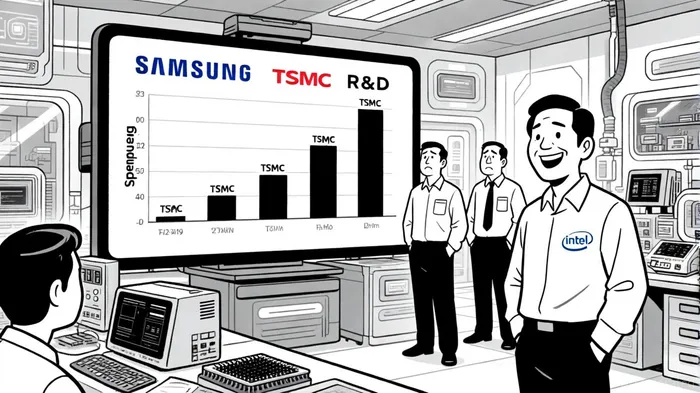
Samsung's R&D investments underscore this ambition. In 2024, the company allocated $9.5 billion to semiconductor R&D, a 71.3% surge from 2023, according to UST analysis, outpacing TSMC's $6.36 billion and trailing only IntelINTC-- ($16.55 billion) and NvidiaNVDA-- ($12.5 billion). This spending elevated Samsung to third in global semiconductor R&D rankings (UST analysis), with a focus on high-bandwidth memory (HBM) and custom AI chips. Notably, Samsung's 11.7% R&D-to-revenue ratio-higher than TSMC's 8.8%-signals a long-term commitment to innovation (UST analysis).
AI Semiconductor Growth: A $232 Billion Opportunity
The AI semiconductor market is projected to grow from $56.42 billion in 2024 to $232.85 billion by 2034, expanding at a 15.23% CAGR, according to Precedence Research. Samsung's strategic bets align with this trajectory. Its $24.09 billion R&D investment in 2024, detailed in a TechStory report, includes developing AI chips optimized for large language models and on-device AI, supported by a new Advanced Processor Lab in Silicon Valley and a state-of-the-art R&D complex in South Korea. These initiatives aim to capture market share in HBM-a segment expected to grow at a 21.7% CAGR through 2028 (Precedence Research).
However, challenges persist. TSMC's dominance in advanced packaging (e.g., CoWoS) and Intel's IDM 2.0 strategy pose stiff competition. Samsung's 2nm process, while promising, faces yield rate hurdles compared to TSMC's mature 3nm node (a TrendForce report). Additionally, geopolitical tensions, such as U.S.-China trade restrictions and TSMC's suspension of Huawei shipments, have been noted by Allied Market Research and could disrupt supply chains.
Long-Term Growth: Capital Expenditures and Strategic Alliances
Samsung's Q3 2023 capex of KRW 11.4 trillion-part of a full-year plan totaling KRW 53.7 trillion (Samsung's Q3 results)-highlights its readiness to scale production for HBM and advanced nodes. This aligns with the AI semiconductor boom, where HBM demand is expected to double from $15.2 billion in 2024 to $32.6 billion by 2026 (Precedence Research). The company's $45 billion Texas expansion, reported by Allied Market Research, further underscores its commitment to securing domestic manufacturing capacity, mirroring Intel's $20 billion Ohio investment (Allied Market Research).
Conclusion: A Calculated Bet on the Future
Samsung's Q3 performance and strategic investments position it as a formidable player in the AI semiconductor race. While TSMC's foundry dominance and Intel's R&D firepower remain challenges, Samsung's focus on GAA, HBM, and AI-specific silicon offers a compelling value proposition. For investors, the key risks lie in yield rates, geopolitical headwinds, and execution against ambitious timelines. However, the company's 71.3% R&D increase (UST analysis) and aggressive capex plans (Samsung's Q3 results) suggest a long-term vision that could pay dividends as AI adoption accelerates.





Comentarios
Aún no hay comentarios