
Samsung's AI Home Gambit in India: A Strategic Bet on Emerging Markets
The global AI race is no longer confined to Silicon Valley or Shenzhen. Emerging markets, particularly India, are becoming battlegrounds for tech giants seeking to capitalize on a seismic shift in consumer behavior and infrastructure. Samsung's recent foray into India's AI home market, under its “AI Home: Future Living, Now” initiative, is a masterstroke in this context. By leveraging India's surging AI adoption rates and aligning with government-led digital transformation, Samsung is positioning itself to dominate a sector poised for explosive growth.
The AI Home Vision: A Tailored Approach for India
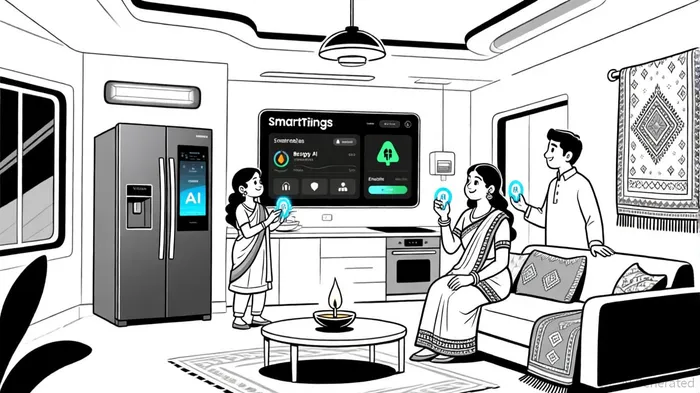
Samsung's strategy in India is not a one-size-fits-all playbook. The company has tailored its AI Home ecosystem to address local pain points, such as energy efficiency and security, while embedding itself into the fabric of Indian households. At the core of this vision is the SmartThings platform, which integrates Galaxy AI, Vision AI, and Bespoke AI to create a seamless, personalized experience. For instance, SmartThings Energy claims to reduce washing machine energy consumption by 70%, a feature that resonates in a country where power outages and rising electricity costs are persistent challenges [1].
Security, another critical concern, is addressed through Knox Vault and Knox Matrix, which offer hardware-level data protection and blockchain-based security. These features are particularly relevant in India, where digital privacy concerns are growing alongside adoption [1]. Samsung's three R&D centers in India are further refining these technologies to suit local preferences, such as multilingual voice recognition and culturally relevant smart home scenarios [1].
India's AI Boom: A Market Ready for Disruption
Samsung's timing is impeccable. India's AI adoption rate hit 30% in 2025, outpacing the global average of 26% [2]. By 2027, the AI market is projected to grow at a compound annual growth rate (CAGR) of 25-35%, reaching $6.4 billion [3]. This surge is fueled by government initiatives like the National Strategy for AI (AIM) and the IndiaAI mission, which aim to integrate AI into sectors ranging from healthcare to agriculture [3].
The economic stakes are high. AI is expected to contribute 20% to India's GDP by 2025 [3], with generative AI (GenAI) already capturing the attention of 76% of Indian enterprises through proofs of concept or investment plans [4]. By 2025, 40% of services engagements in India will include GenAI-enabled delivery, signaling a structural shift in how businesses operate [4]. Samsung's AI Home ecosystem, with its focus on automation and personalization, is uniquely positioned to benefit from this transformation.
Emerging Markets as the New AI Frontier
India is not an outlier. Emerging markets are collectively outpacing developed economies in AI adoption. China, for example, has a 37% annual growth rate in AI implementation, driven by its dominance in sectors like manufacturing and healthcare [5]. Globally, AI adoption has surged from 20% in 2017 to 78% in 2024, with emerging economies accounting for the most aggressive integration [5].
Samsung's India strategy is part of a broader playbook to tap into this trend. The company's “Make in India” and “Digital India” alignment ensures local manufacturing and regulatory compliance, reducing costs and fostering trust. This approach mirrors its success in other emerging markets, where localized innovation has driven growth.
Risks and Realities
Despite the optimism, challenges persist. India's digital infrastructure remains uneven, with rural areas lagging in internet access and smart device penetration. Additionally, the AI talent pool, while growing at 25% CAGR, still faces a skills gap in specialized areas like GenAI [3]. Samsung must navigate these hurdles while competing with local players like Micromax and global rivals like Google and Amazon.
However, the rewards outweigh the risks. With AI projected to unlock $50-55 billion in value for India's financial services sector alone by 2035 [3], Samsung's early mover advantage could translate into long-term dominance. The company's R&D investments in India are not just about product development but also about building an ecosystem of partners and developers, ensuring sustained relevance.
Conclusion: A High-Stakes Bet with High Rewards
Samsung's AI Home initiative in India is more than a product launch—it's a strategic bet on the future of living in emerging markets. By aligning with India's AI-driven economic ambitions and addressing local needs, Samsung is not only capturing market share but also shaping the definition of a “smart home” in a country of 1.4 billion people. For investors, this represents a compelling opportunity to ride the wave of AI adoption in a market where the potential is as vast as the population itself.







Comentarios
Aún no hay comentarios