
Sam Bankman-Fried's Social Media Surge: Catalyst or Cracks in Crypto's Foundation?
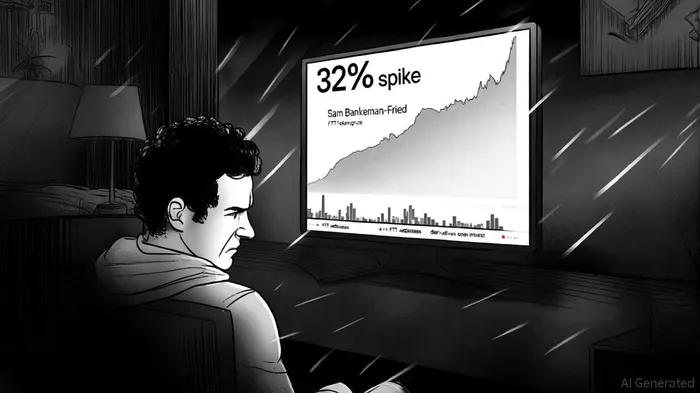
In September 2025, Sam Bankman-Fried (SBF) sent shockwaves through the crypto market with a single tweet. While serving a 25-year prison sentence for orchestrating the FTX collapse, SBF posted “gm” (a crypto community greeting) from his verified X account. The result? A 32% surge in the FTTFTT-- token's price within hours, with trading volume spiking sixfold to $59 million[2]. This event, while brief, exposed the fragile interplay between celebrity influence, speculative behavior, and trust in crypto markets—a dynamic that has defined the industry since its inception.
The SBF Effect: From FUD to FOMO
SBF's tweet triggered a classic “FOMO” (fear of missing out) reaction among traders, despite the token's intrinsic value being tied to a now-bankrupt exchange. Active FTT token addresses jumped to 201 in a single day, far exceeding the monthly average of 56[1]. Derivatives markets saw FTT's open interest rise 65% to a two-month high[2], reflecting a mix of optimism and opportunism. Yet this enthusiasm was short-lived; the token settled at $1.014 by the following day, a far cry from its pre-FTX collapse valuation.
This volatility underscores a critical psychological truth: crypto markets remain deeply influenced by narratives, even when those narratives are detached from fundamentals. SBF's reemergence, while legally and ethically fraught, tapped into a residual fascination with FTX's story—a narrative that has shifted from “FUD” (fear, uncertainty, doubt) to speculative FOMO[2].
Historical Parallels: Musk, Buterin, and the Power of Persona
SBF's impact, though extreme, is not unique. Elon Musk's social media activity has long driven crypto volatility. His 2021 tweets about Bitcoin's environmental impact caused a 20% price drop in a single day[4], while his playful promotion of Dogecoin—labeling himself the “Dogefather”—spurred a 10,000% surge in its value[2]. Similarly, Vitalik Buterin's advocacy for Ethereum's proof-of-stake transition and Layer-2 scalability solutions has shaped long-term investor confidence in the platform's technical viability[5].
However, SBF's case diverges sharply. Unlike Musk or Buterin, whose influence is tied to active projects (Tesla, Ethereum), SBF's power now stems from the lingering trauma of FTX's collapse. Academic research confirms that the FTX event caused a “trust shock,” increasing intraday volatility across major cryptocurrencies and stablecoins[1]. SBF's tweet, rather than restoring trust, highlighted its fragility.
Strategic Implications: Catalyst or Cracks?
The FTT price spike raises a critical question: Is SBF's reemergence a catalyst for broader market recovery, or a symptom of deeper instability?
Catalyst Argument:
- Speculative Momentum: High-profile figures like SBF, Musk, and Buterin demonstrate that crypto markets are still driven by narrative and sentiment. SBF's tweet reignited interest in FTX-related assets, including the FTX Recovery Trust's $1.6 billion creditor repayment plan[2]. This suggests that even in a post-FTX world, speculative demand for “crypto nostalgia” persists.
- Institutional Caution: Unlike retail traders, institutional investors are unlikely to be swayed by SBF's antics. The broader market's focus on regulatory clarity and decentralized governance (e.g., Ethereum's upgrades) indicates a shift toward long-term stability[5].
Instability Argument:
- Erosion of Trust: SBF's actions reinforce the perception that crypto leadership is prone to hubris and mismanagement. His failure to maintain clear boundaries between FTX and Alameda Research—exacerbated by weak mental accounting and overconfidence[3]—has left a lasting scar on investor psychology.
- Regulatory Risks: The FTX collapse triggered a wave of regulatory scrutiny, with the FTX Recovery Trust now pursuing $1.1 billion in legal claims[2]. SBF's social media activity risks reigniting regulatory backlash, particularly if perceived as a PR stunt to rehabilitate his image[4].
Investment Strategies: Navigating the Narrative
For investors, the key lies in distinguishing between short-term noise and long-term value. Here's how to approach the current landscape:
- Short-Term Playbook:
- Speculative Bets: For risk-tolerant traders, FTT and other FTX-related assets may offer high-reward opportunities during liquidation events. However, these positions require strict stop-loss measures given their volatility[2].
Derivatives Hedging: Use options or futures to hedge against sudden swings in tokens tied to high-profile narratives (e.g., FTT, DOGE).
Long-Term Strategy:
- Focus on Fundamentals: Prioritize projects with clear technical upgrades and institutional adoption, such as Ethereum's Layer-2 solutions or BitcoinBTC-- ETFs[5].
Diversify Exposure: Avoid overconcentration in tokens or projects linked to individual personalities. The FTX collapse serves as a stark reminder of the risks of centralized leadership[1].
Sentiment Monitoring:
- Track social media sentiment and on-chain metrics (e.g., active addresses, open interest) to identify speculative bubbles. Tools like Coindesk's market analysis[1] and Ambcrypto's sentiment tracking[2] can provide early warnings.
Conclusion: The Double-Edged Sword of Influence
SBF's “gm” tweet is a microcosm of crypto's paradox: a market where trust is both the foundation and the weakest link. While high-profile figures can drive short-term momentum, their influence often masks deeper structural issues. For investors, the lesson is clear: narratives matter, but they must be balanced with rigorous due diligence. In a space where “gm” can still move markets, the real opportunity lies in separating hype from substance.






Comentarios
Aún no hay comentarios