
Salesforce's Strategic Position at the 2025 Goldman Sachs Communacopia + Technology Conference
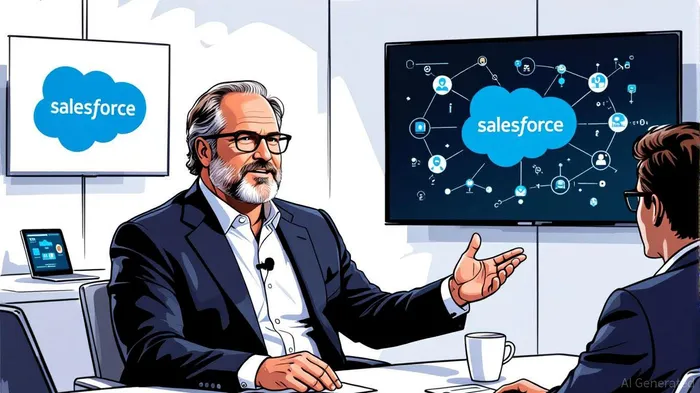
In the ever-evolving SaaS landscape, Salesforce's participation in the 2025 Goldman SachsGS-- Communacopia + Technology Conference has drawn sharp focus, not merely as a showcase of innovation but as a litmus test for its leadership, growth resilience, and ability to differentiate in an AI-saturated market. The company's recent earnings misses and stock volatility have amplified investor scrutiny[3], making its strategic announcements at the conference a critical barometer of its competitive vitality.
Leadership and Strategic Vision: Navigating Turbulence
Marc Benioff, Salesforce's Chair and CEO, faces a dual challenge: restoring investor confidence and steering the company through a generative AI arms race. At the conference, Benioff emphasized the “agentic enterprise” as Salesforce's north star, framing AI not as a standalone tool but as a systemic transformation[1]. This vision aligns with Goldman Sachs' assertion that AI could act as a “force multiplier” for software leaders, enhancing efficiency and unlocking new revenue streams[3]. However, the recent stock plunge following underwhelming earnings reports suggests skepticism about whether Benioff's leadership can translate ambition into execution[3].
Growth Trajectory: Data Cloud and AI-Driven Revenue
Salesforce's Q2 2025 results offered a glimmer of hope, with Data Cloud growing 120% year-over-year and the company raising its fiscal 2025 revenue guidance to $41.1–$41.3 billion[1]. These figures underscore the potential of AI integration to drive growth, particularly in data monetization and automation. Yet, the broader SaaS sector is witnessing a paradigm shift: competitors like GoogleGOOGL-- Cloud are leveraging proprietary AI infrastructure and generative models to capture market share[2]. Google Cloud CEO Thomas Kurian's emphasis on performance, cost, and scalability advantages[2] highlights a stark contrast to Salesforce's reliance on ecosystem partnerships to address talent bottlenecks in AI implementation[4]. For SalesforceCRM--, the path to sustained growth hinges on whether its AI investments can outpace rivals in both innovation and adoption.
Competitive Differentiation: AgentForce and the Agentic Enterprise
Salesforce's AgentForce initiative, designed to deploy AI agents for automating internal tasks and customer interactions, positions it at the forefront of the AI agent movement[4]. This mirrors efforts by AmazonAMZN-- Web Services and Google Cloud, but Salesforce's differentiator lies in its enterprise-centric approach. By embedding AI across its product suite—from Data Cloud to Customer 360—the company aims to create a seamless agentic experience[1]. However, as Dave Nicholson of The Futurum Group notes, the real challenge is not just technology but “human expertise” in guiding enterprises through AI integration[4]. Salesforce's reliance on partner ecosystems to bridge this gap could either be a strength or a vulnerability, depending on how effectively it scales support for clients.
Conclusion: A Test of Resilience in the AI Era
Salesforce's strategic announcements at the 2025 Goldman Sachs conference reveal a company at a crossroads. While its vision for the agentic enterprise and AI-driven growth is compelling, the pressure to deliver tangible results in a hyper-competitive market is immense. Investors will be watching closely to see whether Benioff's leadership can harmonize innovation with execution, and whether AgentForce can carve out a sustainable edge against rivals with deeper AI infrastructure. For now, the stock's volatility and Google Cloud's aggressive AI bets[2] serve as reminders that in the SaaS sector, differentiation is not just about technology—it's about ecosystems, execution, and the ability to adapt to a rapidly shifting landscape.





Comentarios
Aún no hay comentarios