
Salesforce's AI-Driven Transformation: A Convincing Case for Long-Term Growth in Q3 2026
In the ever-shifting landscape of enterprise technology, few companies have managed to redefine their relevance as effectively as SalesforceCRM--. The Q3 2026 earnings report, released on December 3, 2025, offers a compelling glimpse into how the company is leveraging artificial intelligence to not only defend its market position but to accelerate its trajectory toward a $60 billion revenue target. At the heart of this transformation are two products: Agentforce and Data 360, which have become linchpins in Salesforce's strategy to democratize AI across industries.
The Financial Engine Behind the AI Push
Salesforce's Q3 results underscore the explosive potential of its AI initiatives. Annual recurring revenue (ARR) for Agentforce and Data 360 surged to nearly $1.4 billion, a 114% year-over-year increase. Agentforce alone contributed $500 million in ARR, a 330% growth compared to the prior year. These figures are not just impressive; they signal a fundamental shift in how enterprises are adopting AI. The product's success is further amplified by its customer retention and expansion metrics: over 50% of Q3 bookings for Agentforce came from existing clients deepening their investment, a testament to the platform's value proposition.
This momentum is not accidental. As stated by Salesforce, Agentforce's rapid adoption is "reinforcing the company's path toward its $60 billion revenue target". The product's ability to automate workflows-ranging from customer service to sales lead qualification-has positioned it as a critical tool for businesses seeking to reduce costs and boost productivity.
Strategic Integration: Data 360 as the Foundation
While Agentforce grabs headlines, Data 360 operates as the unsung hero of Salesforce's AI ecosystem. The platform's role in unifying disparate enterprise data sources cannot be overstated. In Q3, Data 360 ingested 32 trillion records, with 15 trillion processed via its zero-copy architecture-a 341% year-over-year increase. This capacity to harmonize data at scale is foundational for Agentforce's AI agents, which rely on high-quality, contextualized data to operate autonomously.
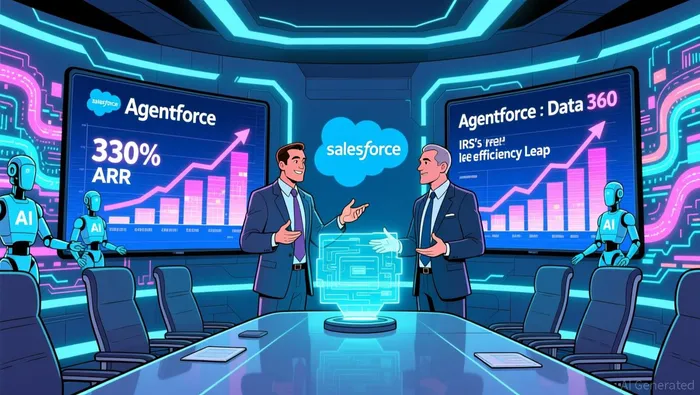
The strategic synergy between these products is evident in real-world applications. For instance, the IRS leveraged Agentforce and Data 360 to automate 98% of manual activities, slashing case processing time from 10 days to 30 minutes. Similarly, Formula 1 improved service response times by 80% using the same tools. These case studies, as highlighted in Salesforce's blog and press releases, demonstrate how the company's AI offerings are moving beyond theoretical promise to deliver measurable operational efficiency.
Enterprise AI Adoption: From Experimentation to Scale
The broader industry context further validates Salesforce's approach. According to Salesforce's second annual CIO study, AI implementation has surged 282% since 2024, with CIOs now prioritizing scalability over experimentation. Agentforce, introduced in October 2024, represents a pivotal shift in this evolution. Unlike traditional chatbots or copilots, Agentforce's autonomous agents can make decisions and execute actions-such as resolving customer cases or optimizing marketing campaigns-without human intervention.
This shift is not lost on investors. As noted in a Bloomberg report, Salesforce's integration of AI into its core platform-eliminating the need for complex data integrations-has positioned it as "the world's #1 AI CRM". The company's ecosystem strategy, which includes Customer 360, Data Cloud, Tableau, and Slack, creates a cohesive environment where AI agents can thrive. This holistic approach contrasts with AI-first startups that lack Salesforce's decades of enterprise relationship-building.
Challenges and the Road Ahead
Despite its success, Salesforce faces headwinds. Critics argue that AI-first business models could disrupt traditional SaaS players like Salesforce. However, the company's Q3 results suggest it is adapting effectively. By embedding AI into its existing platform and leveraging Data 360's data unification capabilities, Salesforce has mitigated the risk of being sidelined by newer, AI-native competitors.
Moreover, the explosive growth of Agentforce-now with 18,500 use cases-indicates that enterprises are not merely experimenting but embedding AI into their operational DNA. This trend aligns with broader market dynamics: as CIOs move from pilot projects to enterprise-wide AI deployment, Salesforce's platform is uniquely positioned to benefit.
Conclusion: A Convincing Case for Long-Term Growth
Salesforce's AI-driven transformation is more than a strategic pivot-it is a redefinition of its core value proposition. The Q3 2026 results, bolstered by Agentforce's 330% ARR growth and Data 360's data unification capabilities, present a compelling case for long-term investors. The company's ability to turn AI from a buzzword into a business-critical tool, supported by real-world case studies and customer expansion metrics, underscores its leadership in the enterprise AI race.
As the market continues to grapple with the implications of autonomous AI agents, Salesforce's ecosystem strategy and execution provide a blueprint for sustainable growth. For investors, the message is clear: the company's AI initiatives are not just a passing trend but a foundational pillar of its next phase of expansion.





Comentarios
Aún no hay comentarios