
The Saks Global Debt Crisis: A Case Study in Retail Bankruptcy and Investment Risk
The collapse of Saks Global, parent company of Saks Fifth Avenue, Neiman Marcus, and Bergdorf Goodman, offers a stark lesson in the perils of highly leveraged retail mergers. By late 2025, the company had accumulated $2.2 billion in debt, a burden exacerbated by its 2024 acquisition of Neiman Marcus for $2.7 billion, which was financed largely through debt. This acquisition, intended to create a luxury retail powerhouse, instead left Saks with an unsustainable capital structure, operational inflexibility, and a liquidity crisis that culminated in a missed $100 million interest payment in December 2025. The case underscores how aggressive debt financing in retail M&A can amplify systemic risks, particularly in sectors reliant on discretionary consumer spending.
The Debt-Driven Merger and Its Consequences
Saks' financial unraveling began with its leveraged buyout of Neiman Marcus, a deal that combined two iconic but distinct brands under a single corporate umbrella. According to a Reuters report, the acquisition was structured with $2.2 billion in debt, leaving Saks with a debt-to-EBITDA ratio exceeding 10x-far above the 4–6x range typically considered sustainable for retail firms. This heavy debt load constrained the company's ability to invest in digital transformation, omnichannel integration, or inventory replenishment, all critical in an era where luxury consumers increasingly demand seamless online-offline experiences.
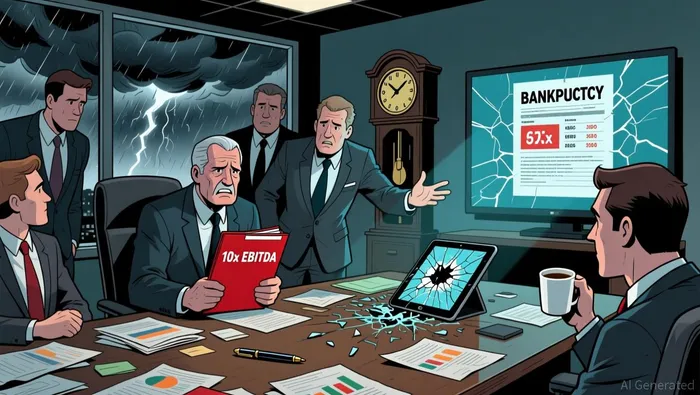 The operational fallout was swift. Vendors began withholding shipments due to delayed payments, with some brands reporting delays of over a year. This created a self-reinforcing cycle: inventory shortages led to declining sales, which further weakened cash flow and exacerbated liquidity constraints. By mid-2026, Saks had sold high-value real estate assets, including the land beneath its Beverly Hills store, to raise capital, but these measures proved insufficient to stabilize the business. The company's attempts to secure a $1 billion debtor-in-possession (DIP) loan for a potential Chapter 11 filing also faltered, as lenders questioned its ability to restructure effectively.
A Pattern of High-Risk Retail M&A
Saks' crisis is not an isolated incident. A comparative analysis of highly leveraged retail mergers reveals a recurring pattern of financial and operational failures. For instance, the 2005 leveraged buyout of Toys "R" Us by KKR, Bain Capital, and Vornado Realty Trust saddled the company with over $5 billion in debt, crippling its ability to adapt to shifting consumer preferences and e-commerce competition. This ultimately led to its bankruptcy in 2017. Similarly, Party City's 2012 acquisition by Thomas H. Lee Partners imposed a $1.7 billion debt burden, contributing to its 2023 bankruptcy filing amid rising interest rates and online competition.
These cases share common threads: excessive debt loads, inadequate cost synergies, and a failure to invest in operational modernization. As noted in a 2025 PwC report, "High-leverage deals often prioritize short-term value extraction over long-term resilience, leaving acquirers vulnerable to macroeconomic shocks and sector-specific disruptions." Saks' inability to integrate Neiman Marcus' legacy systems, streamline supply chains, or reduce overhead costs exemplifies this vulnerability.
Investor Implications and Systemic Risks
For investors, Saks' collapse highlights the risks of overleveraged retail M&A. The company's debt-heavy capital structure left it with limited financial flexibility to weather a slowdown in luxury spending-a sector already pressured by inflation and geopolitical uncertainty. According to a study on fintech M&A, highly leveraged transactions often underperform due to integration complexities and regulatory headwinds, with bidders frequently experiencing negative abnormal returns around announcement dates. Saks' experience aligns with this trend, as its stock price plummeted by over 70% in 2025 amid growing bankruptcy speculation.
Moreover, the ripple effects of Saks' crisis extend beyond its own stakeholders. Vendors, particularly independent designers, now face significant exposure to unsecured claims in a potential Chapter 11 filing, with some estimating losses in the hundreds of thousands of dollars. This underscores the interconnected nature of retail supply chains and the systemic risks posed by the failure of large, leveraged retailers.
Conclusion: Lessons for the Future
The Saks Global case serves as a cautionary tale for investors and corporate strategists alike. It demonstrates that highly leveraged retail mergers, while potentially lucrative in a low-interest-rate environment, can become existential threats when macroeconomic conditions shift. The key takeaway is that debt financing must be balanced with operational discipline, innovation, and contingency planning. As the retail sector continues to grapple with digital disruption and shifting consumer behavior, the Saks saga reminds us that financial engineering alone cannot substitute for sound business fundamentals.







Comentarios
Aún no hay comentarios