
Saint-Gobain's Renewable Plasterboard Plant: A Green Manufacturing Milestone
The global materials manufacturing sector is undergoing a seismic shift as decarbonization transitions from a corporate buzzword to a strategic imperative. At the forefront of this transformation is Saint-Gobain, whose recent launch of North America's first zero-carbon plasterboard plant in Sainte-Catherine, Quebec, represents not just an environmental milestone but a calculated move to secure long-term competitive and financial advantages. By aligning with global sustainability goals and leveraging renewable energy, Saint-Gobain is redefining industry benchmarks while positioning itself to capitalize on the surging demand for low-carbon materials.
Decarbonization as a Strategic Differentiator
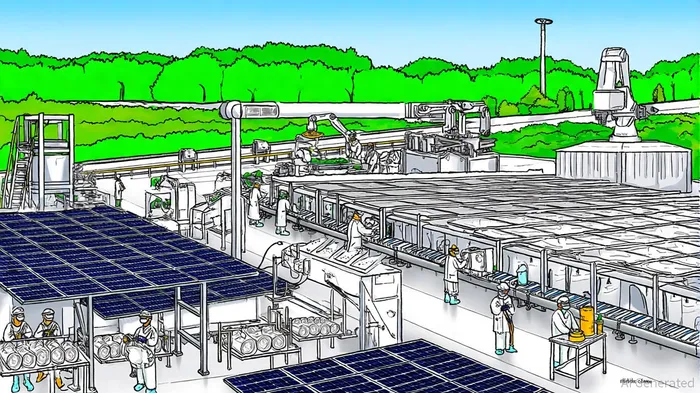
Saint-Gobain's Sainte-Catherine plant exemplifies the intersection of technological innovation and environmental stewardship. Powered entirely by hydroelectricity, the facility eliminates Scope 1 and 2 emissions, a feat unmatched in the plasterboard sector. According to a report by Investing.com, the plant's modernization increased production capacity by 40% while reducing energy consumption by 30%, resulting in an annual CO₂ reduction of 44,000 tons—equivalent to removing 14,000 cars from the road[3]. This achievement is underpinned by advanced technologies such as electric heating elements, real-time energy meters, and heat recovery systems[1].
The environmental impact is further amplified by the introduction of the Infinaé line, including CarbonLow, which cuts embodied carbon by up to 60%[6]. These innovations align with Saint-Gobain's net-zero-by-2050 target and its 2030 intermediate goals, which include a 33% reduction in Scope 1 and 2 emissions compared to 2017 levels[2]. By embedding sustainability into its product lifecycle, Saint-Gobain is addressing regulatory pressures and consumer demand for greener alternatives, a trend underscored by the global decarbonization market's projected growth to $4.06 trillion by 2030[2].
Financial Resilience in a Carbon-Constrained World
Saint-Gobain's decarbonization efforts are not merely symbolic; they are financially prudent. The company reported a record operating margin of 11.4% in 2024 and free cash flow of €4.0 billion, demonstrating that sustainability and profitability can coexist[5]. The Quebec plant's expansion was supported by a $40 million grant from Quebec's EcoPerformance program, illustrating how policy incentives can offset capital expenditures and accelerate ROI[1].
Comparatively, the plasterboard market is forecasted to grow at a 6.66% CAGR, reaching $44.89 billion by 2030[4]. Saint-Gobain's early adoption of zero-carbon production positions it to capture a disproportionate share of this growth, particularly as 60% of infrastructure projects now mandate low-carbon materials[3]. Competitors like Adaptavate, with its carbon-negative Breathaboard, highlight the urgency for innovation[5], but Saint-Gobain's scale and integration of circular economy principles—such as waste repurposing and material recycling—offer a broader, more scalable advantage[2].
Industry-Wide Implications and Competitive Positioning
The materials sector's decarbonization race is intensifying, with rivals adopting AI-driven efficiency, electrification, and carbon capture. For instance, Adaptavate's pilot production of carbon-negative plasterboard and Cemex's net-zero concrete pilots underscore the sector's innovation arms race[5]. However, Saint-Gobain's holistic approach—combining process modernization, renewable energy, and product innovation—creates a moat against competitors. Its 67% reliance on carbon-free electricity and 34% pro forma reduction in emissions since 2017[5] reflect a trajectory that outpaces industry averages.
Financially, the company's 2025 outlook of maintaining an operating margin above 11.0%[5] suggests that decarbonization is not a cost burden but a catalyst for efficiency. By reducing energy costs through hydroelectricity and enhancing brand value via sustainability certifications, Saint-Gobain is transforming regulatory risks into revenue opportunities. This aligns with McKinsey research showing that ESG-integrated firms achieve superior shareholder returns, particularly in sectors like chemicals and construction[2].
Conclusion: A Blueprint for Sustainable Industrial Leadership
Saint-Gobain's Quebec plant is more than a green manufacturing milestone—it is a blueprint for how industrial decarbonization can drive competitive advantage and financial resilience. By marrying technological innovation with strategic foresight, the company is not only reducing its carbon footprint but also future-proofing its business in a world where carbon pricing, circularity, and consumer preferences will dominate. As the low-carbon materials market accelerates, Saint-Gobain's early mover status and integrated sustainability model position it to outperform peers, making its renewable plasterboard initiative a compelling case study for investors seeking long-term value in the green transition.







Comentarios
Aún no hay comentarios