
SAIC's Strategic Reorganization and Strong Backlog Signal Undervalued Opportunity
Science Applications International Corporation (NYSE: SAIC) has positioned itself as a compelling undervalued opportunity amid its Q1 2025 earnings and aggressive strategic reorganization. Despite short-term revenue headwinds, the company's backlog growth, margin resilience, and sector leadership in defense and space modernization suggest a prime entry point for investors.
Earnings Reflect Transition, Not Decline
SAIC reported Q1 2025 revenue of $1.85 billion, down 9% year-over-year due to the divestiture of its logistics business (which contributed $188 million in prior-year revenue) and contract completions. However, organic growth adjusted for this divestiture was 0.4%, signaling stabilization in its core operations. Net income dipped to $77 million (-21% YoY), but adjusted EBITDA held steady at $166 million (9.0% margin), narrowly below prior-year levels. Critically, SAIC reaffirmed its full-year guidance of $7.35–7.50 billion in revenue, $680–700 million in EBITDA, and $8.00–8.20 in adjusted EPS, underscoring management's confidence in its long-term trajectory.
Backlog Growth: A Fortress of Future Revenue
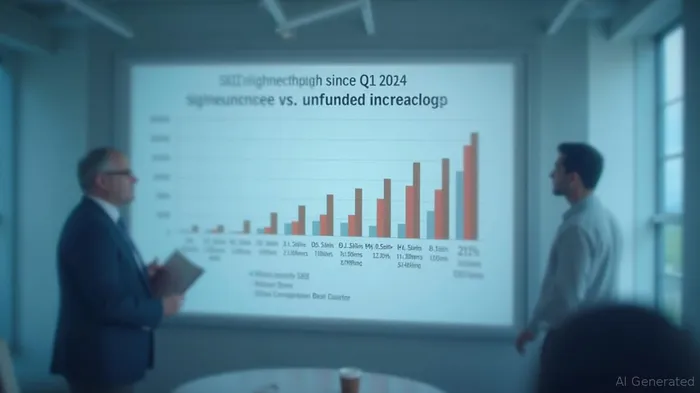
The company's total backlog surged to $23.6 billion, including $3.5 billion in funded contracts, up from $20.1 billion unfunded. This represents a 1.4 book-to-bill ratio, with notable wins such as a $444 million U.S. Space Force contract for digital modernization and a $494 million NASA recompete. These wins, alongside a $706 million pipeline from the space and intelligence communities, provide $20 billion in unfunded backlog—a clear runway for future growth.
Strategic Reorganization: Unlocking Long-Term Value
SAIC's February 2024 reorganization into five customer-focused business groups under two segments (Defense & Intelligence and Civilian) is a masterstroke. This structure aligns its $23.6 billion backlog with key markets, including space modernization, cybersecurity, and government IT. The Defense & Intelligence segment, despite a 10% revenue dip, saw adjusted growth of 1.9% excluding divestitures, while the Civilian segment—now led by new Executive VP Srini Attili—is poised to capitalize on federal efficiency initiatives.
CEO Toni Townes-Whitley emphasized that returns from this reorganization will accelerate in FY2026-2027, with FY2026 guidance projecting $7.6–7.75 billion in revenue (3% organic growth) and 9.4–9.6% EBITDA margins. This suggests a margin expansion tailwind as the reorganization matures.
Undervalued Amid Near-Term Noise
Despite its strong fundamentals, SAIC's stock has lagged, trading at $112—13% below the $130 median analyst target. The disconnect stems from short-term execution risks like recompete delays and government budget uncertainty. However, the $0.37 quarterly dividend (yielding ~1.3%) and share repurchases ($81 million in Q1) reinforce management's commitment to shareholder returns.
Why Act Now?
- Backlog-to-revenue leverage: The $23.6 billion backlog is 3.2x trailing annual revenue, ensuring stability.
- Margin resilience: Despite headwinds, adjusted EBITDA margins held near 9%, and FY2026 guidance points to expansion.
- Catalysts ahead: The reorganization's benefits, coupled with high-margin space and cybersecurity wins, could surprise on upside. Historically, a buy-and-hold strategy of purchasing SAIC shares on earnings announcement dates and holding for 20 days has delivered an average return of 7.24%, though underperforming the benchmark by 3.36% over the same period. With the current backlog strength and margin resilience, this could be an optimal entry point to capitalize on the reorganization's upcoming benefits.
Conclusion: A Rare Buy in a Volatile Sector
SAIC's strategic reorganization, robust backlog, and undervalued stock price make it a rare buy in a defense sector fraught with macro risks. While near-term volatility may persist, the company's long-term growth drivers—led by its $444 million Space Force contract and leadership in zero-trust cybersecurity—are undeniable. Investors ignoring this opportunity risk missing a multi-year turnaround.
Act now before the market catches up.





Comentarios
Aún no hay comentarios