
SAIC's $500M Notes Offering and Capital Strategy Implications
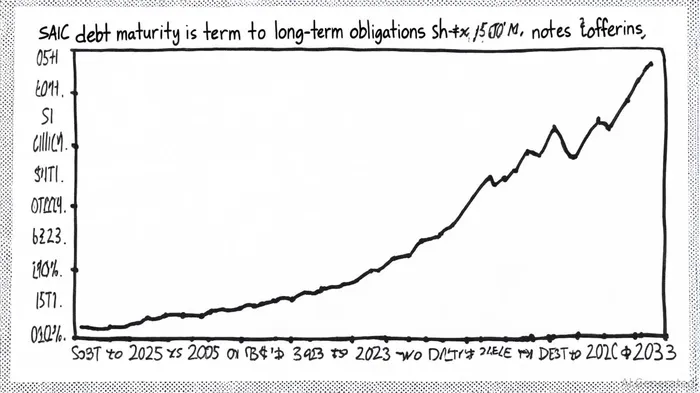
Science Applications International Corporation (SAIC) has embarked on a strategic refinancing initiative with its recent $500 million senior notes offering, a move that underscores its commitment to optimizing capital structure while addressing immediate liquidity needs. The offering, priced at 100% of par with a 5.875% coupon and a 2033 maturity, is designed to repay all outstanding balances under its revolving credit facility, cover offering expenses, and fund growth initiatives [1]. This action aligns with SAIC's broader objective to extend its debt maturity profile and reduce near-term financial risk, particularly as its current debt obligations have surged by 43% to $448 million in 2025 [2].
Strategic Rationale: Refinancing and Growth
The notes offering reflects a calculated shift from short-term to long-term debt, a critical step for a company with robust free cash flow generation. In FY25, SAICSAIC-- reported $499 million in free cash flow and $494 million in operating cash flow, demonstrating its capacity to service debt while investing in strategic projects [2]. By retiring its revolving credit facility debt—typically tied to variable rates and shorter maturities—the company mitigates refinancing risks amid a high-interest-rate environment. The 5.875% fixed rate on the new notes, while elevated, locks in predictable costs for nearly a decade, providing stability as SAIC navigates macroeconomic uncertainties [1].
Moreover, the proceeds allocated for general corporate purposes, including working capital and strategic transactions, position SAIC to capitalize on its $23.2 billion backlog and a recent $1.8 billion contract win for the System Software Lifecycle Engineering program [2]. These initiatives, coupled with improved contract profitability and a patent settlement recovery, have driven an expanded adjusted operating margin of 10.3% in Q2 2025 [2]. The offering thus serves as a catalyst for growth, enabling the company to scale operations without diluting equity.
Shareholder Value and Capital Deployment
SAIC's FY25 capital deployment strategy further highlights its focus on shareholder returns. The company allocated $638 million to capital deployment, including $527 million in share repurchases and $75 million in dividends [2]. This aggressive buyback program, funded in part by strong free cash flow, signals confidence in the company's intrinsic value and aligns with its commitment to rewarding stakeholders. The notes offering, by reducing reliance on its credit facility, preserves liquidity for future buybacks and dividends, reinforcing SAIC's dual emphasis on growth and capital efficiency.
However, the offering's impact on equity dilution is minimal, as the private placement avoids public market issuance. This approach minimizes disruption to shareholder value while accessing institutional buyers and non-U.S. investors through Rule 144A and Regulation S exemptions [1]. The unregistered status of the notes also expedites the closing process, with the transaction expected to finalize on September 25, 2025 [1].
Risks and Mitigants
Despite these strategic advantages, SAIC faces headwinds. The DOJ antitrust investigation, though not directly tied to the offering, introduces regulatory uncertainty that could affect future operations [2]. Additionally, the 5.875% interest rate on the new notes, while fixed, may appear costly compared to historical benchmarks, potentially squeezing margins if revenue growth slows. Yet, SAIC's FY25 adjusted EBITDA margin of 9.5% and $710 million in EBITDA provide a solid buffer against interest expenses [2].
The company's debt-to-EBITDA ratio, though not explicitly stated, is likely within manageable levels given its strong cash flow generation. The offering's focus on refinancing short-term debt also reduces the risk of liquidity crunches, a critical consideration as the current portion of its debt rises.
Conclusion: Balancing Growth and Prudence
SAIC's $500 million notes offering exemplifies a disciplined approach to capital management. By extending debt maturities, reducing refinancing pressures, and preserving liquidity for strategic investments, the company strengthens its financial flexibility. For shareholders, the offering supports continued buybacks and dividends without compromising growth opportunities. While risks such as regulatory scrutiny and interest rate volatility persist, SAIC's robust cash flow and strategic backlog provide a strong foundation for long-term value creation.
As the technology and defense sectors evolve, SAIC's ability to balance prudent financing with aggressive capital deployment will be pivotal. The notes offering, therefore, is not merely a tactical move but a strategic cornerstone in its journey to sustain profitability and shareholder trust.





Comentarios
Aún no hay comentarios